Brochantite
Chemical formula: Cu<sup>2+</sup><sub>4</sub>S<sup>6+</sup>O<sub>4</sub>(OH)<sub>6</sub>
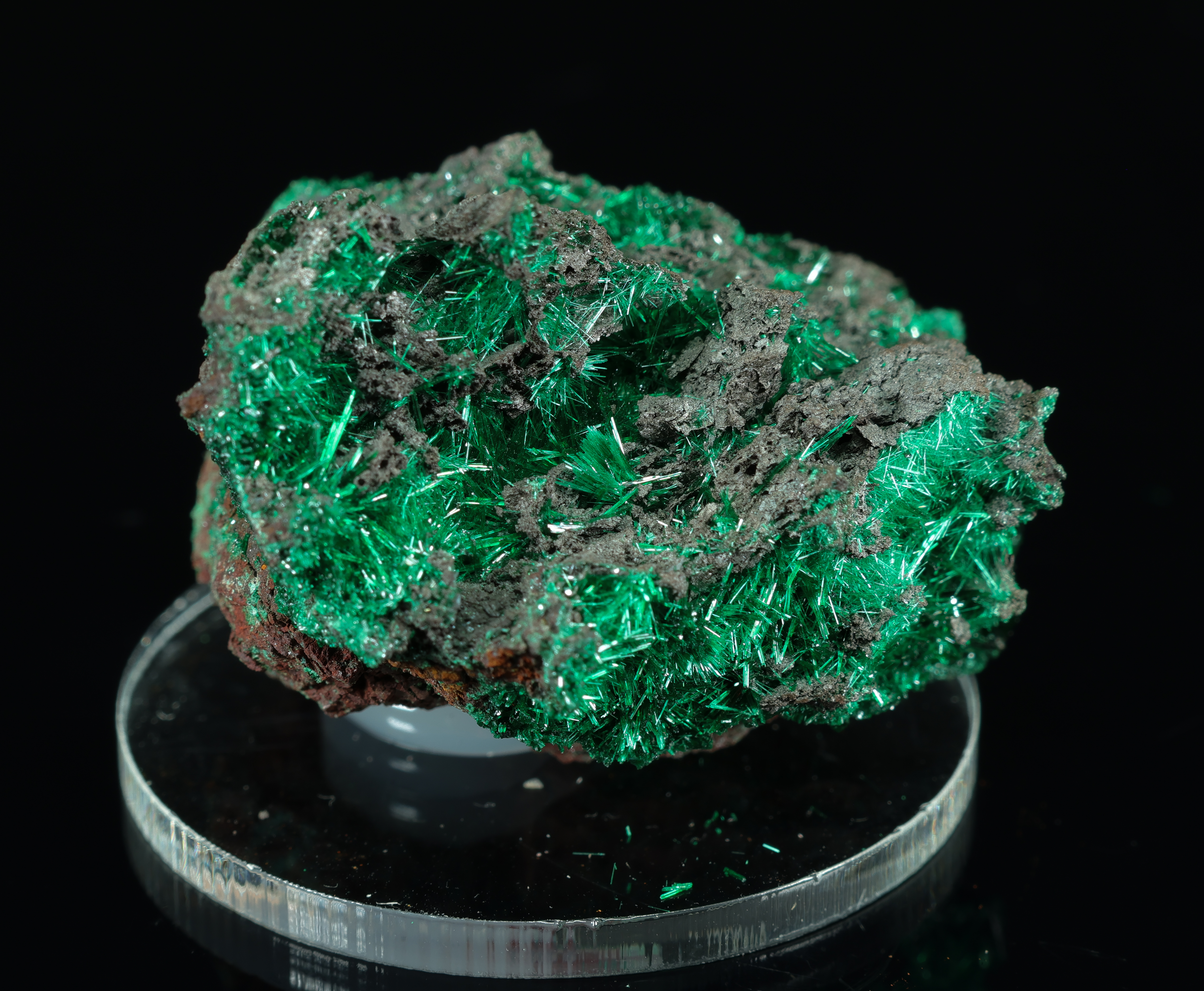
Brochantite is a rare, secondary copper mineral from the sulfate group, typically forming small, acicular crystals of an intensely green color.
Properties
- Mohs hardness
- 3.5-4
- Luster
- Vitreous, Pearly
- Streak
- Pale green
- Density
- 3.97
- Cleavage
- On {100} perfect.
- Fracture
- Nierówny
- Transparency
- Transparent,Translucent
- Crystal system
- Monoclinic
Diagnostic features
## Identification Brochantite can be identified by its characteristic, intensely green color, often emerald, and acicular or columnar crystal habit. It usually occurs in radial aggregates or as crusts. A light green streak is also a diagnostic feature. ## Distinguishing from similar minerals Brochantite is sometimes confused with malachite, atacamite, dioptase, or emerald. It is distinguished from malachite by its lack of reaction with hydrochloric acid (malachite effervesces), and from atacamite by a different streak color (atacamite has a green streak, but its color is often darker and more olive). Dioptase has significantly higher hardness and a more intense, bluish-green color. Emerald is much harder and has a different crystallographic system. ## Crystal forms Brochantite most often forms elongated, acicular or columnar crystals, which can be single or form radial aggregates, fibrous masses, and also crusts.
Geological environment
## Genesis Brochantite is a secondary mineral, forming in the oxidation zones of copper deposits, in dry and arid climates. It forms as a result of the reaction of sulfate solutions with copper minerals, such as chalcopyrite or bornite. ## Mineral associations It often co-occurs with other secondary copper minerals, such as malachite, azurite, chrysocolla, cuprite, as well as with quartz and hematite. ## Localities Known brochantite localities include Chile (Chuquicamata), USA (Arizona, especially the Bisbee mine), Russia (Urals), Namibia (Tsumeb), Great Britain (Cornwall), and Australia.
Rarity
Very Common
For collectors
## Quality criteria The most prized brochantite specimens are those that exhibit well-formed, distinct, and large crystals of an intense, emerald-green color. Radial aggregates or druses with numerous, shiny crystals are particularly sought after. The aesthetic appeal of the specimen, contrast with the matrix, and absence of mechanical damage are also important. ## Popular localities The most valued specimens come from Chile (Chuquicamata), USA (Arizona), and Namibia (Tsumeb), where crystals of exceptional size and color intensity are found.
Care and storage
## Cleaning Brochantite is a relatively soft mineral, so it requires gentle cleaning. It is best to use a soft brush or paintbrush to remove dust. For heavier soiling, lukewarm distilled water can be used, avoiding prolonged soaking. ## What to avoid Avoid using strong chemicals, acids, and detergents, which can damage the mineral's surface. Brochantite is sensitive to high temperatures and direct sunlight, which can lead to color fading. It is also important to avoid sudden temperature changes and excessive humidity. ## Storage Brochantite specimens are best stored in enclosed display cases or boxes, away from dust and direct light. Due to its softness, contact with harder minerals that could scratch its surface should be avoided. Ideal conditions include stable temperature and moderate humidity.