SKU: B_20_0012
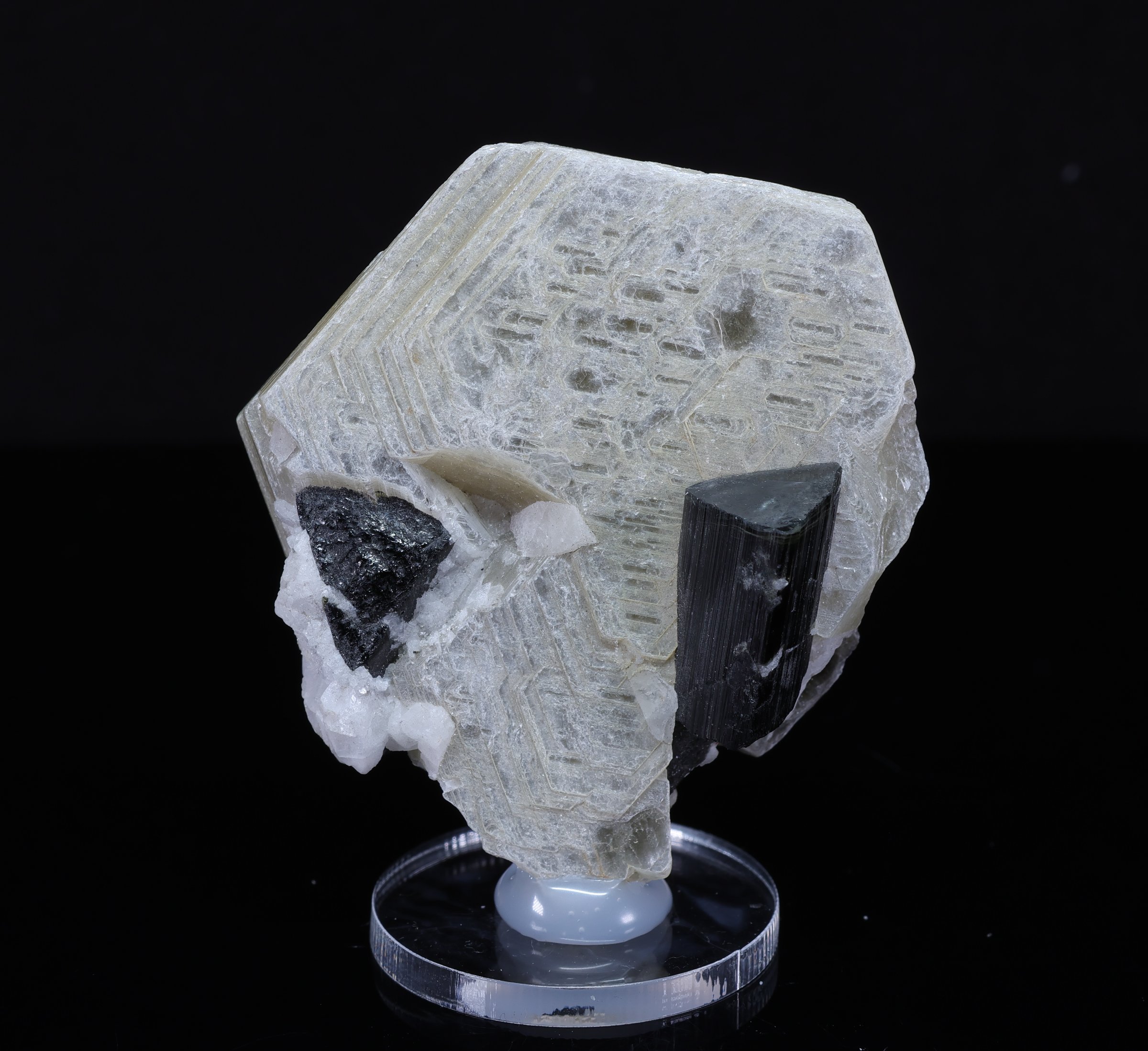
Specimen from Pakistan showcasing an extremely interesting paragenesis of black tourmaline and muscovite, on which fascinating geometric growth patterns are visible on its surfaces. Dark, contrasting schorl crystals with a strong, glassy luster are embedded in this bright, pearly structure. Main Features: distinct geometric growth patterns on muscovite; strong contrast; well-exposed, shiny tourmaline crystal. Condition: Very good - the main muscovite package is stable. Schorl crystals exhibit a very nice luster.
Price: 8 EUR (35 PLN)
Availability: Sold out
Location: -, Pakistan
Size: 50 x 20 x 51 mm
Weight: 54.4 g
Chemical formula: NaFe²⁺₃Al₆(Si₆O₁₈)(BO₃)₃(OH)₃(OH)
Mohs hardness: 7
Characteristics Schorl is a mineral belonging to the tourmaline group, specifically an iron-sodium variety. Typical schorl specimens take the form of prismatic, elongated crystals with a triangular or hexagonal cross-section, often with distinct striations along the axis. Its color is usually intensely black, sometimes with brownish-black or bluish-black hues. The surface of the crystals can be shiny, vitreous to greasy, but can also be dull. Physical Properties Schorl is characterized by a hardness of 7 on the Mohs scale, making it a relatively scratch-resistant mineral. It has a vitreous to greasy luster, sometimes dull. It is opaque to translucent. The density of schorl is approximately 3.18 g/cm³. Colors and Varieties The dominant color of schorl is black, often with subtle bluish, brownish, or less commonly, greenish hues. There are no distinct color varieties of schorl, as is the case with other tourmalines, but the intensity and shade of black can vary depending on impurities and crystallization conditions. History and Name The name "schorl" comes from the old German term "Schörl", already used in the 16th century to describe black tourmalines. The first mentions of minerals referred to by this name come from the vicinity of Zschorlau in Saxony, where they were mined. The mineral was described in 1505. Applications Schorl, due to its commonality and black color, is not widely used in jewelry, although it is sometimes used to create ornamental jewelry. Its main application is primarily in collecting, where well-formed crystals and aesthetic aggregates are valued. In industry, schorl has no significant applications.
Identification Schorl is relatively easy to identify due to its characteristic black color, vitreous or greasy luster, and typical form of prismatic crystals with distinct striations. A hardness of 7 on the Mohs scale allows it to scratch glass, which is an additional diagnostic feature. It often occurs in acicular or prismatic aggregates. Distinguishing from similar minerals Schorl is sometimes confused with other black minerals, such as augite, hornblende, or black garnet (andradite). It differs from augite and hornblende by the absence of distinct cleavage and the triangular cross-section of its crystals (augite and hornblende have cleavage and usually a tetragonal or hexagonal cross-section). It differs from black garnet by its crystal habit – garnets usually form isometric dodecahedra or icositetrahedra, while schorl has a prismatic habit. The streak of schorl is grayish-white to bluish-white, which can be helpful in differentiation.
Genesis Schorl is a mineral typical of igneous and metamorphic rocks. It most commonly forms in granitic pegmatites, where it crystallizes from boron- and iron-rich hydrothermal solutions. It also occurs in granites, greisens, and some metamorphic rocks, such as crystalline schists and gneisses, where it forms as a result of metasomatic processes. Mineral Associations Schorl often co-occurs with quartz, feldspar (orthoclase, albite), muscovite, biotite, garnet, topaz, beryl, and other minerals from the tourmaline group. In pegmatites, it can be associated with minerals such as lepidolite or spodumene. Localities Schorl is a common mineral and occurs in many places around the world. Significant deposits and localities of high-quality specimens are found in Brazil (Minas Gerais), Pakistan (Gilgit-Baltistan), Afghanistan (Nuristan), the United States (California, Maine), Russia (Urals), Namibia, Madagascar, and in Europe (e.g., in the Alps, Germany, Czech Republic, Poland).
Quality Criteria The most valued schorl specimens are those that have well-formed, undamaged crystals with distinct striations and an intense, deep black color. The aesthetics of the specimen are also important, meaning how the crystals are set on the matrix, and their size. Large, single crystals with an ideal habit are particularly sought after. The clarity and luster of the crystal surfaces also affect their collector's value. Popular Localities The most valued schorl specimens come from Brazil, especially from the state of Minas Gerais, where large, well-formed crystals are found. Other popular localities include Pakistan and Afghanistan, known for aesthetic schorl aggregates on light matrices, as well as the United States (e.g., Pala in California).
See mineralogical reference for Schorl in the Knowledge Base →