Schorl
Chemical formula: NaFe<sup>2+</sup><sub>3</sub>Al<sub>6</sub>(Si<sub>6</sub>O<sub>18</sub>)(BO<sub>3</sub>)<sub>3</sub>(OH)<sub>3</sub>OH
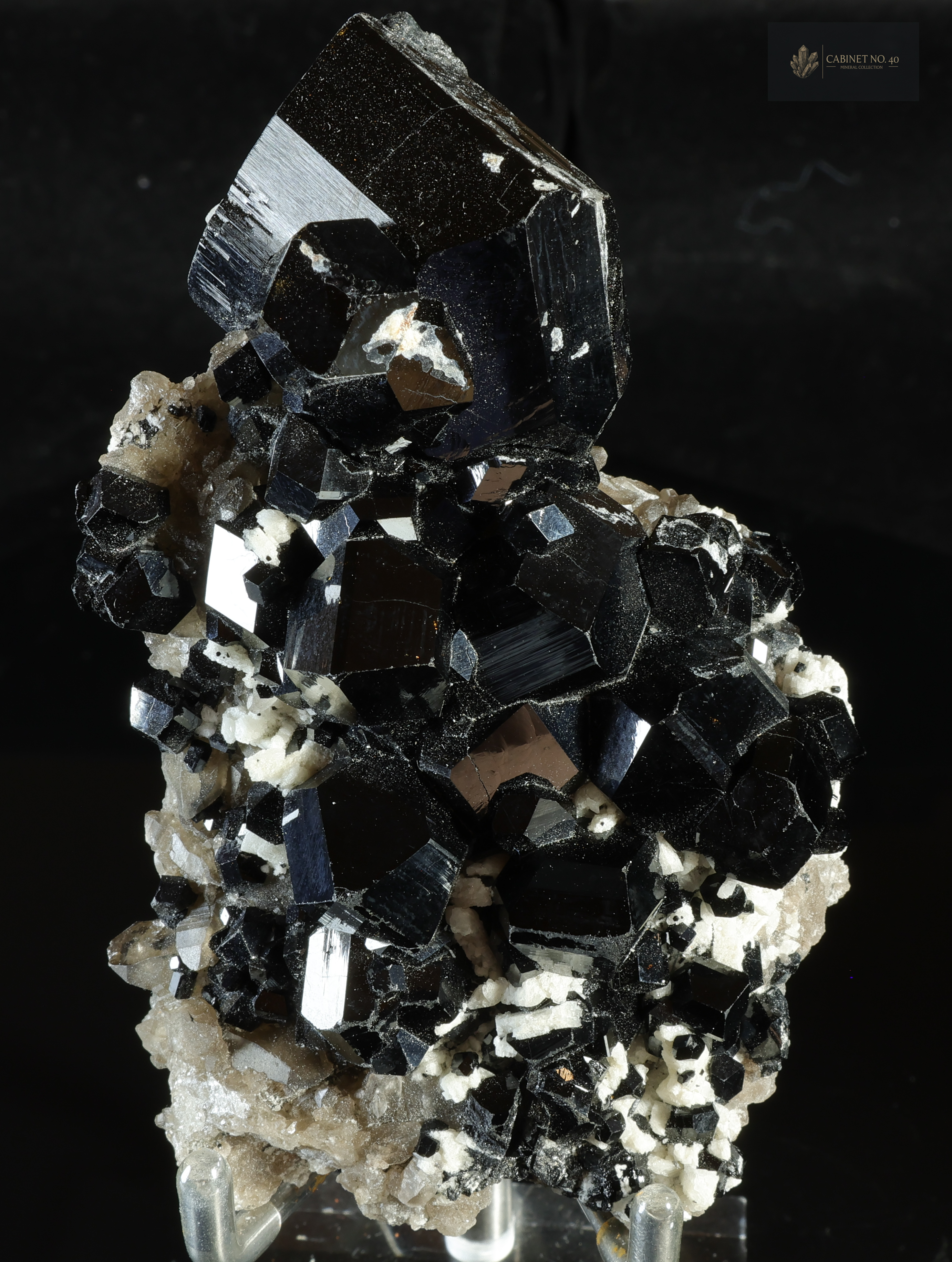
Schorl is a common mineral from the tourmaline group, characterized by its black color and often forming elongated, striated crystals.
Properties
- Mohs hardness
- 7
- Luster
- Vitreous to oily, dull.
- Streak
- Greyish-white to bluish-white.
- Density
- 3.18
- Cleavage
- Very poor on <mi>{11_20}, {10_11}</mi>
- Fracture
- Nierówny
- Transparency
- Translucent,Opaque
- Crystal system
- Trigonal
Diagnostic features
## Identification Schorl is relatively easy to identify due to its characteristic black color, vitreous or greasy luster, and typical form of prismatic crystals with distinct striations. A hardness of 7 on the Mohs scale allows it to scratch glass, which is an additional diagnostic feature. It often occurs in acicular or prismatic aggregates. ## Distinguishing from similar minerals Schorl is sometimes confused with other black minerals, such as augite, hornblende, or black garnet (andradite). It differs from augite and hornblende by the absence of distinct cleavage and the triangular cross-section of its crystals (augite and hornblende have cleavage and usually a tetragonal or hexagonal cross-section). It differs from black garnet by its crystal habit – garnets usually form isometric dodecahedra or icositetrahedra, while schorl has a prismatic habit. The streak of schorl is grayish-white to bluish-white, which can be helpful in differentiation.
Geological environment
## Genesis Schorl is a mineral typical of igneous and metamorphic rocks. It most commonly forms in granitic pegmatites, where it crystallizes from boron- and iron-rich hydrothermal solutions. It also occurs in granites, greisens, and some metamorphic rocks, such as crystalline schists and gneisses, where it forms as a result of metasomatic processes. ## Mineral Associations Schorl often co-occurs with quartz, feldspar (orthoclase, albite), muscovite, biotite, garnet, topaz, beryl, and other minerals from the tourmaline group. In pegmatites, it can be associated with minerals such as lepidolite or spodumene. ## Localities Schorl is a common mineral and occurs in many places around the world. Significant deposits and localities of high-quality specimens are found in Brazil (Minas Gerais), Pakistan (Gilgit-Baltistan), Afghanistan (Nuristan), the United States (California, Maine), Russia (Urals), Namibia, Madagascar, and in Europe (e.g., in the Alps, Germany, Czech Republic, Poland).
Rarity
Very Common
For collectors
## Quality Criteria The most valued schorl specimens are those that have well-formed, undamaged crystals with distinct striations and an intense, deep black color. The aesthetics of the specimen are also important, meaning how the crystals are set on the matrix, and their size. Large, single crystals with an ideal habit are particularly sought after. The clarity and luster of the crystal surfaces also affect their collector's value. ## Popular Localities The most valued schorl specimens come from Brazil, especially from the state of Minas Gerais, where large, well-formed crystals are found. Other popular localities include Pakistan and Afghanistan, known for aesthetic schorl aggregates on light matrices, as well as the United States (e.g., Pala in California).
Care and storage
## Cleaning Schorl is a relatively hard mineral, which facilitates its care. To clean specimens, simply use a soft brush and lukewarm water with mild soap. After washing, rinse the mineral thoroughly with clean water, preferably distilled, to avoid limescale deposits, and then dry with a soft cloth. ## What to avoid Avoid using aggressive chemical agents, such as acids or strong detergents, which can damage the surface of the mineral or its matrix. Despite its hardness, schorl can be sensitive to sudden temperature changes, which can lead to cracks. Prolonged exposure to direct sunlight does not negatively affect the color of schorl, but it can weaken some accompanying minerals. Moisture is not a threat to schorl. ## Storage Schorl specimens are best stored in a stable environment, away from dust and potential mechanical damage. They can be displayed in closed display cases or on open shelves, remembering to regularly remove dust. For specimens with delicate accompanying minerals, it is worth considering storage in separate boxes with soft padding.