SKU: P_26-6_35
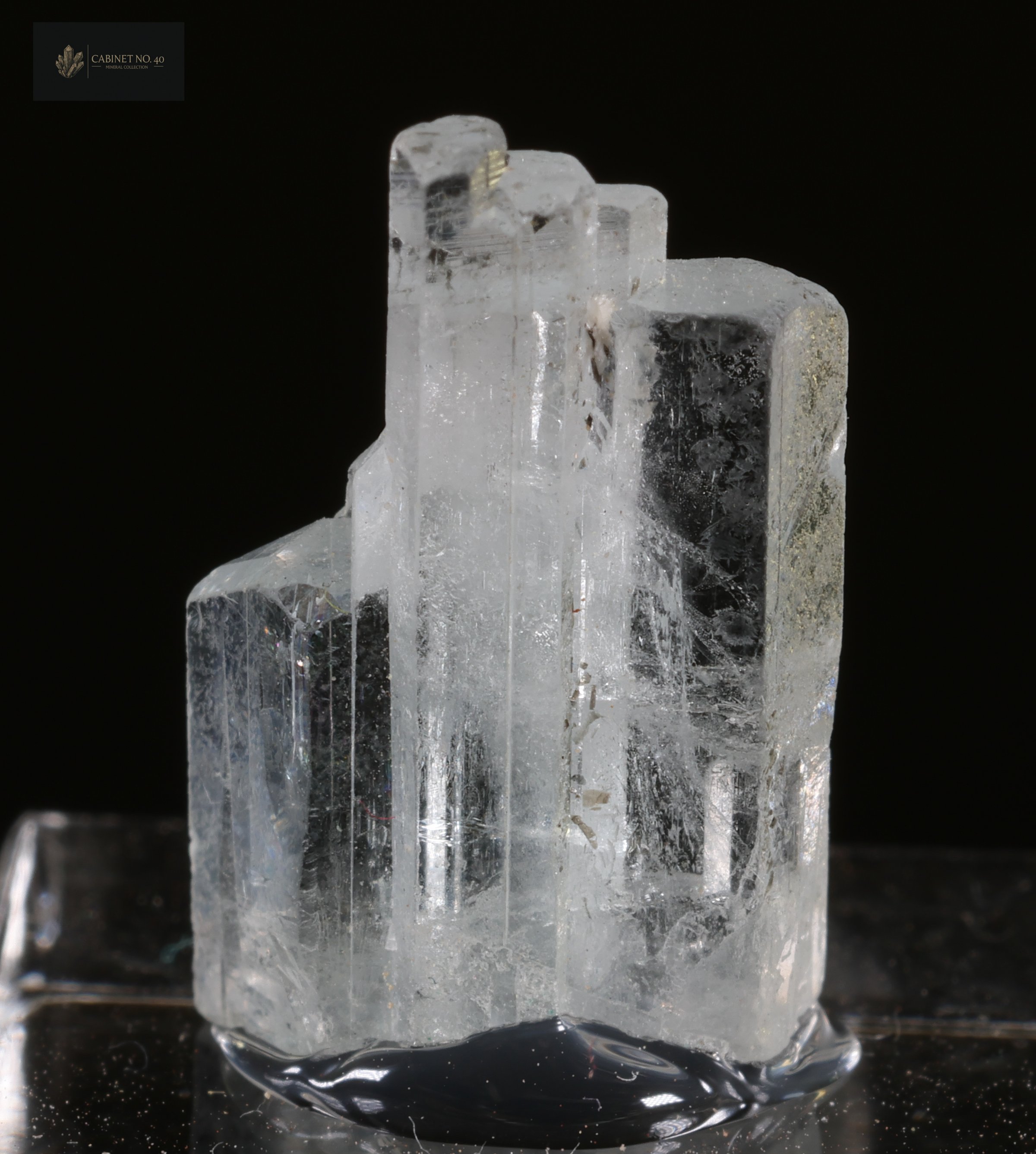
The goshenite specimen consists of several fused prismatic crystals, the tallest of which reaches about 1 cm in length. The crystals are colorless to slightly milky white, with visible internal inclusions that occasionally create rainbow reflections. Main features: fusion of prismatic crystals; colorless to milky white; visible internal inclusions; rainbow reflections. Condition: Very good.
Price: 18 EUR (79 PLN)
Availability: In stock
Location: Stak Nala, Haramosh Mountains, Roundu District, Gilgit-Baltistan, Pakistan
Size: 11 x 5 x 11 mm
Weight: 5 g
Chemical formula: Be₃Al₂Si₆O₁₈
Mohs hardness: 7.5
Characteristics Beryl is a mineral from the silicate class, characterized by a hexagonal crystal system. Typical beryl specimens take the form of prismatic crystals, often with a distinct hexagonal habit. Crystal surfaces can be smooth or covered with delicate striations. This mineral occurs in a wide range of colors, from colorless, through green, blue, yellow, white, to pink. Physical Properties Beryl is characterized by a Mohs hardness of 7.5-8, which makes it a relatively scratch-resistant mineral. It has a vitreous luster. Its density is approximately 2.63. Beryl exhibits cleavage along the {0001} plane, although it is usually poorly visible. The streak of beryl is white. Colors and Varieties Beryl occurs in many colors, which are often the basis for distinguishing its commercial varieties. Emerald is the green variety of beryl, aquamarine - blue, morganite - pink, heliodor - yellow, and goshenite is colorless beryl. Each of these varieties owes its color to the presence of specific trace elements in the crystal structure. History and Name The name "beryl" comes from the Greek word "beryllos", meaning "green precious stone". This mineral was known and valued in antiquity, and the first mentions of it date back to the 1st century AD. Beryl was used for making jewelry and as a material for producing lenses. Applications The most important application of beryl is in jewelry, where its colored varieties, such as emerald, aquamarine, and morganite, are highly valued gemstones. Beryl also has industrial applications, mainly due to its beryllium content, which is used in metal alloys, the aerospace, and nuclear industries. Pure beryllium is light, hard, and has a high melting point.
Identification Beryl can be identified by its hexagonal crystal habit, vitreous luster, and hardness. It often occurs as prisms with a hexagonal cross-section. Color is also an important diagnostic feature, though variable. The presence of characteristic inclusions, especially in emeralds, can aid in identification. Distinguishing from Similar Minerals Beryl can be confused with quartz, topaz, or tourmaline. It is distinguished from quartz by its higher hardness and lack of striations on the prism faces. It is distinguished from topaz by the lack of perfect cleavage. Beryl differs from tourmaline by the absence of a triangular crystal cross-section and the lack of striations on the prism faces. Crystal Forms Beryl most often forms prismatic crystals, often with a distinct hexagonal cross-section. Tabular crystals may also occur. Beryl aggregates can be massive or radial, although well-formed, single crystals are the most valuable.
Genesis Beryl primarily forms in granitic pegmatites, where it crystallizes from hydrothermal solutions rich in beryllium and aluminum. It can also occur in metamorphic rocks, such as mica schists, and in greisens. The conditions for beryl formation require the presence of elements such as beryllium, aluminum, and silicon, as well as appropriate temperatures and pressures. Mineral Associations Beryl often co-occurs with quartz, feldspar, muscovite, biotite, topaz, tourmaline, fluorite, and cassiterite. In pegmatites, it can also be associated with other beryllium minerals. Localities Known beryl deposits are found in many places around the world. Important emerald localities include Colombia, Brazil, Russia (Urals), Zambia, and Zimbabwe. Aquamarines come from Brazil, Pakistan, Russia, and Nigeria. Morganites occur in Brazil, USA (California), and Madagascar. Heliodors are found in Brazil, Namibia, and Ukraine. Goshenites occur in many localities, often where other beryl varieties are found.
Quality Criteria The most important quality criteria for a beryl specimen are color, transparency, clarity, and crystal form. Intense and uniform color is particularly valued for emeralds, aquamarines, and morganites. High transparency and the absence of visible inclusions increase the value of the specimen. Well-formed, undamaged crystals with a distinct hexagonal habit are most sought after by collectors. Size also matters; large crystals are rarer and more valuable. Popular Localities The most prized beryl specimens come from Colombia (emeralds), Brazil (emeralds, aquamarines, heliodors, morganites), Pakistan (aquamarines), and Russia (emeralds, aquamarines).
See mineralogical reference for Beryl in the Knowledge Base →