Arsenokrandalite and Conichalcite from Lavrion

SKU: S_00003

An extremely interesting, multicolored specimen, representing a valuable position for collectors of systematic rarities. Intensely green aggregates of conichalcite are visible on the porous matrix. They are accompanied by light blue, occasionally turning white crusts of the very rare arsenokrandalite, as well as spot accents of deep blue. Main Features: rare arsenokrandalite; intensely green conichalcite; classic location (Lavrion); high color contrast Condition: Very good.
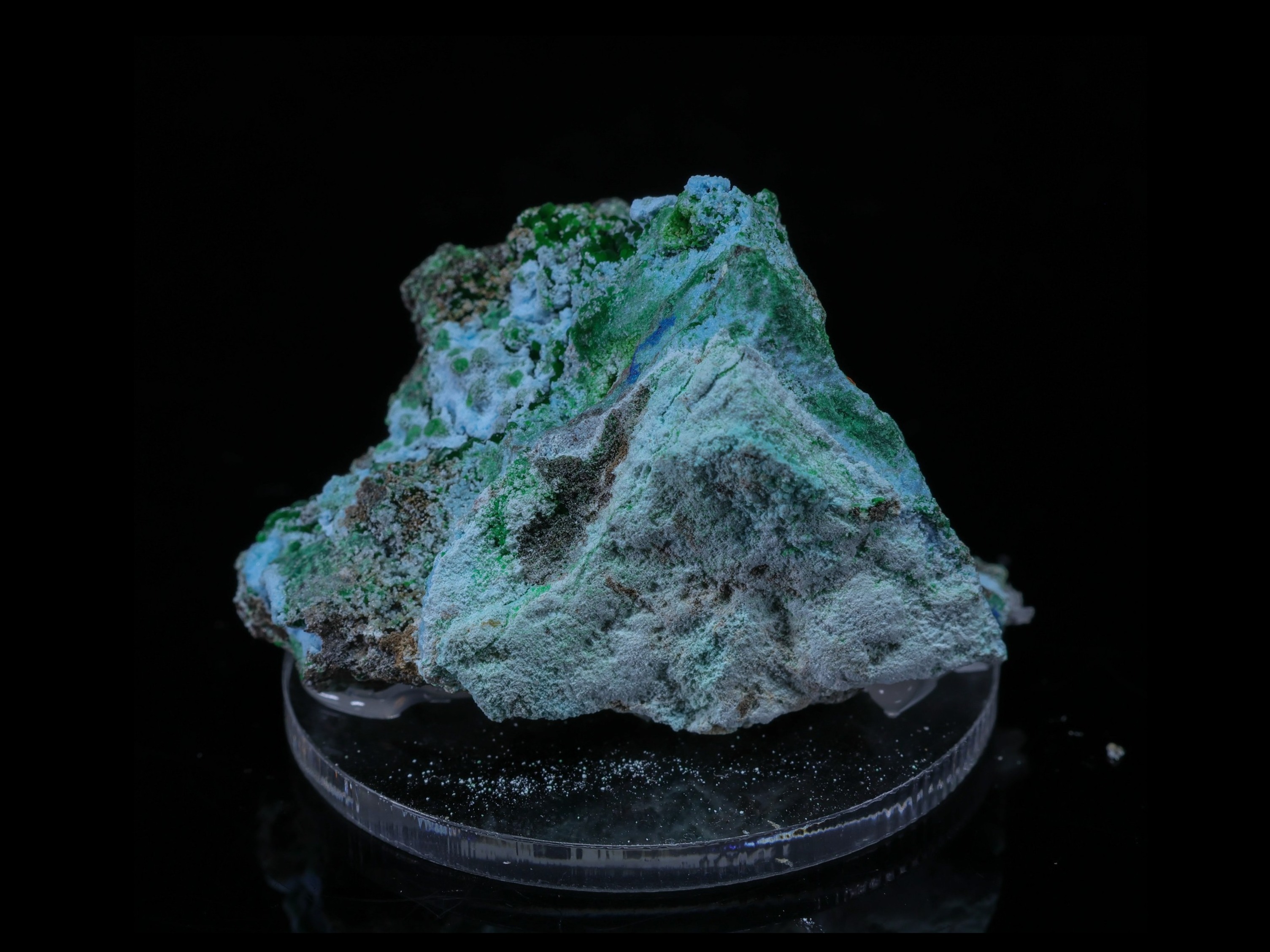
Arsenokrandalite and Conichalcite from Lavrion

Price: 64 EUR (279 PLN)

Availability: In stock

Location: Lavrion, Greece

Size: 26 x 20 x 40 mm

Weight: 24 g

Chemical formula: CaAl₃(AsO₄)(AsO₃OH)(OH)₆

Crystal system: Trigonalny

Mohs hardness: 5.5

Characteristics Arsenocrandallite is a mineral belonging to the crandallite group, being a calcium and aluminum arsenate. It usually occurs as small, radial aggregates or spherical clusters, less frequently as single, small crystals. Its color is variable, from white, through creamy-yellowish-white, to shades of blue and blue-green, which makes it interesting for collectors. Physical Properties The Mohs hardness of arsenocrandallite is 5.5. This mineral exhibits a vitreous luster. It is transparent to translucent. The specific gravity is 3.25. Due to its fine-grained nature, cleavage is not easily observable, but it is presumed that, like other members of the crandallite group, it may be perfect. Colors and Varieties Arsenocrandallite occurs in white, creamy-yellowish-white, as well as in shades of blue and blue-green. Color variability is one of its characteristic features. History and Name The mineral was discovered in 1981. The name "arsenocrandallite" refers to its chemical composition, indicating the presence of arsenic and its belonging to the crandallite group. Applications Arsenocrandallite has no industrial applications. It is a mineral of purely scientific and collectible importance, valued for its rarity and aesthetics.

Diagnostic features

Identification Arsenocrandallite can be identified by its variable color (white, cream, blue, blue-green), vitreous luster, and the radial aggregate habit typical of the crandallite group. A Mohs hardness of 5.5 is also a diagnostic feature. Differentiation from similar minerals Due to similarities in chemical composition and structure, arsenocrandallite can be confused with other minerals from the crandallite group. Accurate differentiation often requires specialized laboratory tests, such as X-ray analysis or spectroscopy. Crystal forms Arsenocrandallite most often occurs as radial aggregates, spherical or reniform clusters. Well-formed, though small, single crystals with a trigonal habit are rarer.

Formation environment

Genesis Arsenocrandallite forms in the oxidation zones of arsenical deposits, often in hydrothermal environments. It is a secondary mineral, forming as a result of weathering processes and transformation of other arsenical minerals. Mineral associations This mineral co-occurs with other minerals of the oxidation zone, such as arsenates, phosphates, and iron oxides. The exact associations depend on the specific characteristics of the deposit. Localities Known localities of arsenocrandallite include areas with arsenical deposits where suitable conditions for its formation exist. It is a rare mineral, and its occurrence is limited to specific geological environments.

For the collector

Quality criteria The most prized arsenocrandallite specimens are those with intense and uniform colors, especially blue and blue-green. The size and aesthetics of the aggregates, as well as the absence of mechanical damage, are also important. Well-formed crystals, though rare, are particularly sought after. Popular localities Due to the rarity of the mineral, there are not many popular localities that provide large quantities of high-quality specimens. Every find is valuable to collectors.

See mineralogical reference for Arsenocrandallite in the Knowledge Base →

View product →