Arsenocrandallite
Chemical formula: CaAl<sub>3</sub>(As<sup>5+</sup>O<sub>4</sub>)(As<sup>5+</sup>O<sub>3</sub>OH)(OH)<sub>6</sub>
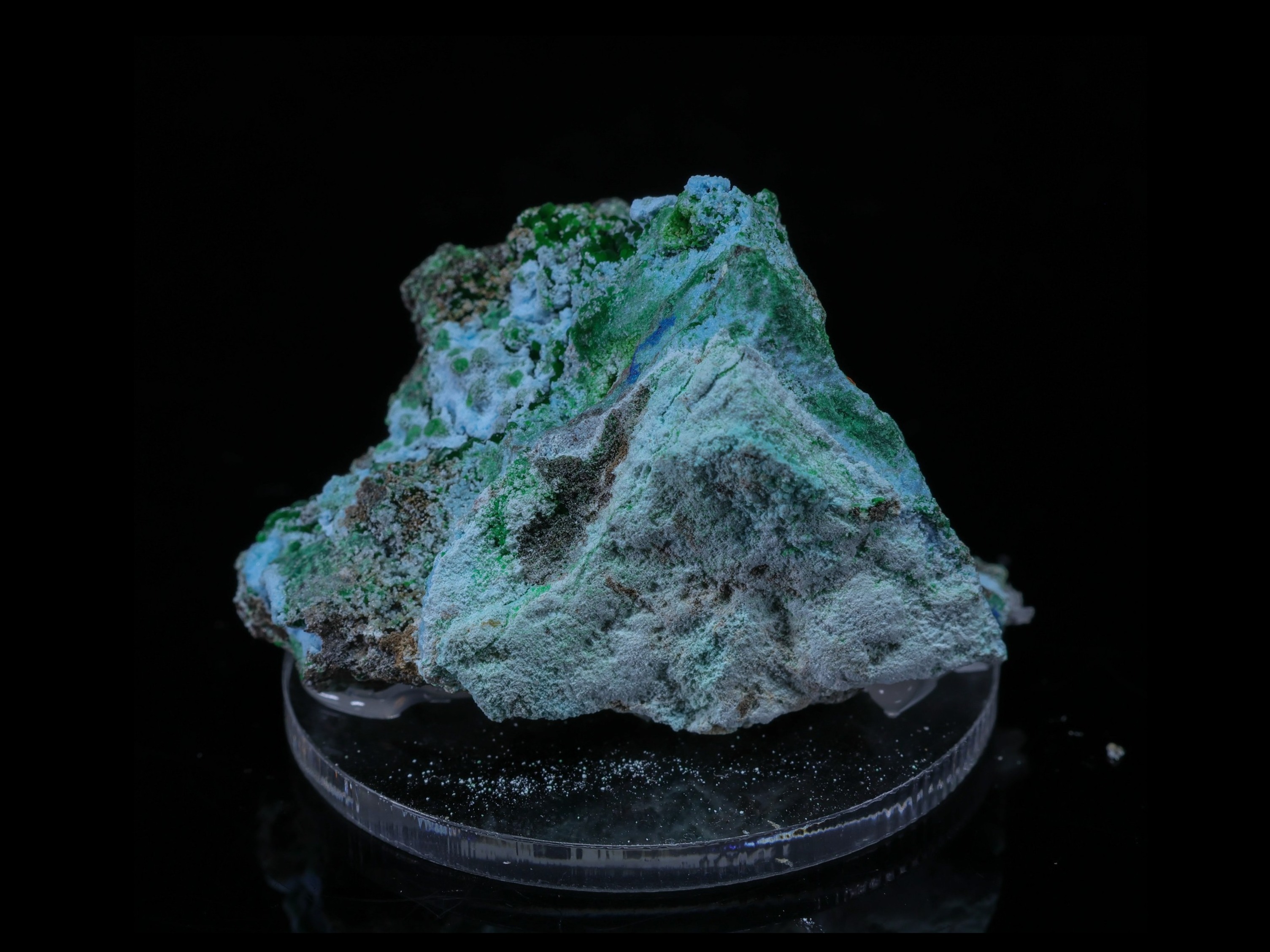
Arsenocrandallite is a rare mineral of the crandallite group, a calcium and aluminum arsenate, characterized by variable color and vitreous luster.
Properties
- Mohs hardness
- 5.5
- Luster
- Vitreous.
- Streak
- White
- Density
- 3.25
- Cleavage
- Probably has a perfect cleavage as in other members of the group, but not observed because of small grain size.
- Fracture
- Brak danych
- Transparency
- Transparent,Translucent
- Crystal system
- Trigonal
Diagnostic features
## Identification Arsenocrandallite can be identified by its variable color (white, cream, blue, blue-green), vitreous luster, and the radial aggregate habit typical of the crandallite group. A Mohs hardness of 5.5 is also a diagnostic feature. ## Differentiation from similar minerals Due to similarities in chemical composition and structure, arsenocrandallite can be confused with other minerals from the crandallite group. Accurate differentiation often requires specialized laboratory tests, such as X-ray analysis or spectroscopy. ## Crystal forms Arsenocrandallite most often occurs as radial aggregates, spherical or reniform clusters. Well-formed, though small, single crystals with a trigonal habit are rarer.
Geological environment
## Genesis Arsenocrandallite forms in the oxidation zones of arsenical deposits, often in hydrothermal environments. It is a secondary mineral, forming as a result of weathering processes and transformation of other arsenical minerals. ## Mineral associations This mineral co-occurs with other minerals of the oxidation zone, such as arsenates, phosphates, and iron oxides. The exact associations depend on the specific characteristics of the deposit. ## Localities Known localities of arsenocrandallite include areas with arsenical deposits where suitable conditions for its formation exist. It is a rare mineral, and its occurrence is limited to specific geological environments.
Rarity
Very Rare
For collectors
## Quality criteria The most prized arsenocrandallite specimens are those with intense and uniform colors, especially blue and blue-green. The size and aesthetics of the aggregates, as well as the absence of mechanical damage, are also important. Well-formed crystals, though rare, are particularly sought after. ## Popular localities Due to the rarity of the mineral, there are not many popular localities that provide large quantities of high-quality specimens. Every find is valuable to collectors.
Care and storage
## Cleaning Arsenocrandallite should be cleaned gently, using a soft brush and lukewarm water. For heavier soiling, distilled water can be used to avoid mineral deposits. ## What to avoid Avoid using aggressive chemical agents that can damage the mineral's surface. Prolonged exposure to direct sunlight can potentially affect color stability. Temperature and humidity changes should also be minimized. ## Storage Arsenocrandallite specimens are best stored in closed display cases or containers, protecting them from dust and mechanical damage. It is important to ensure stable environmental conditions to preserve their natural appearance.