Anatase on Quartz (Kharan Pakistan) - Unique Floater

SKU: S_00111

An aesthetic specimen of anatase on quartz from the well-known location of Kharan in Pakistani Balochistan, characterized by a rare 'floater' form. Numerous small, nearly black crystals of anatase with a strong metallic luster are embedded in large, partially transparent quartz crystals. The upper parts of the specimen are covered with a characteristic rust-brown coating of iron oxides. Main Features: numerous anatase crystals; floater specimen; strong metallic luster of anatase; rust-brown mineral coatings. Condition: Very good.
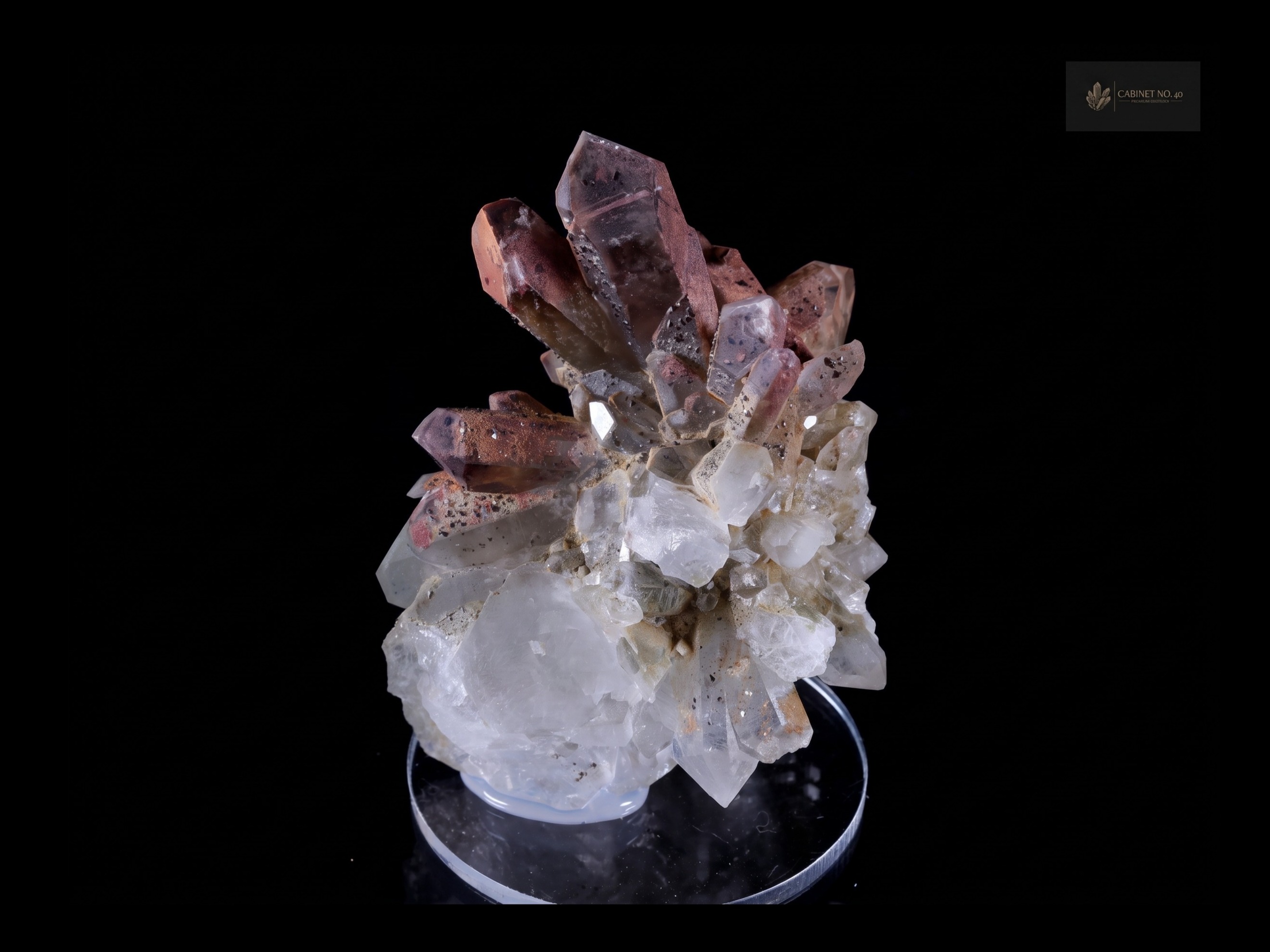
Frontowy widok okazu anatazu na kwarcu z Pakistanu, widoczne ciemne kryształy na jasnym tle.

Price: 87 EUR (379 PLN)

Availability: In stock

Location: Kharan, Baluchistan, Pakistan

Size: 68 × 51 × 39 mm

Weight: 101 g

Chemical formula: TiO₂

Mohs hardness: 5.5–6.0

Characteristics Anatase is a titanium oxide mineral, one of three naturally occurring polymorphic varieties of TiO₂, alongside rutile and brookite. It typically occurs as small, well-formed crystals, often with a pyramidal or bipyramidal habit. Its surface is often striated. The color of anatase is variable, from brown, through yellowish-brown, indigo, to black; pale green, lilac, gray, and even nearly colorless specimens are less common. Physical Properties Anatase is characterized by a Mohs hardness of 5.5-6. It possesses a strong adamantine luster, which in darker specimens can transition to submetallic-adamantine. It is transparent to translucent. Its density is 3.79 g/cm³. This mineral exhibits perfect cleavage along {001} and {011} planes. Colors and Varieties Anatase exhibits a variety of colors, including brown, pale yellow, reddish-brown, indigo, and black. Pale green, pale lilac, or gray specimens are less common, and nearly colorless ones are very rare. In transmitted light, it can show brown, yellowish-brown, pale green, or blue colors. History and Name Anatase was described in 1801. The mineral's name comes from the Greek word "anatasis", meaning "extension", referring to the elongated axes of its crystals compared to rutile. Uses Anatase has no significant industrial applications due to its rarity and small crystal sizes. It is primarily valued as a collector's mineral, owing to its aesthetic appeal and excellent crystal development.

Diagnostic features

Identification Anatase can be identified by its characteristic crystal habit, often pyramidal or bipyramidal, and strong adamantine luster. Darker specimens may exhibit a submetallic-adamantine luster. Its Mohs hardness of 5.5-6 allows it to scratch glass. Distinguishing from Similar Minerals Anatase can be confused with rutile, another TiO₂ polymorph. It differs from rutile in crystal habit (anatase often forms steeper pyramids) and cleavage. Rutile also has a higher density and hardness. From brookite, another polymorph, anatase is distinguished by its crystallographic system and crystal form. Crystal Forms Anatase most commonly occurs as well-formed, sharply terminated crystals with a pyramidal or bipyramidal habit. These are often isometric or prismatic crystals. Crystal faces may be striated. It can also form granular or radiating aggregates, although these are less typical for collector specimens.

Formation environment

Genesis Anatase forms under low-temperature hydrothermal conditions, often in fissures of metamorphic rocks such as crystalline schists, gneisses, and quartzites. It also occurs in alpine veins, pegmatites, and as an accessory mineral in some igneous rocks. It can also be a weathering product of rutile or ilmenite. Mineral Associations Anatase often co-occurs with quartz, rutile, brookite, ilmenite, hematite, chlorite, adularia, and titanite. In some deposits, it is also associated with apatite and muscovite. Localities Known anatase localities include the Alps (Switzerland, France, Italy), where it occurs in beautiful, well-formed crystals. Other important localities are Brazil (Minas Gerais), Norway (Hardangervidda), Russia (Urals), Pakistan (Gilgit-Baltistan), and the United States (Arkansas, Virginia).

For the collector

Quality Criteria The most prized anatase specimens are those with well-formed, sharply terminated crystals exhibiting a distinct pyramidal or bipyramidal habit. The intensity and uniformity of color, as well as a strong adamantine luster, are important. Transparent specimens are more desirable. Crystal size also matters, although even small, perfectly formed specimens are highly valued. Clarity and absence of mechanical damage are crucial for collector value. Popular Localities The most sought-after anatase specimens come from the Alps, especially Switzerland (e.g., Binnental region) and France. Specimens from Brazil, often characterized by beautiful colors and forms, are also highly valued. Localities in Pakistan also yield high-quality crystals.

See mineralogical reference for Anatase in the Knowledge Base →

View product →