Anatase
Chemical formula: Ti<sup>4+</sup>O<sub>2</sub>
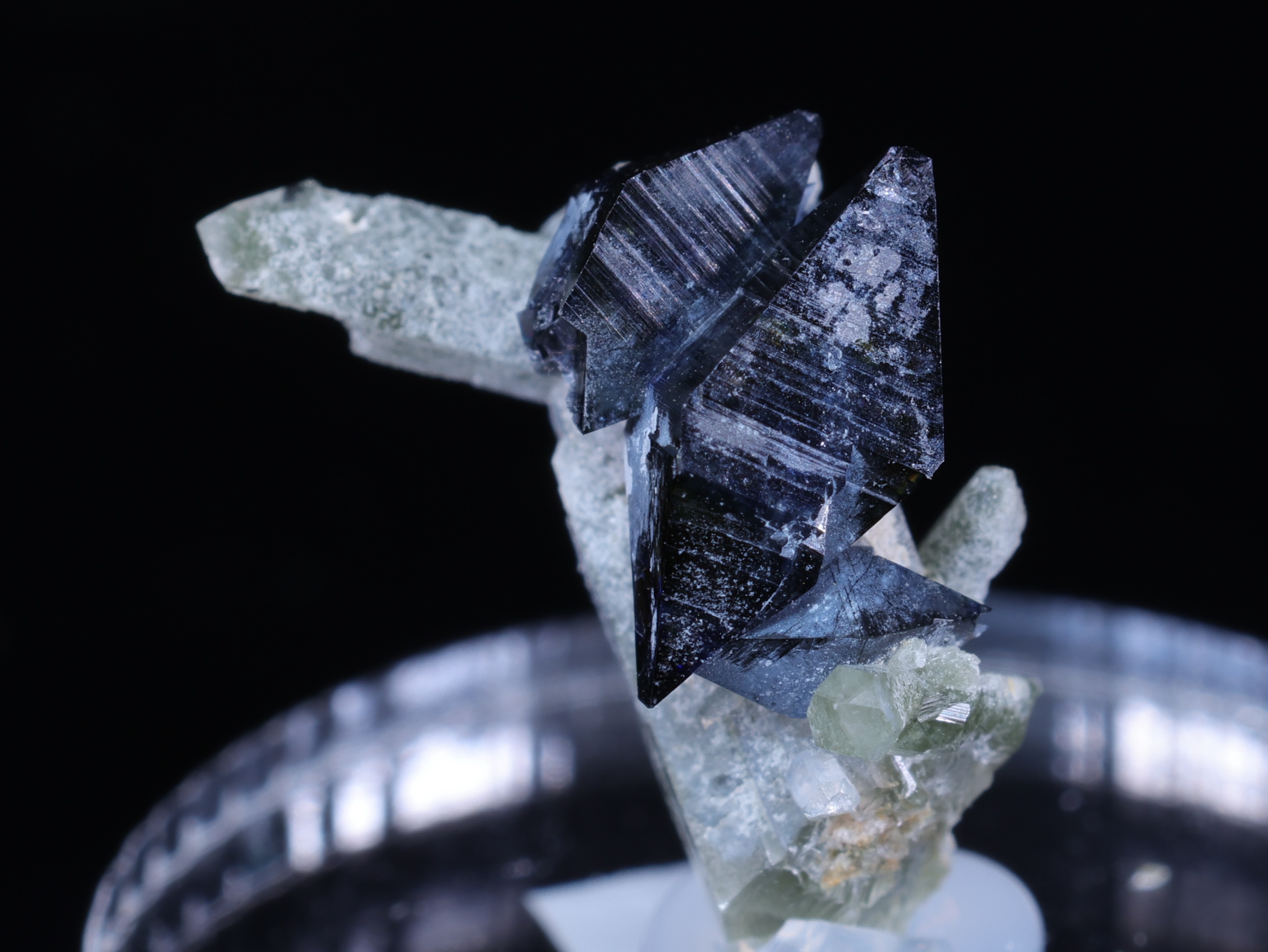
Anatase is a rare titanium oxide mineral, polymorphic with rutile and brookite, often characterized by pyramidal crystals with a strong luster.
Properties
- Mohs hardness
- 5.5-6
- Luster
- Adamantine to metallic-adamantine in darker colored specimens.
- Streak
- White to pale yellow
- Density
- 3.79
- Cleavage
- on {001} and {011}
- Fracture
- Brak danych
- Transparency
- Transparent,Translucent
- Crystal system
- Tetragonal
Diagnostic features
## Identification Anatase can be identified by its characteristic crystal habit, often pyramidal or bipyramidal, and strong adamantine luster. Darker specimens may exhibit a submetallic-adamantine luster. Its Mohs hardness of 5.5-6 allows it to scratch glass. ## Distinguishing from Similar Minerals Anatase can be confused with rutile, another TiO₂ polymorph. It differs from rutile in crystal habit (anatase often forms steeper pyramids) and cleavage. Rutile also has a higher density and hardness. From brookite, another polymorph, anatase is distinguished by its crystallographic system and crystal form. ## Crystal Forms Anatase most commonly occurs as well-formed, sharply terminated crystals with a pyramidal or bipyramidal habit. These are often isometric or prismatic crystals. Crystal faces may be striated. It can also form granular or radiating aggregates, although these are less typical for collector specimens.
Geological environment
## Genesis Anatase forms under low-temperature hydrothermal conditions, often in fissures of metamorphic rocks such as crystalline schists, gneisses, and quartzites. It also occurs in alpine veins, pegmatites, and as an accessory mineral in some igneous rocks. It can also be a weathering product of rutile or ilmenite. ## Mineral Associations Anatase often co-occurs with quartz, rutile, brookite, ilmenite, hematite, chlorite, adularia, and titanite. In some deposits, it is also associated with apatite and muscovite. ## Localities Known anatase localities include the Alps (Switzerland, France, Italy), where it occurs in beautiful, well-formed crystals. Other important localities are Brazil (Minas Gerais), Norway (Hardangervidda), Russia (Urals), Pakistan (Gilgit-Baltistan), and the United States (Arkansas, Virginia).
Rarity
Very Common
For collectors
## Quality Criteria The most prized anatase specimens are those with well-formed, sharply terminated crystals exhibiting a distinct pyramidal or bipyramidal habit. The intensity and uniformity of color, as well as a strong adamantine luster, are important. Transparent specimens are more desirable. Crystal size also matters, although even small, perfectly formed specimens are highly valued. Clarity and absence of mechanical damage are crucial for collector value. ## Popular Localities The most sought-after anatase specimens come from the Alps, especially Switzerland (e.g., Binnental region) and France. Specimens from Brazil, often characterized by beautiful colors and forms, are also highly valued. Localities in Pakistan also yield high-quality crystals.
Care and storage
## Cleaning Anatase can be cleaned using a soft brush and lukewarm water. For heavier soiling, a mild soap may be used, followed by thorough rinsing with clean water. After washing, it should be dried with a soft cloth. ## What to Avoid Avoid using strong acids and bases, which can damage the mineral's surface. Anatase is sensitive to rapid temperature changes, so it should not be exposed to extreme thermal conditions. Prolonged exposure to direct sunlight can lead to slight color changes, especially in lighter specimens. Mechanical impacts that could cause chipping or cracks should also be avoided. ## Storage Anatase specimens are best stored in closed display cases or boxes, protecting them from dust and mechanical damage. It is advisable to place them on a soft surface to prevent scratches. Stable temperature conditions and avoidance of high humidity areas are recommended.