How to Take Photos of Minerals Without Distortions
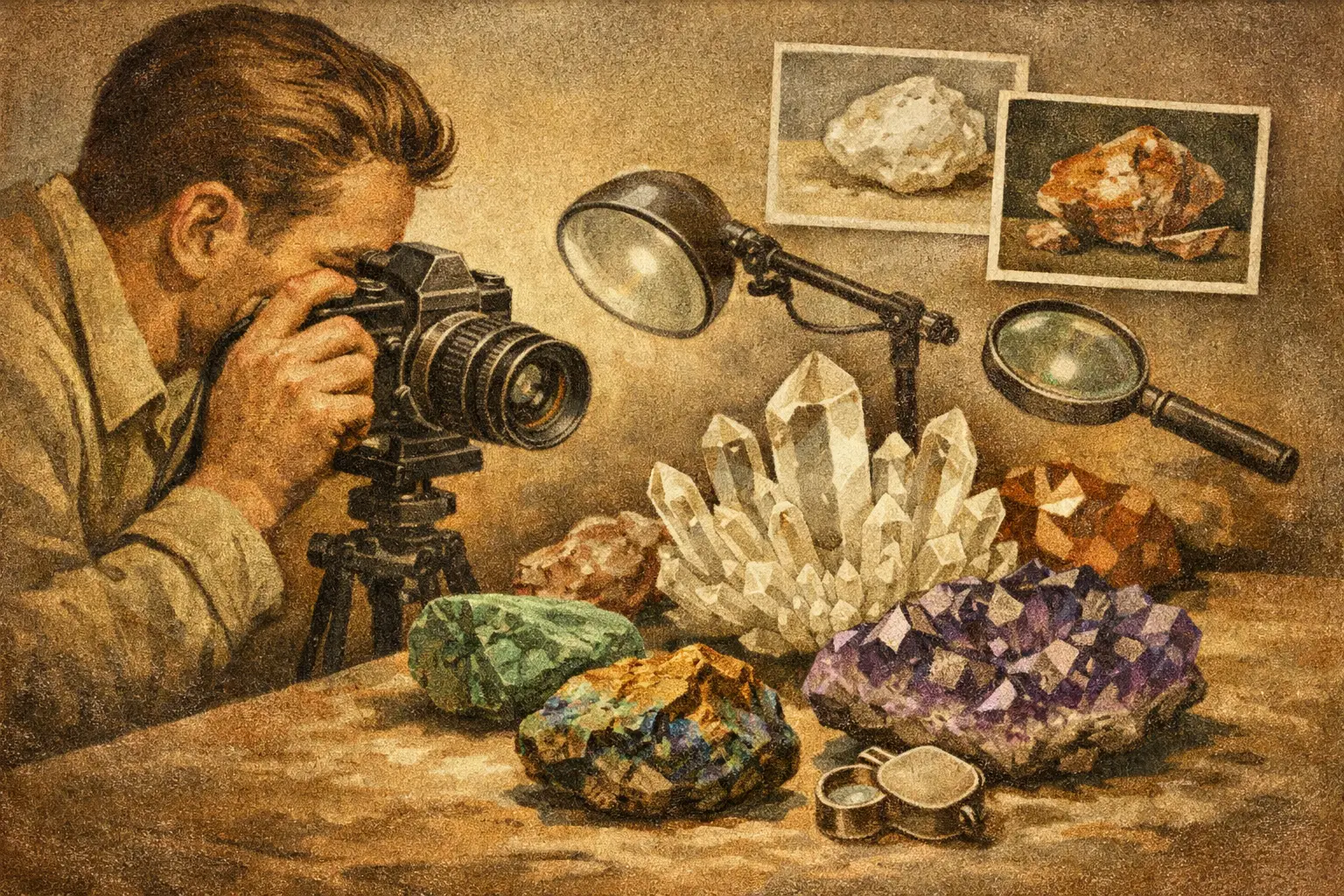
How to photograph minerals to accurately capture color, luster, and habit? A practical guide for collectors: light, background, macro, and focus.
It is easiest to ruin a mineral photograph where the specimen looks best in person—in its luster, transparency, and fine surface structure. The camera often loses what the collector sees immediately: the subtle color zoning of fluorite, the metallic character of pyrite, the satin reflection of malachite, or the matte, granular fracture of vanadinite. If you are wondering how to take photos of minerals that do not misrepresent the specimen, you need to think like both a photographer and a collection documentalist at the same time.
A good mineral photograph is not just about the specimen being "pretty." In a collection, the clarity of features also matters: crystal habit, the relationship between minerals in an intergrowth, the way it is seated on the matrix, surface quality, and sometimes even damage. For this reason, the best photos are usually more controlled than flashy. The less left to chance, the better the material for cataloging, sales, identification, and archiving.
How to take photos of minerals - where to start
Start with a simple premise: the photo is meant to show a specific specimen, not the camera's capabilities. This changes the entire process. In collector photography, three things are most important: stable light, neutral color reproduction, and control over depth of field.
A phone may suffice for general documentation, but with specimens featuring fine crystallization, it will quickly show its limitations. Aggressive sharpening, automatic contrast boosting, and unstable white balance make the photo attractive at the expense of credibility. A camera with manual mode or a phone with manual exposure control provides a much better starting point.
Equally important is the preparation of the specimen itself. Dust, fibers, and fingerprints are often barely visible to the naked eye, but in macro, they immediately dominate the frame. Before photographing, it is worth gently cleaning the specimen with a photographic blower or a soft brush. This isn't about cosmetics; it's about ensuring the photo represents the mineral, not particles from the display case.
Light decides everything
In the question of how to take photos of minerals, the answer is usually: master the light first. It is light that reveals relief, transparency, and luster, but it is also the easiest path to errors. Too harsh a spotlight burns out reflections and kills color. Too flat a light diffuses the structure and makes crystals look like a uniform mass.
The safest option is soft, diffused light, coming from two sides or from above at a slight angle. A simple light tent, a sheet of translucent material, or a diffuser between the lamp and the specimen usually yields a better effect than a "stronger" lamp without modification. For highly lustrous specimens, such as pyrite or galena, diffusion is practically mandatory.
However, there is no single setting for all minerals. Quartz and calcite often benefit from side lighting because it reveals edges and transparency. Minerals with velvety or fibrous surfaces look better with more oblique light that brings out the texture. On the other hand, samples with intense color saturation, like malachite or azurite, need neutral and calm light without a warm cast.
If you are working with two lamps, do not automatically set them symmetrically. Symmetry can be convenient, but it often robs the specimen of its volume. It is better to leave one lamp as the main modeling source and weaken or move the second one back just to control the shadows.
A background that doesn't compete with the specimen
The background in mineral photography has a museum function, not a decorative one. It is meant to organize the image, separate the form from the surroundings, and not affect color perception. In practice, neutral backgrounds work best: gray, off-white, and sometimes deep black. The choice depends on the specimen itself.
A light background serves dark minerals and specimens with a clear contour well. A black background can emphasize transparency and saturated color, but it easily leads to an overly theatrical effect. Gray is the safest for cataloging because it maintains a balance between separation and naturalness. If you are photographing a specimen with a light matrix, pure white can make it difficult to distinguish edges and flatten the form.
It is also worth remembering that shiny stands and textured backgrounds almost always distract. In collector photography, less is more. The specimen should build the image.
Focus, scale, and perspective
The biggest technical problem with minerals is not a lack of light, but too shallow a depth of field. In close-up shots, even a small specimen may only have a fragment in focus if you photograph with a wide-open aperture. That is why "pretty" photos are not always useful for documentation.
If you are using a camera, it is usually worth working within the range of medium to higher aperture values, but with moderation. Closing the lens too much can degrade detail through diffraction. This is one of the classic compromises—you want more sharpness, but not at the expense of microtexture. In practice, it is best to take several test shots for the same frame.
For small specimens or macro photos, the best solution is often focus stacking—combining several shots with different focal planes. This is particularly useful for crystal clusters, druses, and specimens with complex geometry. There is one condition: the camera and the specimen must remain absolutely still.
Perspective has collector significance. Do not always photograph from above or straight on. First, find the side that best shows the habit, spatial relationships, and aesthetics of the specimen, and only then set up the light. For a catalog, it is worth taking at least one main shot and one auxiliary shot that shows the depth or the seating of the crystals.
Scale is a separate topic. If the photo is to be used for sales, archiving, or comparisons, the size of the specimen should be provided in the description, but maintaining a consistent scale between photographs throughout the collection is also helpful. This makes the collection look organized, and the viewer quickly understands whether they are looking at a thumbnail, a cabinet, or a larger format specimen.
Color, white balance, and processing pitfalls
Color fidelity is the point where many mineral photos lose their reference value. Automatic white balance often shifts colors toward being too warm or too cool, especially in mixed lighting. The effect can be subtle, but for a collector, it matters. The purple of fluorite, the honey hue of calcite, or the green tone of malachite are easily distorted.
It is best to work with one type of light and set the white balance manually. If possible, shoot in RAW, as it provides more control without degrading detail. Post-processing should correct, not interpret. Increasing contrast can help bring out the form, but doing it too strongly leads to the loss of subtle tonal transitions and blocked shadows. Similarly with saturation—the mineral should look like a specimen, not a render.
Sharpening should be used cautiously. Crystals with naturally sharp edges look convincing anyway if the photo is correctly exposed. Artificial sharpening quickly creates halos and unnatural micro-contrast, which is easy to recognize in collector documentation.
How to take photos of minerals with a phone
A phone is not the ideal tool for every specimen, but with a sensible method, it can produce surprisingly good material. The most important thing is to avoid automation. Tap the screen on the most important detail, lock focus and exposure, and then slightly adjust the brightness so as not to blow out the reflections.
Do not use the phone's flash. It provides harsh, axial light that destroys relief and produces aggressive reflections. Instead, place the specimen near a diffused light source and prop up the phone or use a small tripod. If the device offers a macro mode, check it critically—sometimes it provides better detail, and sometimes just a stronger digital effect.
In practice, a phone works best for medium and larger specimens and for quick collection documentation. For fine crystallization, transparent minerals, and complex lusters, a camera still has a clear advantage.
A consistent standard for the entire collection
The most useful photos are not single successful shots, but a repeatable system. A constant background, a similar light angle, the same color temperature, and uniform processing make the collection look professional and easier to manage. This is especially important if you are creating a digital catalog, comparing specimens between locations, or preparing materials for publication.
At Cabinet No. 40, this repeatability has the greatest practical value—photography does not end with aesthetics; it supports identification, presentation, and order within the collection. A well-photographed specimen is easier to assign, describe, and compare with other pieces.
It is not worth chasing one "ideal" setting for every mineral. A better approach is a method that yields predictable results and allows for conscious exceptions. Once you master light, background, and color control, the camera stops guessing for you and starts recording what is actually important in the specimen. And that is exactly when a photo becomes part of the documentation, rather than just its decoration.