SKU: P_26-2_34
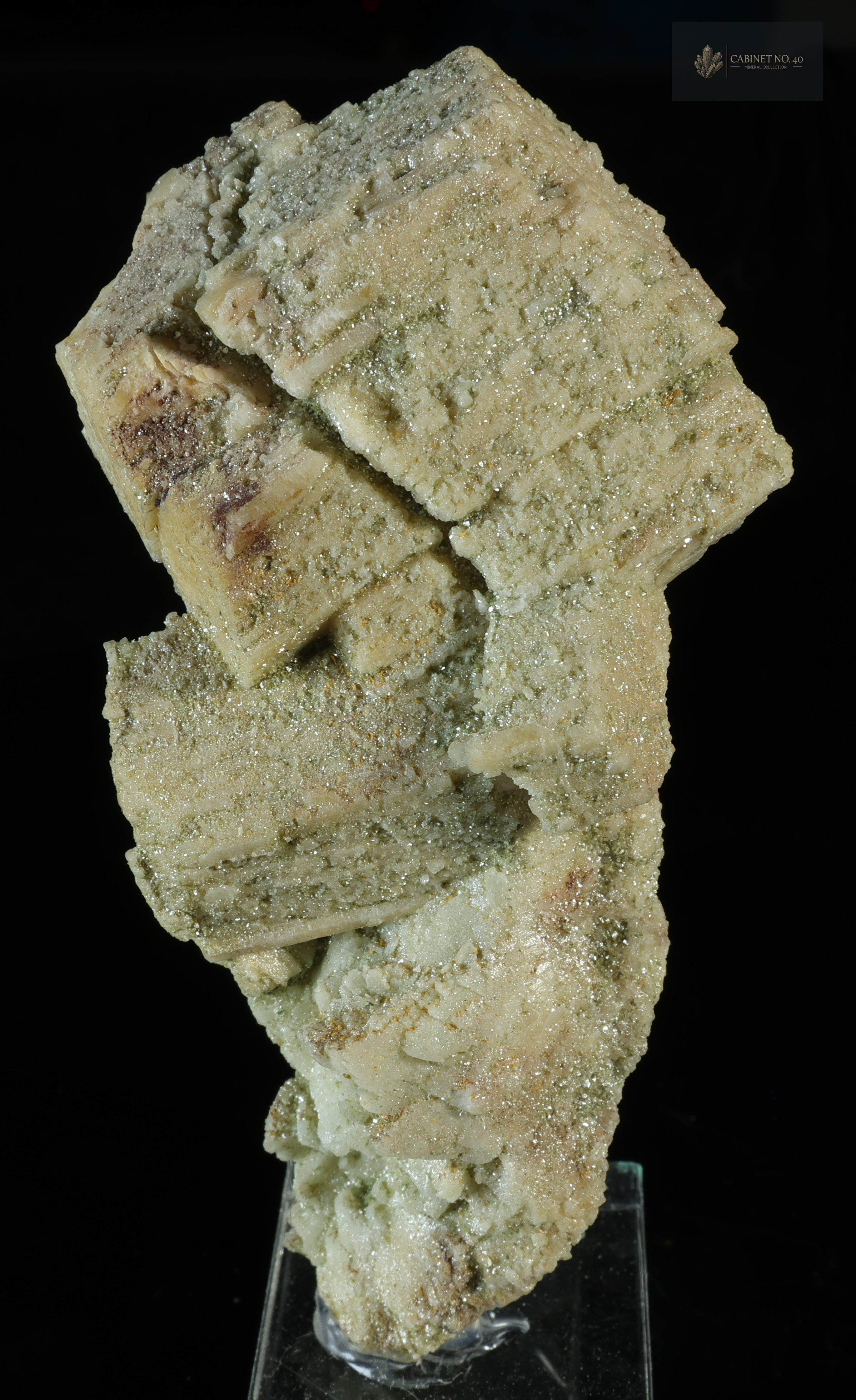
The specimen consists of well-formed, tabular crystals of microcline with a pale yellow color and a matte luster. The surfaces of the microcline are covered with a fine crystalline, greenish layer of zinnwaldite, creating an interesting contrast. The specimen is glued to a base; upon request, we can detach it.
Price: 32 EUR (139 PLN)
Availability: In stock
Location: Strzegom, Gmina Strzegom, Świdnica County, Lower Silesian Voivodeship, Poland
Size: 45 x 91 x 40 mm
Weight: 200 g
Chemical formula: KLiFeAl(AlSi₃O₁₀)(F,OH)₂
Mohs hardness: 2.5-4
Characteristics Zinnwaldite is a mineral from the mica group, characterized by its platy or scaly habit. It often forms aggregates with platy, radial, or rosette habits. The color of zinnwaldite ranges from light gray, through yellowish-brown, to dark brown, and even violet. This mineral can be transparent to translucent, which gives it a distinctive appearance. Physical Properties Zinnwaldite has a Mohs hardness of 2.5-3.5, making it a relatively soft mineral. It exhibits perfect cleavage in one direction, which is typical for micas. The luster of zinnwaldite is vitreous to pearly, and its streak is white. The density of the mineral is approximately 2.9-3.0 g/cm³. Colors and Varieties The color of zinnwaldite is variable, most commonly found in shades of gray, brown, yellow, and also violet. The intensity of the color depends on the iron and lithium content in the mineral's structure. There are no specific commercial varieties of zinnwaldite, but differences in chemical composition can affect its appearance. History and Name The name zinnwaldite comes from the locality Zinnwald (now Cínovec) on the border of the Czech Republic and Germany, where this mineral was first described. Zinnwaldite was named in 1845 by Karl Friedrich Plattner. Applications Zinnwaldite is an important source of lithium, which makes it a mineral of industrial significance. Lithium is used in the production of batteries, ceramics, glass, and in the pharmaceutical industry. Zinnwaldite specimens with well-formed crystals or interesting aggregates are also valued by mineral collectors.
Identification Zinnwaldite can be identified by its platy habit, vitreous to pearly luster, and perfect cleavage. The mineral's color, often gray, brown, yellowish, or violet, is also a diagnostic feature. Its aggregates with radial or rosette habits are also characteristic. Distinguishing from Similar Minerals Zinnwaldite can be confused with other minerals from the mica group, such as muscovite or biotite. It differs from muscovite by its usually darker color and the presence of lithium in its chemical composition. It differs from biotite by its lighter color and often more violet hue. Precise differentiation requires chemical analysis. Crystal Forms Zinnwaldite most commonly occurs as platy, scaly, or tabular crystals. It often forms aggregates with radial, rosette, or fan-like habits. Crystals are usually small, although larger specimens can occur.
Genesis Zinnwaldite primarily forms in pegmatites and greisens, which are associated with granitic intrusions. It is a high-temperature mineral, forming in the final stages of magma crystallization. It also occurs in hydrothermal veins, often in association with cassiterite and wolframite. Mineral Associations Zinnwaldite often coexists with other minerals typical of pegmatites and greisens. The most common associated minerals include quartz, orthoclase, albite, topaz, fluorite, cassiterite, wolframite, tourmaline, and other micas, such as muscovite and biotite. Localities The most important zinnwaldite localities are in Zinnwald (Cínovec) on the border of the Czech Republic and Germany, where this mineral was first described. Other significant localities include Altenberg in Germany, St. Just in Cornwall (England), as well as some regions of Russia, Brazil, and the USA.
Quality Criteria The most prized zinnwaldite specimens are those with well-formed, large, and aesthetic crystals, especially in the form of rosettes or radial aggregates. The intensity and uniformity of color, as well as the transparency of the mineral, are also important. Specimens without mechanical damage and with interesting mineral associations are particularly sought after. Popular Localities The most valued zinnwaldite specimens come from the historical locality of Zinnwald (Cínovec) on the border of the Czech Republic and Germany. Other popular places from which high-quality specimens originate include Altenberg in Germany and St. Just in Cornwall.
See mineralogical reference for Zinnwaldite in the Knowledge Base →