White Dolomite Crystals on Fluorite from Moscona Mine

SKU: S_00086

A classic and extremely aesthetic specimen, featuring a crystalline layer of honey-yellow fluorite as its base, on which snow-white dolomite crystals have abundantly formed. The dolomite here takes on a very characteristic form for this location, creating three-dimensional, sparkling clusters. Main Features: snow-white dolomite with saddle-shaped form; honey-yellow fluorite background; strong color contrast; classic European location; high aesthetics. Condition: Very good.
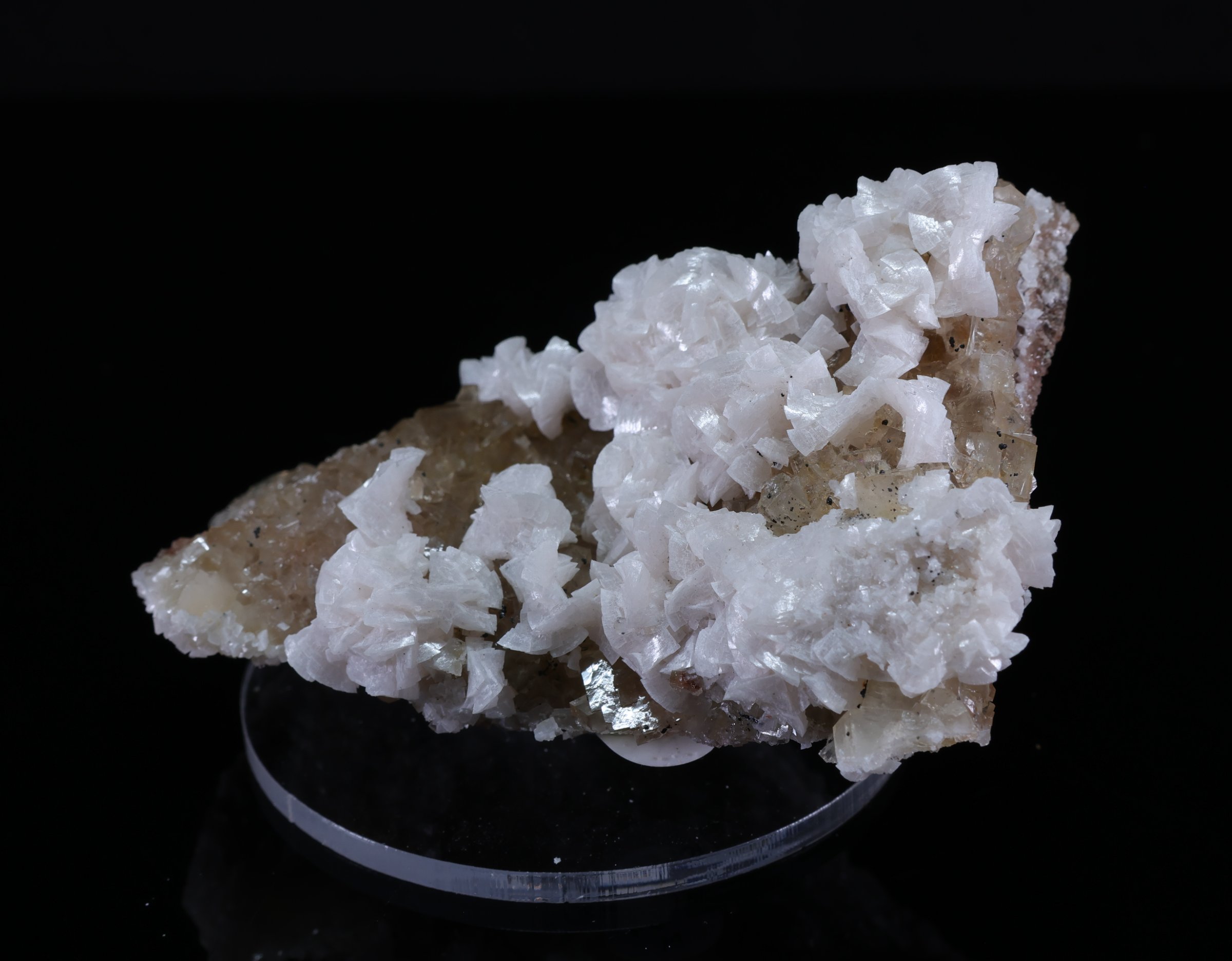
White Dolomite Crystals on Fluorite from Moscona Mine

Price: 41 EUR (179 PLN)

Availability: In stock

Location: Moscona Mine, Solis, Asturias, Spain

Size: 20 x 80 x 50 mm

Weight: 159 g

Chemical formula: CaF₂

Crystal system: Isometric

Mohs hardness: 4

Mineral group: Dolomite Group

Characteristics Dolomite is a carbonate mineral with the composition CaMg(CO₃)₂. It typically occurs as rhombohedral crystals, often with curved faces, giving them a characteristic saddle-shaped appearance. It can also form compact, granular, or massive aggregates. Its color is variable, ranging from colorless, white, gray, to pinkish and brownish. Green varieties are less common. Physical Properties Dolomite's hardness on the Mohs scale is 3.5-4. It has a vitreous luster and a white streak. It is transparent to translucent. The specific gravity of dolomite is approximately 2.84 g/cm³. Colors and Varieties Dolomite occurs in a wide range of colors, most commonly colorless, white, gray, pinkish, or brownish. Green specimens are rarely found. The color in transmitted light is colorless. History and Name The mineral was described in 1791. The name comes from the French geologist Déodat Gratet de Dolomieu, who was the first to study dolomitic rocks in the Alps. Uses Dolomite has wide industrial applications. It is used as a raw material for cement production, refractories, artificial fertilizers, and as a building and decorative stone. It is also important in metallurgy as a flux.

Diagnostic features

Identification Dolomite can be identified by its characteristic rhombohedral crystal habit, often with curved faces. It reacts with dilute hydrochloric acid, but more slowly than calcite, especially in compact form. A hardness of 3.5-4 on the Mohs scale is also a diagnostic feature. Distinguishing from Similar Minerals Dolomite is often confused with calcite. The main difference is the reaction to hydrochloric acid – calcite effervesces strongly with cold acid, while dolomite reacts more weakly, often only after pulverization or heating. Dolomite crystals often have curved faces, which is rare in calcite. It also differs in chemical composition, containing magnesium. Crystal Forms Dolomite most commonly forms rhombohedral crystals, often with characteristically curved faces. It can also occur as granular, compact, or massive aggregates, as well as coatings and incrustations.

Formation environment

Genesis Dolomite forms in various geological environments. Most commonly, it forms as a result of metasomatic replacement of calcite in carbonate rocks (limestones) under the influence of magnesium-rich solutions. It can also crystallize directly from hydrothermal solutions and in evaporitic and sedimentary environments, especially in lagoons and shallow seas. Mineral Associations Dolomite often co-occurs with other carbonate minerals, such as calcite, magnesite, and ankerite. It can also be found in association with quartz, pyrite, chalcopyrite, and other ore minerals in hydrothermal veins. Localities Significant dolomite deposits occur worldwide. In Europe, these include the Alps (Italy, Austria), where dolomitic rocks form extensive massifs. Other important localities include the United States (e.g., Ohio, Illinois), Canada, Brazil, Mexico, Spain, and Poland (Holy Cross Mountains, Silesia).

For the collector

Quality Criteria Valued dolomite specimens are those with well-formed, large, and aesthetic crystals, especially those with rare colors or interesting forms (e.g., saddle-shaped crystals). Transparency and lack of mechanical damage also increase the value of a specimen. Crystalline aggregates with interesting aesthetics are also sought after. Popular Localities Particularly prized dolomite specimens come from the Alps, where they form beautiful, often pink or white crystals. Other well-known localities include Spain (e.g., Picos de Europa), where well-formed crystals occur, and Mexico, known for its diverse forms and colors.

See mineralogical reference for Dolomite in the Knowledge Base →

View product →