SKU: W-0217_3-RU
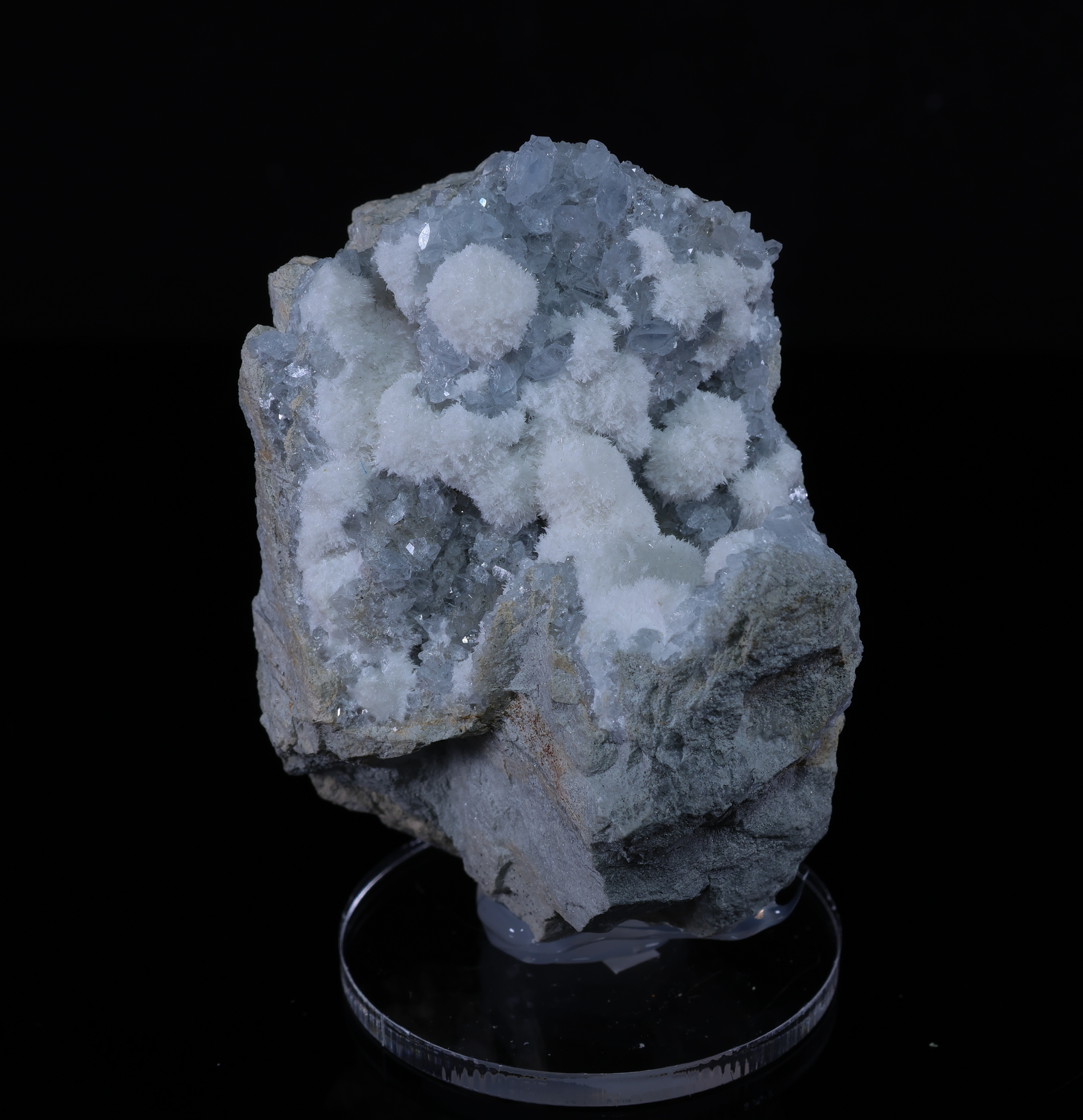
An aesthetic and representative specimen combining two strontium minerals from a classic Russian locality. Against the backdrop of well-formed crystals of Celestine are set numerous snow-white aggregates of Strontianite with a characteristic needle-like habit. Main Features: snow-white Strontianite; blue Celestine; classic locality; ex coll. K. Urbanik. Condition: Very good - delicate, needle-like clusters of Strontianite are exceptionally well preserved; the crystals of Celestine exhibit natural luster and sharp edges.
Price: 43 EUR (189 PLN)
Availability: In stock
Location: mine Sinije Kamni Dagestan, Caucasus, Russia
Size: 45 x 45 x 62 mm
Weight: 114 g
Chemical formula: SrCO₃ + SrSO₄
Crystal system: rhombohedral
Mohs hardness: 3,5–4 / 3–3,5
Mineral group: Gypsum Group
Rarity: Uncommon
Characteristics Strontianite is strontium carbonate that crystallizes in the orthorhombic system. Typical strontianite specimens take the form of acicular, radial, or fibrous aggregates, often forming spherical concretions. Crystals can be columnar, prismatic, or acicular, usually small. This mineral can also occur in compact, granular, or fibrous masses. The surface of crystals often exhibits striations. Physical Properties The hardness of strontianite on the Mohs scale is 3.5, making it a relatively soft mineral. It is characterized by a vitreous luster, which can be resinous on fracture surfaces. The mineral is transparent to translucent. The specific gravity of strontianite is 3.74 g/cm³. It has perfect cleavage on the {110} rhombic prism faces, weak on {021}, and trace on {010}. The streak of strontianite is white. Colors and Varieties Strontianite most commonly occurs in white, colorless, or gray. It can also take on pale yellow, greenish, or brown hues, often associated with the presence of impurities. In transmitted light, it is colorless. History and Name The name strontianite comes from the town of Strontian in Scotland, where this mineral was first discovered and described in 1790. The discovery of strontianite led to the identification of a new chemical element – strontium. Uses Strontianite is the main ore of strontium, which is used in the pyrotechnic industry for producing red fireworks and in the glass and ceramic industries. It is also used in medicine, for the production of ferrite magnets, and in sugar refining.
Identification Strontianite can be identified by its characteristic acicular or radial aggregates, often forming spherical concretions. Its hardness (3.5 on the Mohs scale) and reaction with acids (emission of carbon dioxide) are also helpful. Vitreous to resinous luster and a white streak are additional diagnostic features. Distinguishing from Similar Minerals Strontianite can be confused with aragonite, which is also a carbonate and crystallizes in the orthorhombic system, forming similar shapes. However, strontianite is heavier (density 3.74 g/cm³ compared to 2.95 g/cm³ for aragonite) and often exhibits a characteristic red flame color during a pyrochemistry test (due to the presence of strontium). Crystal Forms Strontianite crystals are usually columnar, prismatic, or acicular, often with distinct striations. It also occurs in compact, granular, fibrous, or spherical aggregates.
Genesis Strontianite primarily forms in low-temperature hydrothermal veins, often in limestones, marls, and other sedimentary rocks. It can also occur in the oxidation zones of barite and celestine deposits as a secondary product. Mineral Associations Strontianite often co-occurs with other carbonate minerals, such as calcite and aragonite, as well as with barite, celestine, gypsum, fluorite, and sulfide minerals. Localities Known strontianite localities include Strontian in Scotland (type locality), Westphalia in Germany, Cave-in-Rock in Illinois (USA), near Faringdon in England, and various locations in Canada and Mexico.
Quality Criteria The most prized strontianite specimens are those with well-formed, transparent crystals of intense color (if present) and distinct form. Large, aesthetic acicular aggregates or spherical concretions on matrix are also highly sought after. Purity and absence of mechanical damage are key factors influencing collectible value. Popular Localities Specimens from the historic locality in Strontian, Scotland, are highly valued due to their historical significance. Other popular localities include Westphalia, Germany, known for well-formed crystals, and Cave-in-Rock, Illinois (USA), where aesthetic concretions occur.
See mineralogical reference for Strontianite in the Knowledge Base →