SKU: B_20_0010
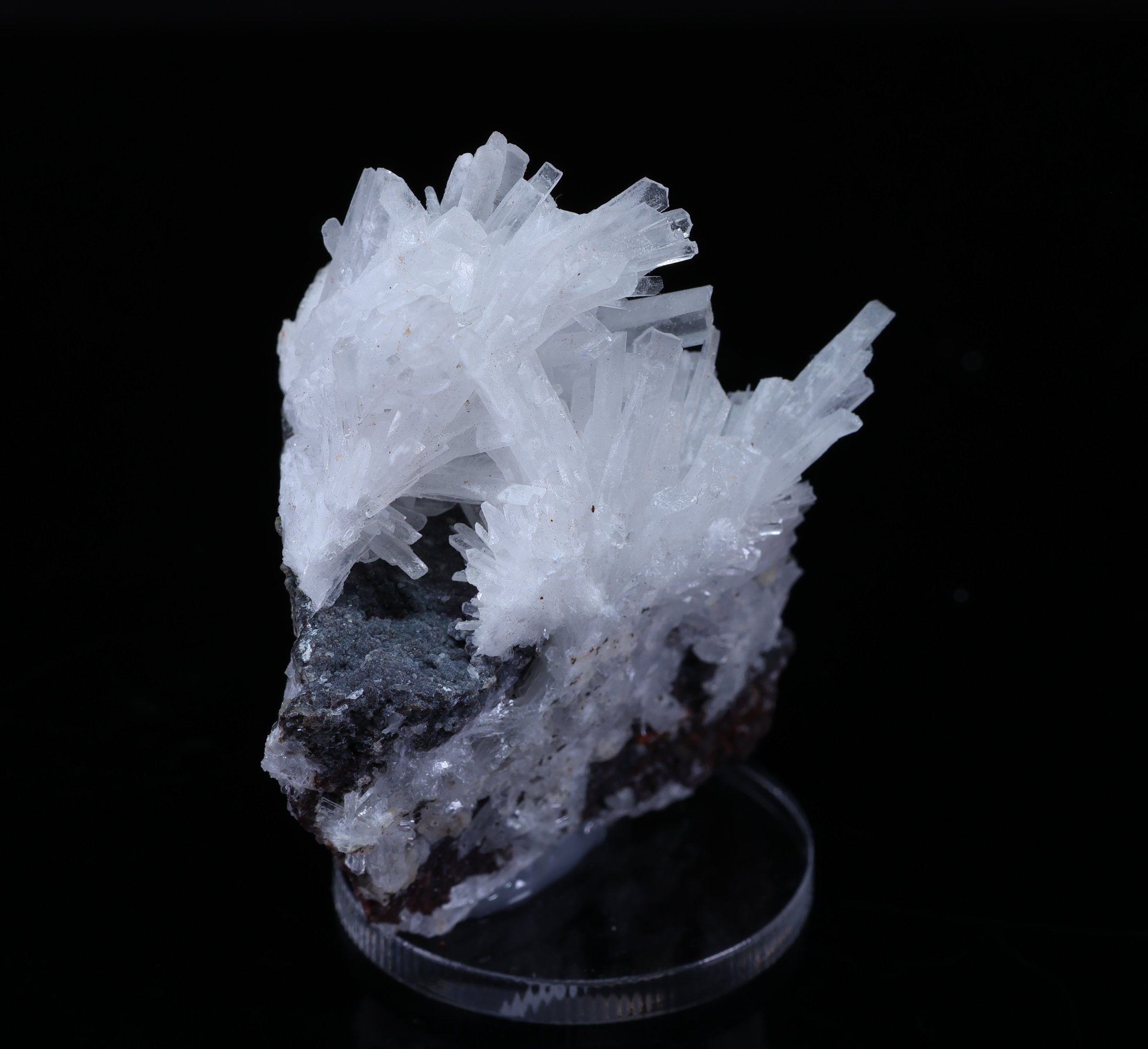
An aesthetic miniature showcasing a radiating, fan-like cluster of white crystals of aragonite. The mineral has formed in the shape of elongated, needle-like and prismatic crystals with relatively sharp endings, densely growing on a dark matrix. Main Features: needle-like and prismatic crystal habit; radiating growth arrangement; strong contrast between the white mineral and the dark matrix. Condition: Good.
Price: 3 EUR (15 PLN)
Availability: Sold out
Location: -, Pakistan
Size: 38 x 28 x 45 mm
Weight: 43.7 g
Chemical formula: Ca(CO₃)
Mohs hardness: 3.5-4
Characteristics Aragonite is a carbonate mineral, one of the naturally occurring varieties of calcium carbonate. Typical specimens often form aggregates of acicular or columnar crystals, which can arrange into radial, fibrous, or reniform aggregates. Pseudohexagonal twins, formed by the intergrowth of three individual crystals, giving them the appearance of hexagonal columns or tablets, are also characteristic. This mineral can also form speleothems, such as stalactites and stalagmites, as well as coralloidal structures, known as “iron flowers”. Physical Properties The Mohs hardness of aragonite is 3.5-4, making it a relatively soft mineral. It has a vitreous to resinous luster. It is transparent to translucent. The specific gravity of aragonite is 2.947 g/cm³. Colors and Varieties Aragonite occurs as colorless, white, or gray, but is often colored in various shades by impurities, taking on colors such as blue, green, red, or violet. In transmitted light, it is colorless. Varieties of aragonite are known, such as ikaite (aragonite pseudomorphs after ikaite) or aragonite grottoes, which are characterized by specific speleothem forms. History and Name The name aragonite comes from Aragon, Spain, where the mineral was first described in 1797. It was named by Abraham Gottlob Werner. Uses Aragonite is mainly used as a collector's mineral due to its attractive crystal forms and variety of colors. It is also used in the chemical industry as a source of calcium carbonate, and in agriculture to improve soil quality. In aquaristics, it is sometimes used as a substrate in marine tanks due to its ability to stabilize water pH.
Identification Aragonite can be identified by its characteristic crystal forms, especially radial or acicular aggregates and pseudohexagonal twins. It reacts with hydrochloric acid, releasing carbon dioxide, similar to calcite, but aragonite is more reactive in cold acid. Its Mohs hardness is 3.5-4. Distinguishing from Similar Minerals Aragonite is a polymorph of calcite, meaning they have the same chemical composition but different crystal structures. The main difference is the crystal system: aragonite crystallizes in the orthorhombic system, and calcite in the trigonal system. Aragonite is also slightly harder and has a higher density than calcite. Furthermore, aragonite is less thermally stable and can transform into calcite at elevated temperatures. A test for the presence of aragonite involves immersing a sample in a cobalt solution: aragonite will turn lilac, while calcite will remain unchanged. Crystal Forms Aragonite often forms columnar, acicular, or tabular crystals. Characteristic are pseudohexagonal twins, which look like hexagonal columns. It also occurs in the form of radial, fibrous, reniform, spherical aggregates, as well as speleothems (stalactites, stalagmites) and coralloidal forms, known as “iron flowers”.
Genesis Aragonite forms in various geological environments. It often forms at low temperatures and elevated pressures, which favors its crystallization over calcite. It occurs in sedimentary carbonate rocks, such as limestones and marls, as well as in metamorphic rocks. It is also common in hydrothermal deposits, where it crystallizes from aqueous solutions. Aragonite is a component of the shells of many marine organisms, such as bivalves and gastropods, as well as pearls. Mineral Associations Aragonite often co-occurs with calcite, gypsum, celestine, strontianite, sulfur, and minerals from the zeolite group. In caves, it can occur with other speleothems. Localities Known aragonite localities are in Aragon (Spain), from which its name originates. Other important occurrences include Horschenberg (Austria), Tarnobrzeg (Poland), Limousin (France), Sicily (Italy), as well as numerous localities in the United States, Mexico, and Slovakia. Beautiful speleothem specimens, the so-called “iron flowers”, can be found in caves, e.g., in Ochtinská Aragonite Cave in Slovakia.
Quality Criteria Collectors value aragonite for its diverse and often very aesthetic crystal forms. The most desirable are well-formed, transparent crystals, especially those forming pseudohexagonal twins or radial aggregates. The intensity and uniformity of color, as well as the absence of mechanical damage, also influence the value of the specimen. Specimens with rare speleothem forms, such as “iron flowers”, are particularly sought after. Popular Localities The most prized aragonite specimens come from classic localities such as Aragon (Spain), Horschenberg (Austria), and from caves in Slovakia, where the famous “iron flowers” occur. Specimens from Tarnobrzeg in Poland are also valued by collectors.
See mineralogical reference for Aragonite in the Knowledge Base →