SKU: K-0216_5-CD
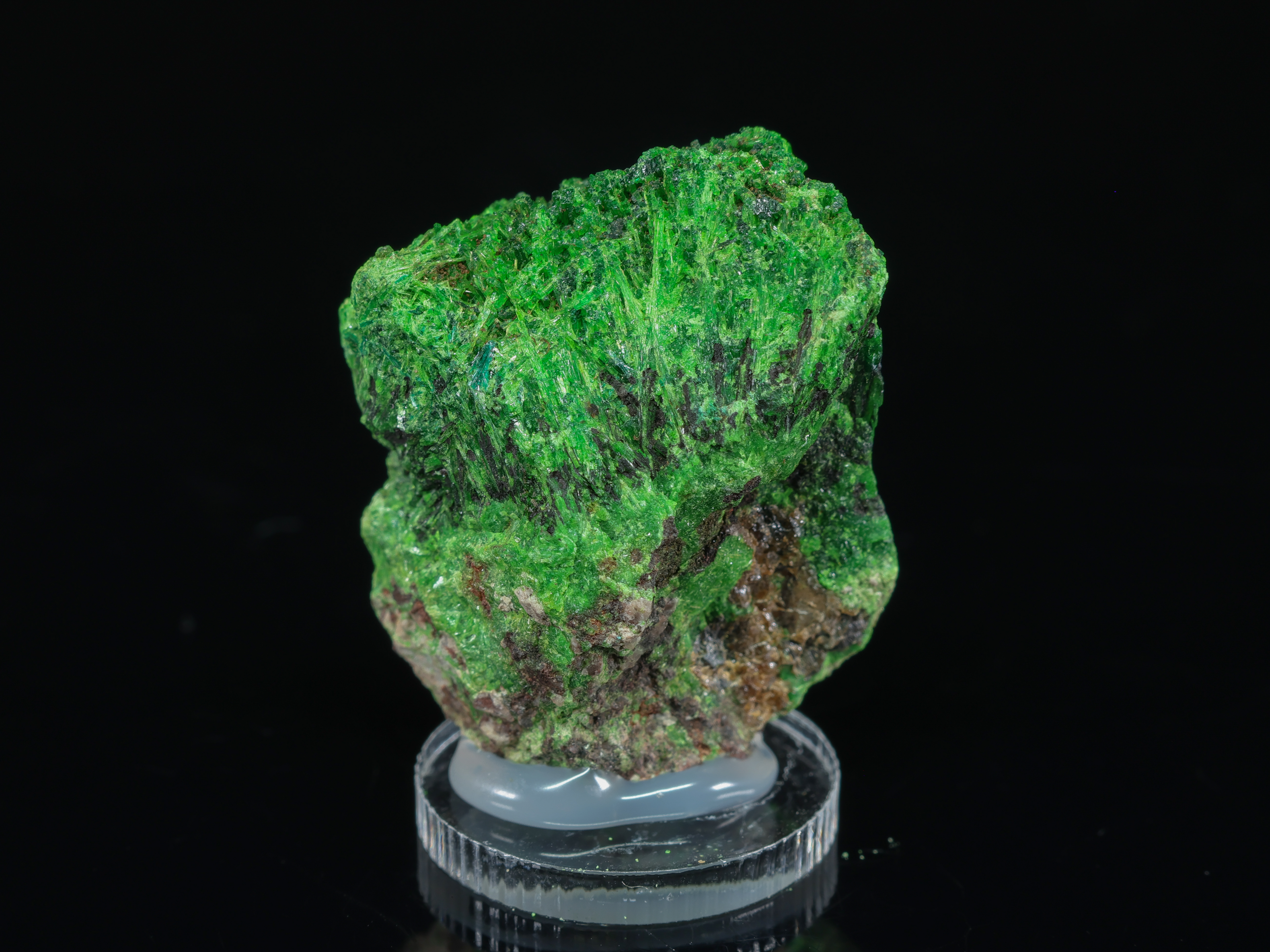
An exceptional, extremely vivid miniature of cuprosklodowskite originating from the legendary Musonoi mine in Congo - absolutely the best and most sought-after location for this mineral in the world. The mineral has formed here in the form of dense, intertwined aggregates of acicular and fibrous crystals. Note: Cuprosklodowskite is a uranium-bearing (radioactive) mineral and requires appropriate, conscious storage. Main Features: exceptionally vivid, neon green color; dense, acicular/fibrous crystal habit; historical, closed location (Musonoi); rare uranium mineral. Condition: Very Good.
Price: 89 EUR (389 PLN)
Availability: In stock
Location: Musonoi, Kolwezi, Mutshatscha, Lualaba, Congo
Size: 31 x 20 x 24 mm
Weight: 16.8 g
Chemical formula: Cu₅(SiO₃)₄(OH)₂
Crystal system: monoclinic
Mohs hardness: 2–2,5
Mineral group: Sklodowskite Group
Rarity: Very Rare
Characteristics Cuprosklodowskite is a rare secondary mineral of uranium, copper, and silicon. It most often occurs as small, acicular or fibrous crystals, frequently forming radial or spherical aggregates. The mineral's color is usually intensely greenish-yellow, lime-yellow, or emerald-green, making it easily recognizable. Crystals are typically very small, rarely exceeding a few millimeters in length. This mineral often forms coatings and incrustations on other uranium minerals. Physical Properties Cuprosklodowskite is characterized by a Mohs hardness of 4-5. It has a vitreous to silky luster. It is transparent to translucent. The mineral's density is approximately 3.7-3.8 g/cm³. Cleavage is perfect in one direction, which is typical for minerals with a layered structure. The fracture is uneven. Colors and Varieties The typical color of cuprosklodowskite is greenish-yellow, lime-yellow, or emerald-green. Shades may vary depending on impurities and the degree of hydration, but they always remain within the yellow-green spectrum. There are no known commercial or color varieties that are separately named. History and Name Cuprosklodowskite was described in 1933 by J.F. Vaes. The mineral's name comes from its chemical composition, indicating the presence of copper (cuprum) and from sklodowskite, a mineral with a similar structure, named in honor of Marie Skłodowska-Curie. It was discovered in the Shinkolobwe mine in the Democratic Republic of Congo. Uses Cuprosklodowskite has no industrial applications due to its rarity and radioactivity. It is exclusively a collector's mineral, valued for its intense color and rarity.
Identification Cuprosklodowskite can be identified by its characteristic greenish-yellow color, acicular or fibrous crystal habit, and its radial or spherical aggregates. This mineral is radioactive, which can be confirmed with a Geiger counter. It typically occurs in the oxidation zones of uranium deposits. Distinguishing from Similar Minerals Cuprosklodowskite can be confused with sklodowskite, which has a similar color and habit but does not contain copper. Distinguishing these two minerals requires chemical analysis. Other uranium minerals, such as autunite or torbernite, usually have more intense green colors and different crystal morphologies. Crystal Forms Cuprosklodowskite most often forms elongated, acicular or fibrous crystals. They frequently occur as radial, spherical, or stellate aggregates. Crystals are usually very fine, often forming coatings or incrustations on the surface of other minerals.
Genesis Cuprosklodowskite is a secondary mineral, forming in the oxidation zones of uranium deposits. It forms as a result of the weathering of primary uranium minerals, such as uraninite, in the presence of copper and silicon. This process occurs under hydrothermal conditions, where solutions rich in uranium, copper, and silicon react with each other. Mineral Associations Cuprosklodowskite often co-occurs with other uranium minerals, such as sklodowskite, uraninite, torbernite, autunite, as well as with malachite, chrysocolla, and other secondary copper minerals. It can also occur with quartz and clay minerals. Localities The most important localities for cuprosklodowskite are in the Democratic Republic of Congo, especially in the Shinkolobwe mine, where it was discovered. Other known occurrences include Jáchymov in the Czech Republic, as well as isolated occurrences in the United States (e.g., Arizona) and Australia.
Quality Criteria The most prized specimens of cuprosklodowskite are characterized by an intense, uniform greenish-yellow color, well-formed, acicular crystals forming aesthetic aggregates. The size and density of these aggregates also influence the value of the specimen. Purity and lack of mechanical damage are crucial. Popular Localities The most sought-after specimens come from the Democratic Republic of Congo, especially from the historic Shinkolobwe mine, which is the classic locality for this mineral. Specimens from Jáchymov in the Czech Republic are also valued, though less common.
See mineralogical reference for Cuprosklodowskite in the Knowledge Base →