SKU: P_26-3_11
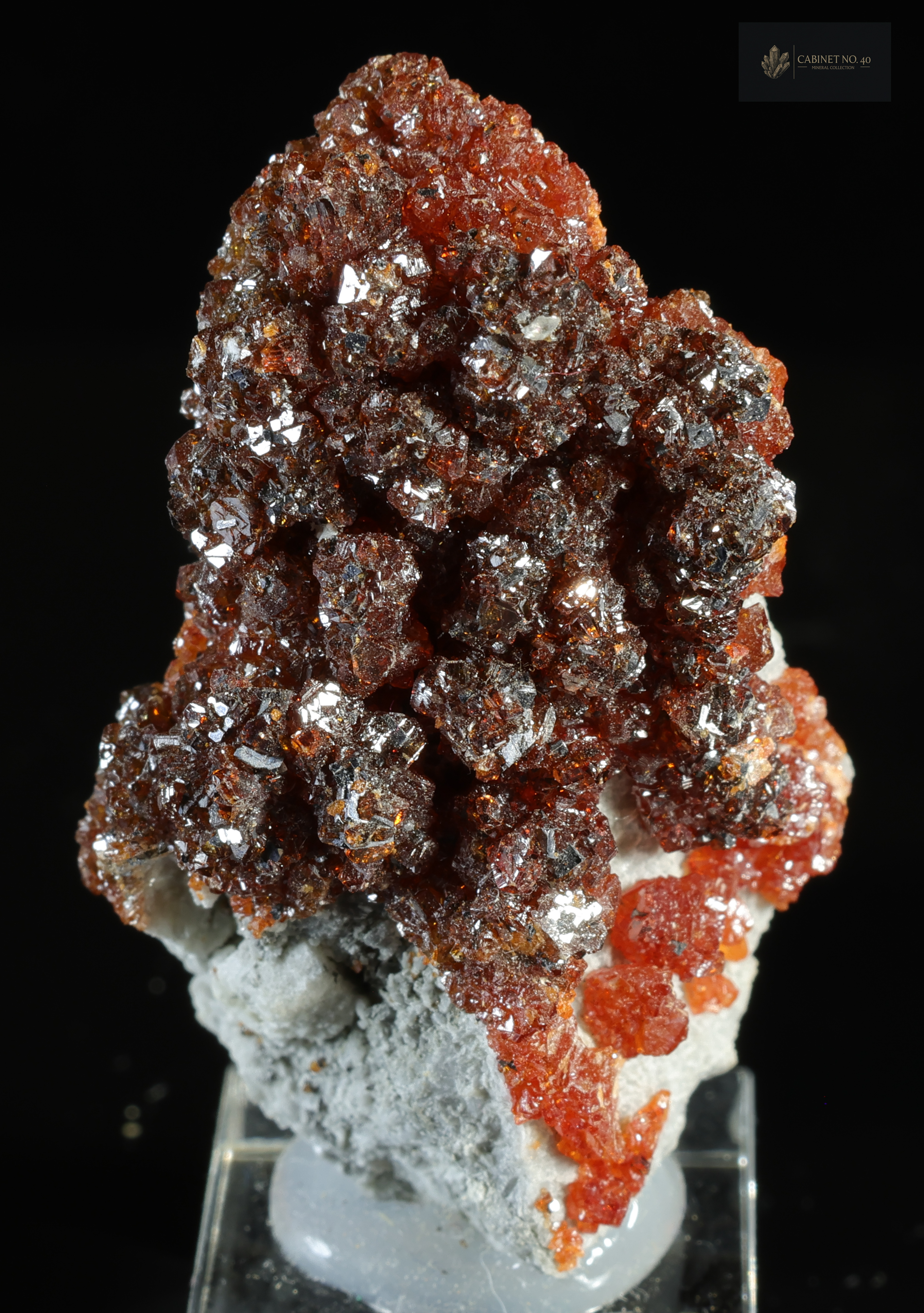
A specimen of sphalerite in the form of a compact, shiny cluster of small crystals with an intense dark red to brownish-red color. The crystals are densely packed, well-formed, with a distinct luster on the faces and edges. The specimen is glued to a base; we can detach it upon request.
Price: 39 EUR (169 PLN)
Availability: In stock
Location: Huxu Au deposit, Dongxiang County, Fuzhou, Jiangxi, China
Size: 25 x 17 x 40 mm
Weight: 200 g
Chemical formula: ZnS
Mohs hardness: 3.8
Characteristics Sphalerite is a sulfide mineral, constituting the main ore of zinc. Typical sphalerite specimens occur as massive aggregates or well-formed crystals. Crystals often form twins, and their surfaces can be uneven or striated. This mineral is distinguished by a characteristic, often resinous luster, which can transition to adamantine in transparent varieties. Physical Properties Sphalerite is characterized by a Mohs hardness of 3.5-4, making it a relatively soft mineral. It possesses perfect cleavage in three directions, meaning it readily breaks into fragments with smooth surfaces. The density of sphalerite is approximately 3.9 g/cm³. It is transparent to translucent, and its streak ranges from pale yellow to brown. Colors and Varieties The color of sphalerite is highly variable. Most commonly, it occurs in shades from light brown to dark brown, and even black. Red, reddish-brown, colorless, light blue, or green specimens are rarer. Dark varieties of sphalerite, rich in iron, are sometimes called marmatite. Varieties with an intense red color, often transparent, are known as ruby sphalerite. History and Name The name "sphalerite" comes from the Greek word "sphaleros," meaning "deceptive" or "treacherous," which refers to the difficulty in identifying the mineral due to its color variability and resemblance to other minerals. The mineral was described in 1847. Uses Sphalerite is the most important ore of zinc, a metal used in many industries, including steel galvanization, alloy production (e.g., brass), and batteries. Transparent, well-formed sphalerite crystals, especially those with intense colors, are valued by mineral collectors.
Identification Sphalerite can be identified by its characteristic, often resinous luster, which can be adamantine in transparent varieties. Its Mohs hardness (3.5-4) is relatively low, allowing it to be scratched by a steel tool. An important diagnostic feature is its perfect cleavage, which causes the mineral to break into fragments with smooth, flat surfaces. The streak color, from pale yellow to brown, also aids in identification. Distinguishing from Similar Minerals Sphalerite is sometimes confused with galena, but galena has a metallic luster, significantly higher density, and a darker, lead-gray streak. Dark varieties of sphalerite may resemble magnetite, but magnetite is strongly magnetic and has a black streak. The variable color of sphalerite can also lead to confusion with other minerals, so checking hardness, cleavage, and streak color is crucial. Crystal Forms Sphalerite crystallizes in the isometric system, most often forming crystals in the shape of tetrahedra, rhombic dodecahedra, or combinations thereof. Twinning is common, giving crystals a characteristic appearance. Sphalerite can also form granular aggregates, massive forms, reniform, or botryoidal habits.
Genesis Sphalerite is a hydrothermal mineral, forming over a wide range of temperatures, primarily in ore veins. It also occurs in sedimentary, metasomatic (skarn), and volcanic rocks. Its formation is associated with the presence of hydrothermal solutions rich in zinc and and sulfur, which react with the surrounding rocks. Mineral Associations Sphalerite often co-occurs with other ore minerals, such as galena (lead sulfide), chalcopyrite (copper iron sulfide), and pyrite (iron sulfide). It is also frequently accompanied by gangue minerals such as quartz, calcite, dolomite, and fluorite. Localities Sphalerite is a common mineral and occurs in many places around the world. Important localities include: Broken Hill in Australia, Picos de Europa in Spain, the Tri-State district in the USA (Missouri, Kansas, Oklahoma), mines in Mexico (e.g., Naica), as well as numerous deposits in China and Peru. In Poland, sphalerite occurs in zinc-lead deposits in Upper Silesia.
Quality Criteria The most valued by collectors are well-formed, transparent sphalerite crystals with intense colors, especially red (ruby sphalerite) or green. The purity of the specimen, absence of mechanical damage, and aesthetic arrangement of crystals on the matrix are also important. Large crystal sizes and rare crystallographic forms also increase collectible value. Popular Localities Specimens of sphalerite from Picos de Europa in Spain, known for large, transparent, reddish-brown crystals, are particularly sought after. Specimens from Mexican mines, often occurring in association with other minerals, are also valued. Specimens from China and Peru also provide high-quality collectible material.
See mineralogical reference for Sphalerite in the Knowledge Base →