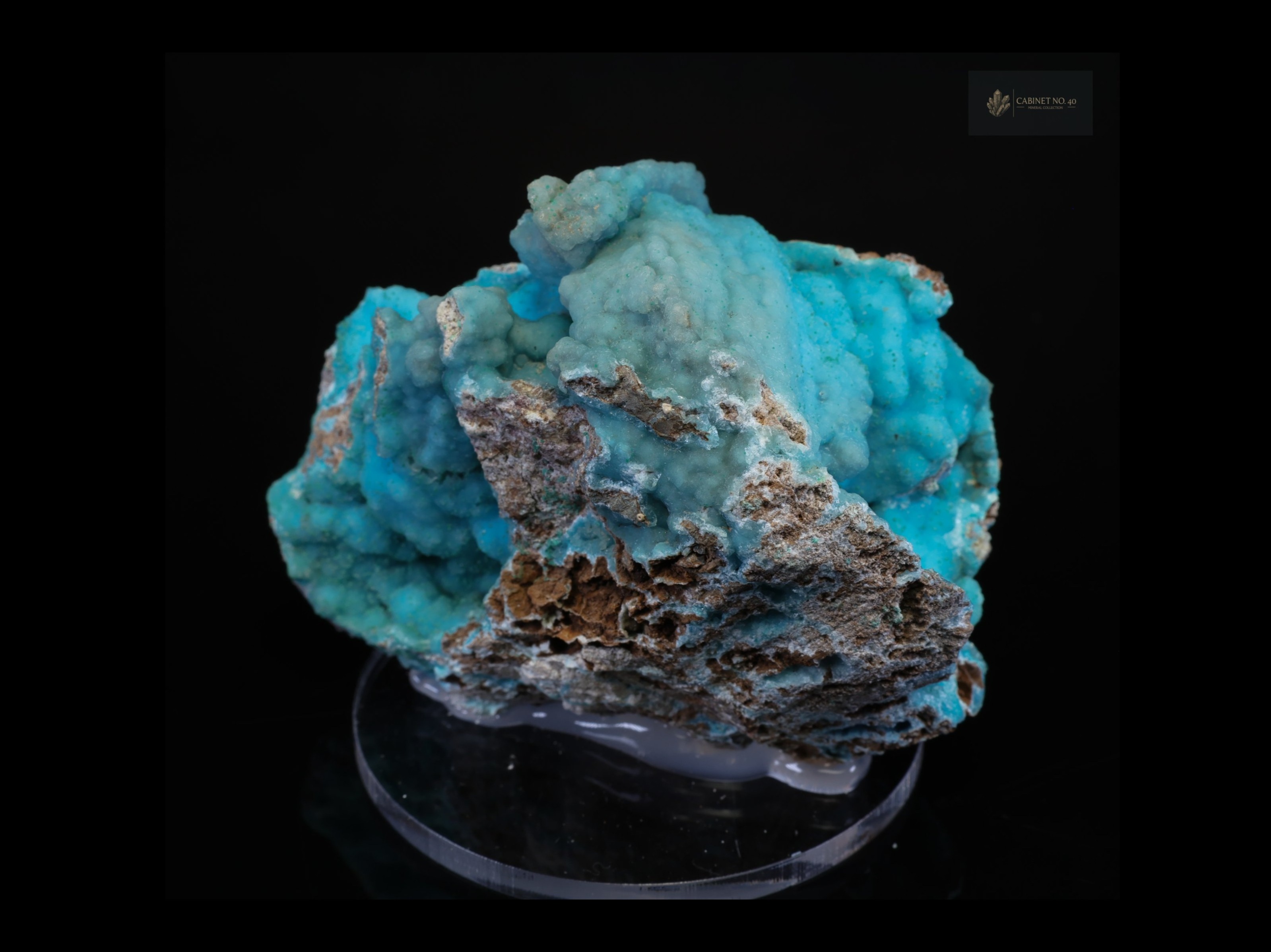
Turquoise Hemimorphite from Mindouli in the Republic of the Congo

SKU: B_36_0043

Specimen of hemimorphite in cabinet format. The mineral exhibits a characteristic botryoidal habit, with colors ranging from light, almost pastel shades to an intense, 'electric' hue. The crystallization lines a natural cavern in a brown matrix. Main Features: Intense blue color; botryoidal habit; classic locality; distinct contrast with the matrix. Condition: Fair / Good minus. Numerous signs of mechanical contact are visible.
Turquoise Hemimorphite from Mindouli in the Republic of the Congo

Price: 27 EUR (119 PLN)

Availability: In stock

Location: Mindouli District, Pool Department, Republic of the Congo

Size: 64 x 31 x 44 mm

Weight: 86.5 g

Chemical formula: Zn₄Si₂O₇(OH)₂·H₂O

Mohs hardness: 4.5–5.0

Characteristics Hemimorphite is a hydrated zinc silicate, often forming crystals with a distinct hemimorphic structure, meaning their ends are dissimilarly developed. These crystals are typically elongated, tabular, or prismatic, often occurring in radial, reniform, spherical, or stalactitic aggregates. Fine striations are often visible on the crystal surfaces. This mineral can also form massive, compact aggregates. Physical Properties Hemimorphite has a Mohs hardness of 4.5-5. It exhibits perfect cleavage in one direction and poor cleavage in two others. Its luster is vitreous, sometimes pearly on cleavage surfaces. It is transparent to translucent, and its density is approximately 3.475 g/cm³. Colors and Varieties This mineral occurs in many colors, most commonly colorless, white, light blue, light green, gray, or brown. Blue coloration is often associated with the presence of copper impurities. No specific commercial varieties are distinguished, but specimens with intense blue coloration are particularly sought after. History and Name The name "hemimorphite" comes from the Greek words "hemi" (half) and "morphe" (form), referring to the characteristic hemimorphic crystal structure where the ends of the crystals are dissimilarly developed. The mineral was described in 1853 when it was identified as a distinct species from calamine (an old name for a mixture of hemimorphite and smithsonite). Uses Hemimorphite is primarily a collector's mineral, valued for its aesthetic forms and colors. Due to its zinc content, it can also be locally used as an ore of this metal, although its industrial importance is less than that of other zinc minerals.

Diagnostic features

Identification Hemimorphite can be identified by its characteristic hemimorphic crystal structure, especially in well-formed specimens. It often occurs in radial, reniform, or stalactitic aggregates. The streak of the mineral is white, and its hardness is 4.5-5 on the Mohs scale. Distinguishing from Similar Minerals Hemimorphite is sometimes confused with smithsonite, another zinc mineral. However, smithsonite has a harder surface (hardness 4-4.5) and reacts with hydrochloric acid, whereas hemimorphite does not react or reacts very weakly. It also differs from calcite, which is much softer and reacts strongly with acids. Sometimes it can also be confused with prehnite, but prehnite is usually greener and has a different hardness. Crystal Forms Typical crystal forms of hemimorphite include elongated, tabular, or prismatic crystals, often with asymmetrical terminations. It frequently forms radial, reniform, spherical, stalactitic, or botryoidal aggregates. Aggregates can be compact and massive.

Formation environment

Genesis Hemimorphite is a secondary mineral, forming in the oxidation zones of zinc deposits, where it develops as a result of the weathering of primary zinc minerals such as sphalerite. It forms at low temperatures, often in caverns and fissures of carbonate rocks, where solutions rich in zinc and silica react with each other. Mineral Associations It often co-occurs with other secondary minerals from the oxidation zone, such as smithsonite, cerussite, anglesite, galena, sphalerite, calcite, limonite, and copper minerals like azurite and malachite. Localities Known localities for hemimorphite are found in many places around the world. Important deposits include Miedzianka (Poland), Acapulco in Guerrero (Mexico), Mapimí in Durango (Mexico), Italy (Sardinia), Belgium (Moresnet), Namibia (Tsumeb), United States (New Jersey, Montana, Arizona), Australia (Tasmania), and China (Guangxi).

For the collector

Quality Criteria The most prized hemimorphite specimens are those with intense, uniform coloration (especially blue), well-formed, large, and undamaged crystals. Radial, reniform, or stalactitic aggregates with aesthetic shapes and no damage are also highly sought after. Transparency and luster are important for the specimen's value. Popular Localities Particularly valued specimens of blue hemimorphite come from the Ojuela Mine in Mapimí, Mexico, and from China. Specimens from Miedzianka in Poland are also known and appreciated by collectors.

See mineralogical reference for Hemimorphite in the Knowledge Base →

View product →