Turquoise-blue aurichalcite on matrix from Turkey

SKU: S_00124

A very aesthetic and contrasting specimen of the rare zinc and copper carbonate - aurichalcite. Fine, needle-like crystals of aurichalcite have formed in the fissures and on the surfaces of the highly iron-rich matrix, gathered into characteristic, radiating rosettes. Main Features: intensely blue color; radiating, needle-like rosettes; strong color contrast. Condition: Good. Delicate, needle-like crystals of aurichalcite are scattered over a large surface of the rock. Many of them, especially those hidden in deeper recesses, have retained excellent sharpness and structure.
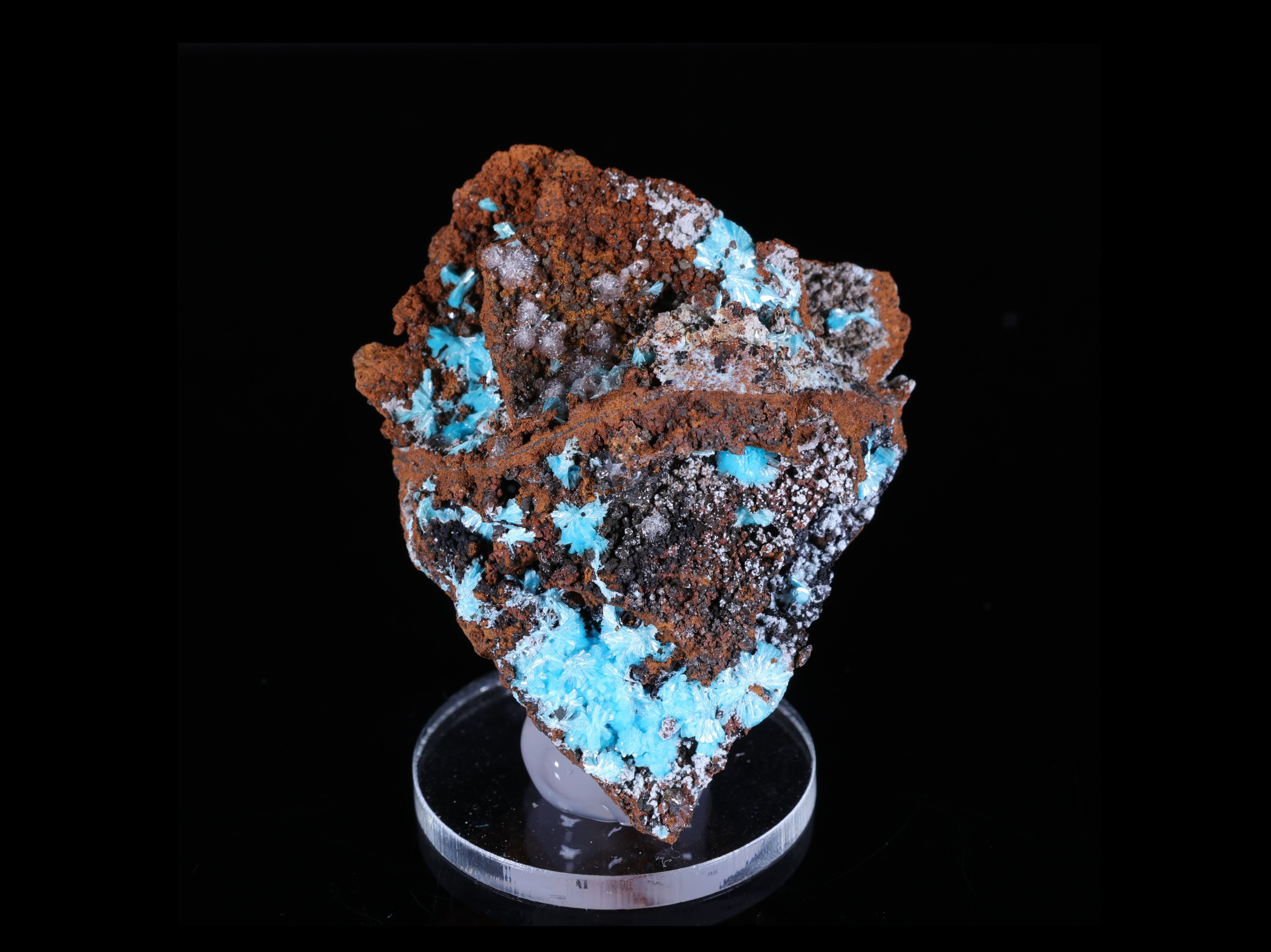
Turquoise-blue aurichalcite on matrix from Turkey

Price: 18 EUR (79 PLN)

Availability: In stock

Location: Uludağ Mine, Mount Uludağ, Bursa, Bursa Province, Turkey

Size: 35 x 40 x 20 mm

Weight: 25.7 g

Chemical formula: (Zn,Cu)₅(CO₃)₂(OH)₆

Crystal system: Monoclinic

Mohs hardness: 1-2

Characteristics Aurichalcite is a hydrated zinc and copper carbonate, usually occurring as small, acicular or platy crystals. It forms radial or fibrous aggregates, often as coatings and crusts. Its color ranges from light blue, through sky blue, to greenish-blue, making it attractive to collectors. Physical Properties This mineral is characterized by a low Mohs hardness of 1-2. It has a pearly luster, and its streak is light blue. It is transparent to translucent. The density of aurichalcite is approximately 3.96 g/cm³. Colors and Varieties Aurichalcite occurs in shades of blue and green. The most common specimens are light blue, sky blue, or greenish-blue. In transmitted light, it can be colorless or take on light shades of blue and green. No specific commercial varieties are distinguished. History and Name Aurichalcite was described in 1839. The name of the mineral comes from the Greek words "oreikhalkos," meaning "mountain brass," which refers to its chemical composition, containing zinc and copper, and its color resembling tarnished brass. Uses Aurichalcite has no industrial applications due to its rarity and delicacy. It is a prized collector's mineral, sought after for its aesthetics and rarity.

Diagnostic features

Identification Aurichalcite can be identified by its characteristic light blue or greenish-blue color, low hardness (can be scratched with a fingernail), and pearly luster. It often occurs as small, acicular or platy crystals forming radial aggregates. Distinguishing from Similar Minerals Aurichalcite can be confused with other secondary copper and zinc minerals, such as azurite, malachite, or hemimorphite. It differs from azurite and malachite by its lower hardness and color hue (azurite is intensely blue, malachite is green). Hemimorphite usually has higher hardness and a different crystal habit. Crystal Forms Aurichalcite crystallizes in the monoclinic system, typically forming elongated, acicular or platy crystals. They often occur as radial, fibrous, or spherical aggregates, as well as coatings and crusts on other minerals.

Formation environment

Genesis Aurichalcite is a secondary mineral, forming in the oxidation zones of zinc and copper deposits. It forms as a result of the weathering of primary minerals of these metals in the presence of carbonates. Mineral Associations It co-occurs with other minerals of the oxidation zone, such as azurite, malachite, hemimorphite, smithsonite, calcite, limonite, and other copper and zinc minerals. Localities Known localities of aurichalcite include Tsumeb in Namibia, Chessy in France, Laurion in Greece, Mapimí in Mexico, and some locations in the United States (e.g., Arizona, Utah).

For the collector

Quality Criteria The most prized aurichalcite specimens are those with intense, uniform color (light blue or sky blue), well-formed, undamaged crystals, and aesthetic aggregates. The size of the specimen and the absence of impurities also affect its collector's value. Popular Localities Specimens from Tsumeb in Namibia are particularly sought after, known for their exceptional quality and intensity of colors. Other valued localities include Chessy in France and Mapimí in Mexico.

See mineralogical reference for Aurichalcite in the Knowledge Base →

View product →