Turquoise Amazonite from Ten-Percenter Mine

SKU: P_26-2_27

This amazonite specimen from the Ten-Percenter Mine in Colorado, USA, exhibits an intense, turquoise blue hue, which in places transitions into lighter, almost white tones. It consists of several conjoined, massive crystals, forming a blocky shape with distinct, flat surfaces. Main Features: intense turquoise color with transitions to white; distinct surface texture; blocky shape with flat surfaces. Condition: Very good, with no visible mechanical damage.
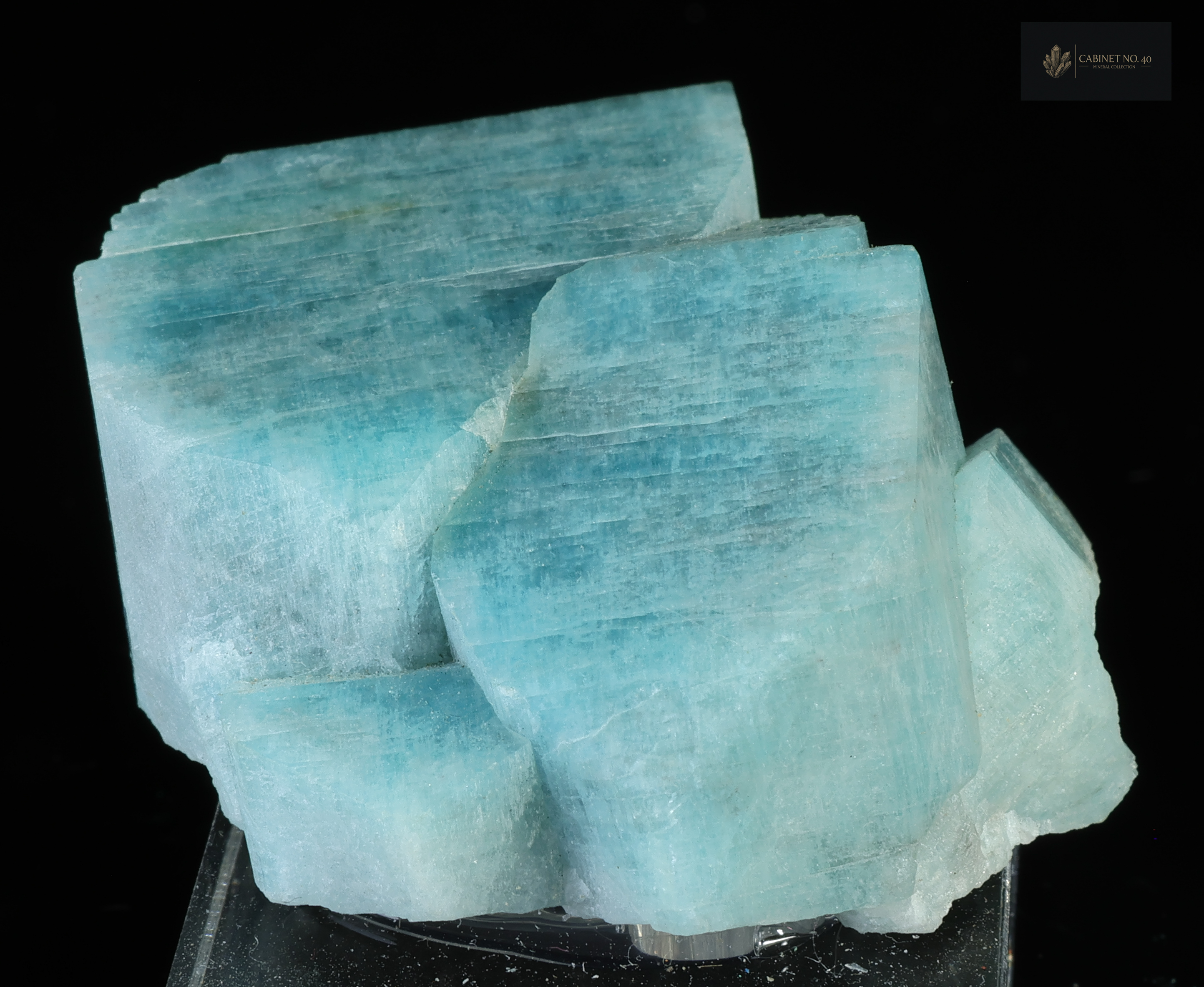
Turquoise Amazonite from Ten-Percenter Mine

Price: 80 EUR (349 PLN)

Availability: In stock

Location: Ten-Percenter Mine, Teller County, Colorado, USA

Size: 37 x 32 x 21 mm

Weight: 200 g

Chemical formula: KAlSi₃O₈

Mohs hardness: 6.0–6.5

Rarity: Common

Characteristics Amazonite is a variety of microcline, a potassium feldspar, characterized by an intense green or blue-green color. It often forms massive aggregates, although it can also be found as well-formed crystals. Its color can be uneven, with lighter or darker bands, which gives it an attractive appearance. Physical Properties The hardness of amazonite on the Mohs scale is 6 to 6.5. The luster is vitreous, often with a pearly sheen on cleavage surfaces. The mineral is transparent to translucent. Density ranges from 2.56-2.58 g/cm³. Colors and Varieties Amazonite occurs in shades of green, from light green to intense turquoise or blue-green. Its color is due to trace amounts of lead in the crystal structure. There are no specific commercial varieties distinguished beyond the general name amazonite. History and Name The name "amazonite" comes from the Amazon River, although this mineral is not commonly found there. The name was probably given by European traders who confused it with other green stones from the Amazon region. The mineral was known and used in ancient Egypt, where it was used to make jewelry and amulets. Uses Amazonite is primarily used as an ornamental and gemstone. It is used to make cabochons, beads, small sculptures, and decorative elements. Due to its color and relatively good hardness, it is popular in the jewelry industry.

Diagnostic features

Identification Amazonite is primarily recognizable by its characteristic green or blue-green color. It often exhibits delicate, white or gray veins that form patterns on the surface. Its vitreous luster and hardness of 6-6.5 on the Mohs scale are also helpful in identification. Distinguishing from Similar Minerals Amazonite is sometimes confused with nephrite, jadeite, chrysoprase, or turquoise. It differs from nephrite and jadeite by its hardness (nephrite and jadeite are harder) and cleavage. Chrysoprase has a more apple-green color and is usually more uniform. Turquoise usually has a more matte luster and a different structure. Crystal Forms Amazonite most often occurs as massive aggregates or thick tabular crystals. Crystals are usually prismatic, often with visible twinning. Aggregates can be granular or lamellar.

Formation environment

Genesis Amazonite forms in granitic pegmatites, which are coarse-grained igneous rocks. It forms in the final stages of magma crystallization, in the presence of hydrothermal solutions rich in potassium, aluminum, and silicon. It also occurs in some hydrothermal veins and metamorphic rocks. Mineral Associations Amazonite often co-occurs with other pegmatitic minerals, such as quartz (smoky, milky), albite, orthoclase, muscovite, biotite, tourmalines (schorl, elbaite), garnets, and topazes. Localities Known amazonite deposits are found in Russia (Ural region, Kola Peninsula), USA (Colorado, Virginia), Brazil (Minas Gerais), Canada, India, Madagascar, Namibia, and Ethiopia.

For the collector

Quality Criteria The most prized amazonite specimens are characterized by an intense, uniform green or blue-green color. Transparency is also important – the more transparent the specimen, the higher its value. Large, well-formed crystals are particularly sought after by collectors. The absence of cracks and inclusions that reduce aesthetics also affects quality. Popular Localities Among the most valued amazonite localities are deposits in Russia (Ural region), where large, intensely colored crystals are found. Specimens from Colorado in the USA are also highly prized for their color and crystal form.

See mineralogical reference for Amazonite in the Knowledge Base →

View product →