SKU: B_20_0001
Very aesthetic, sculptural specimen of scapolite crystals. The crystals have well-preserved terminations on the main pillars. In the middle and upper parts of the specimen, scapolite is covered with small, blocky, translucent crystals, probably of calcite. Additionally, it exhibits beautiful fluorescence and delicate phosphorescence under UV light. Main Features: elongated scapolite crystals; small, blocky accessory crystals; distinct reaction under UV light. Condition: Very good - the terminations of the main crystals are mostly intact.
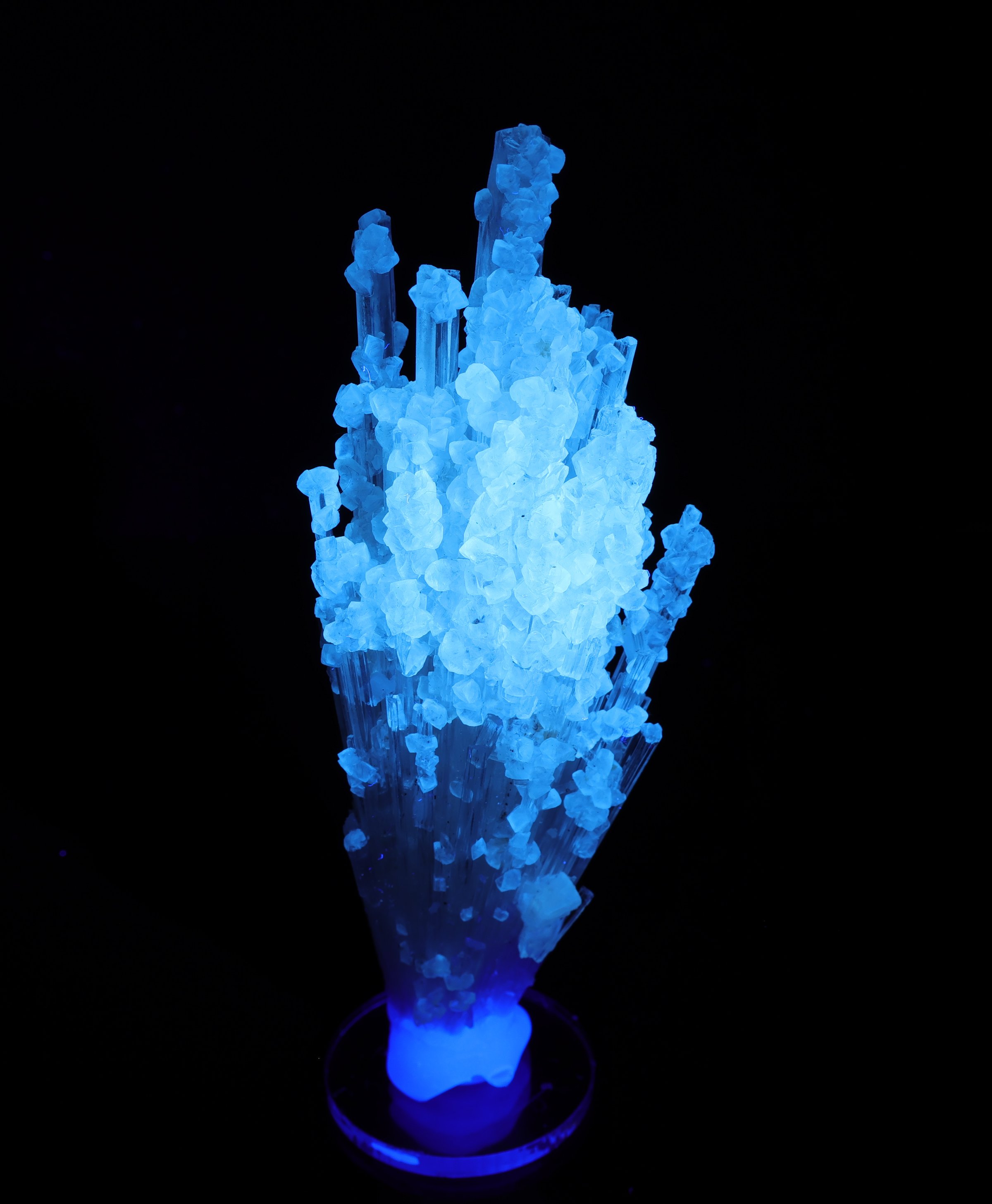
Price: 46 EUR (199 PLN)
Availability: In stock
Location: -, India
Size: 110 x 34 x 33 mm
Weight: 72.2 g
Chemical formula: Ca(Si₃Al₂)O₁₀ · 3H₂O
Mohs hardness: 5-5.5
Characteristics Scolecite is a mineral from the zeolite group, often forming radiating, fibrous, or acicular aggregates. Crystals are typically elongated, prismatic, with a rhombic or acicular habit. Aggregates can be radiating, spherical, or reniform. The crystal surface may be striated parallel to the elongation. This mineral is brittle and relatively soft. Physical Properties Scolecite has a Mohs hardness of 5-5.5. It exhibits perfect cleavage. The luster is vitreous, often silky on fracture surfaces. Scolecite is transparent to translucent. The specific gravity is approximately 2.25 g/cm³. Colors and Varieties Scolecite most commonly occurs in white or colorless. It can also take on pink, salmon, red, and more rarely greenish hues. The coloration often results from the presence of impurities of other minerals or inclusions. History and Name The name "scolecite" comes from the Greek word "skolex", meaning worm, which refers to the mineral's tendency to curl up when exposed to a blowpipe flame. The mineral was described in 1813 by Adolf Ferdinand Gehlen and Johann Nepomuk von Fuchs.
Identification Scolecite can be identified by its characteristic crystal habit, often forming radiating or fibrous aggregates. Vitreous to silky luster and a white streak are also diagnostic features. When exposed to a blowpipe flame, the mineral melts, forming bubbles and curling up, which is a unique characteristic. Distinguishing from Similar Minerals Scolecite is sometimes confused with other zeolites, such as natrolite or mesolite. It is primarily distinguished from natrolite by its reaction to a blowpipe flame (natrolite does not curl). Mesolite has a similar appearance but differs in chemical composition and optical properties. Precise differentiation often requires laboratory analysis. Crystal Forms Scolecite crystals are typically elongated, prismatic, or acicular. They often form radiating aggregates, resembling sheaves or spheres. Fibrous, reniform aggregates or simple rhombic crystals are also found.
Genesis Scolecite is a secondary mineral, primarily forming in gas vesicles of volcanic rocks such as basalts, andesites, and rhyolites. It crystallizes from low-temperature hydrothermal solutions rich in calcium, silicon, and aluminum. It also occurs in fissures and veins in other rock types where metasomatic mineral exchange takes place. Mineral Associations Scolecite often co-occurs with other zeolites, such as stilbite, heulandite, laumontite, natrolite, and mesolite. It can also be found in association with calcite, apophyllite, chabazite, and prehnite. Localities Known localities for scolecite include India (especially in the Deccan region, where beautiful, large specimens are found), Iceland, the United States (Oregon, Washington), Great Britain (Scotland), Germany, and Italy.
Quality Criteria The most prized scolecite specimens are those with well-formed, long, radiating crystals of intense color (if present) and high transparency. Large, aesthetic aggregates with a regular habit are particularly sought after. The integrity of the specimen, absence of mechanical damage, and cleanliness are also important. Popular Localities The most sought-after scolecite specimens come from India, especially from the Deccan region, where large, aesthetic aggregates of radiating crystals are found. Other valued localities include Iceland, due to its clear and well-formed crystals, and some places in the United States.
See mineralogical reference for Scolecite in the Knowledge Base →