SKU: B_27_0044
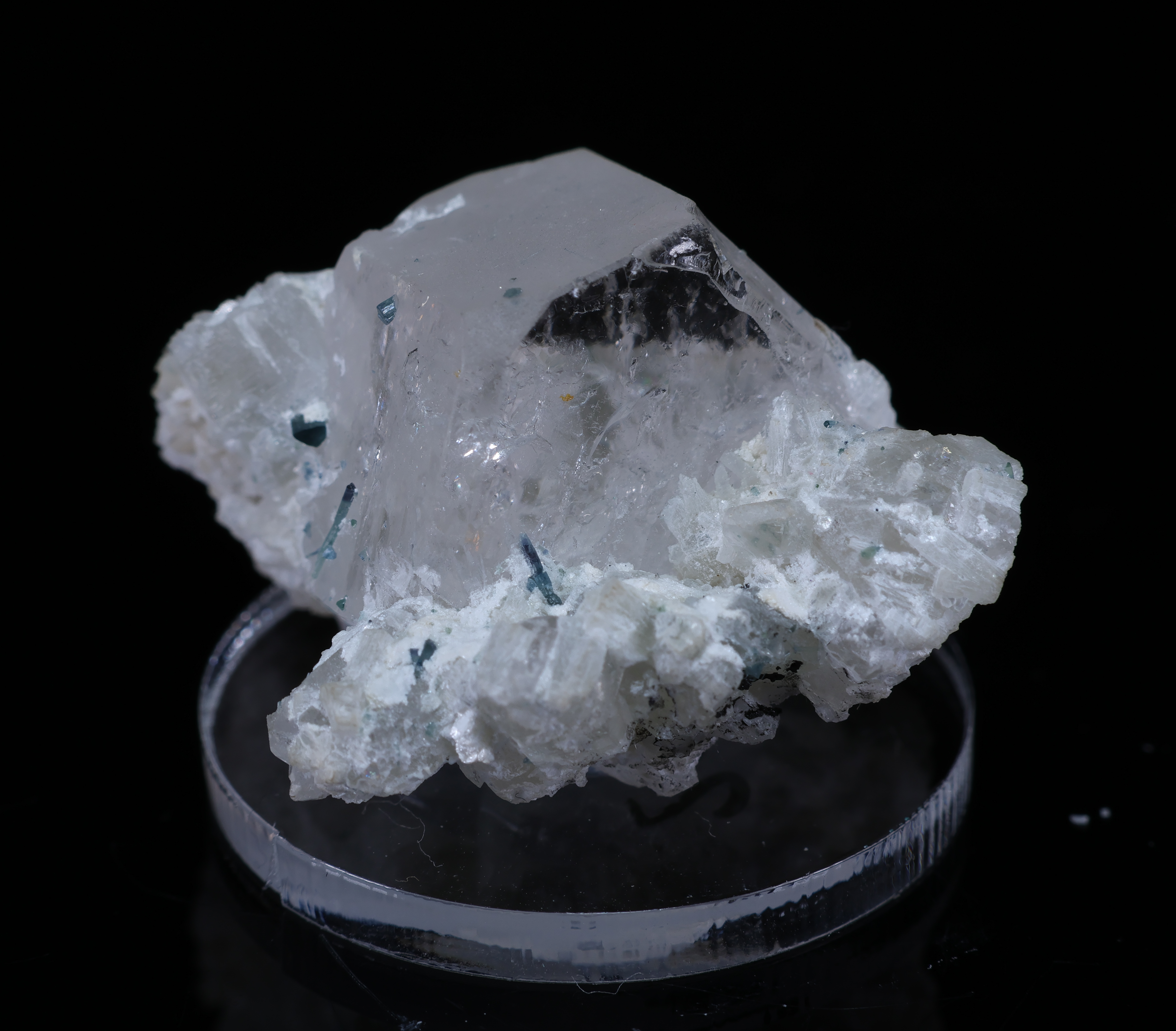
Specimen of goshenite (colorless variety of beryl). The main crystal is set on a light matrix. The piece stands out for its excellent transparency of the interior - insight into the pure structure is facilitated by the perfectly clear, longer side faces, while the shorter ones remain naturally frosted. An additional accent is provided by small, dark blue needles (most likely tourmaline), partially embedded in the outer layers of beryl. Main Features: high transparency; colorless beryl; light matrix. Condition: Very good - the crystal terminations are preserved in very good condition, with sharp and clear surfaces. There is a chip present on one edge.
Price: 50 EUR (219 PLN)
Availability: In stock
Location: Gilgit-Baltistan, Pakistan
Size: 30 x 35 x 21 mm
Weight: 16.5 g
Chemical formula: Be₃Al₂(Si₆O₁₈)
Mohs hardness: 7.5-8
Mineral group: Beryl Group
Characteristics Goshenite is a colorless variety of beryl, making it the chemically purest form of this mineral. Its name comes from its first discovery location – Goshen, Massachusetts, USA. Unlike other beryl varieties, such as emerald (colored by chromium and vanadium) or aquamarine (colored by iron), goshenite does not contain trace elements that would impart color. Typical specimens form well-developed, hexagonal crystals with flat terminations, often exhibiting excellent transparency and a strong, vitreous luster. Physical Properties Goshenite is characterized by significant hardness, ranging from 7.5-8 on the Mohs scale, making it a durable and scratch-resistant mineral. It has a vitreous luster and is usually transparent, less commonly translucent. Its density ranges from 2.6-2.8 g/cm³, which is typical for beryls. Colors and Varieties By definition, goshenite is colorless. The absence of color indicates the absence of impurities. Occasionally, due to natural irradiation, it may acquire a very pale yellowish, greenish, or bluish tint, but in trade and mineralogy, only completely colorless specimens are considered goshenite. History and Name The mineral's name, given in 1844, comes from the town of Goshen in Hampshire County, Massachusetts (USA), where its significant deposits were first identified. Due to its transparency and hardness, it was historically used to produce the first eyeglass lenses and magnifying glasses. Uses Currently, goshenite is primarily a collector's and jewelry stone. It is sometimes used as a less expensive diamond substitute, although its brilliance is lower. Clear and large crystals are sought after by mineral collectors and are also used in gemology for research and educational purposes.
Identification The key diagnostic features of goshenite are its hexagonal crystal shape, high hardness (scratches quartz), and complete lack of color. It has a vitreous luster and is usually fully transparent. Unlike topaz, it does not exhibit perfect cleavage. Distinguishing from Similar Minerals Goshenite is sometimes confused with several other colorless minerals: Rock crystal (quartz): Quartz is slightly softer (hardness 7), has a lower refractive index, and a different crystal form (trigonal), often terminated by pyramids. Topaz: Colorless topaz is harder (8), denser, and has perfect basal cleavage, which goshenite lacks. Danburite: It has similar hardness but crystallizes in the orthorhombic system and is denser. Phenakite: It is very similar in hardness and appearance but crystallizes in the trigonal system and is much rarer. Crystal Forms Goshenite most often forms elongated, prismatic hexagonal crystals, terminated by flat basal faces (pinacoids). It also occurs as granular aggregates or radiating clusters.
Genesis Goshenite primarily forms in granitic pegmatites, often in their miarolitic cavities, as one of the last products of residual magma crystallization. It can also occur in some metamorphic rocks, such as mica schists, and in hydrothermal veins. Mineral Associations This mineral often co-occurs with quartz (especially smoky quartz), feldspars (albite, orthoclase), muscovite, lepidolite, spodumene, various tourmalines (elbaite, schorl), as well as columbite and tantalite. Localities Historically important is Goshen, Massachusetts, USA. Currently, the best quality collector's and jewelry specimens come from pegmatites in Brazil (especially Minas Gerais state), Pakistan (Gilgit-Baltistan), Afghanistan, China, Namibia, and Russia (Urals). In Poland, trace amounts of beryl (without precise variety identification) have been found in the granite pegmatites of the Karkonosze Mountains and Strzegom.
Quality Criteria For collectors, the most important criteria are ideal transparency (so-called "water clarity"), absence of inclusions and fractures, and excellent crystal habit. Sharp, undamaged, fully terminated hexagonal prisms are most highly valued. Large, colorless, and clear goshenite crystals are rare and sought after. Specimens on a rock matrix, especially in association with other pegmatitic minerals (e.g., tourmaline, smoky quartz), command higher prices. Popular Localities The most prized specimens by collectors come from Brazil and Pakistan, from where large, vitreous, and perfectly formed crystals are obtained. Historical specimens from Goshen, USA, also have high value, as do those from some regions of Russia and Afghanistan.
See mineralogical reference for Goshenite in the Knowledge Base →