Transparent Amethyst with Delicate Purple Tips from Las Vigas

SKU: W_2_0023

An aesthetic cluster of several amethyst crystals with a slender, prismatic shape. The mineral is distinguished by its very high transparency and delicate purple color, which becomes darker at the very tips. Main Features: light purple hue; darker tips; high transparency; natural crystal group; a classic from Veracruz. Condition: Excellent. All visible crystal tips are sharp and intact. No signs of mechanical damage on the display surfaces.
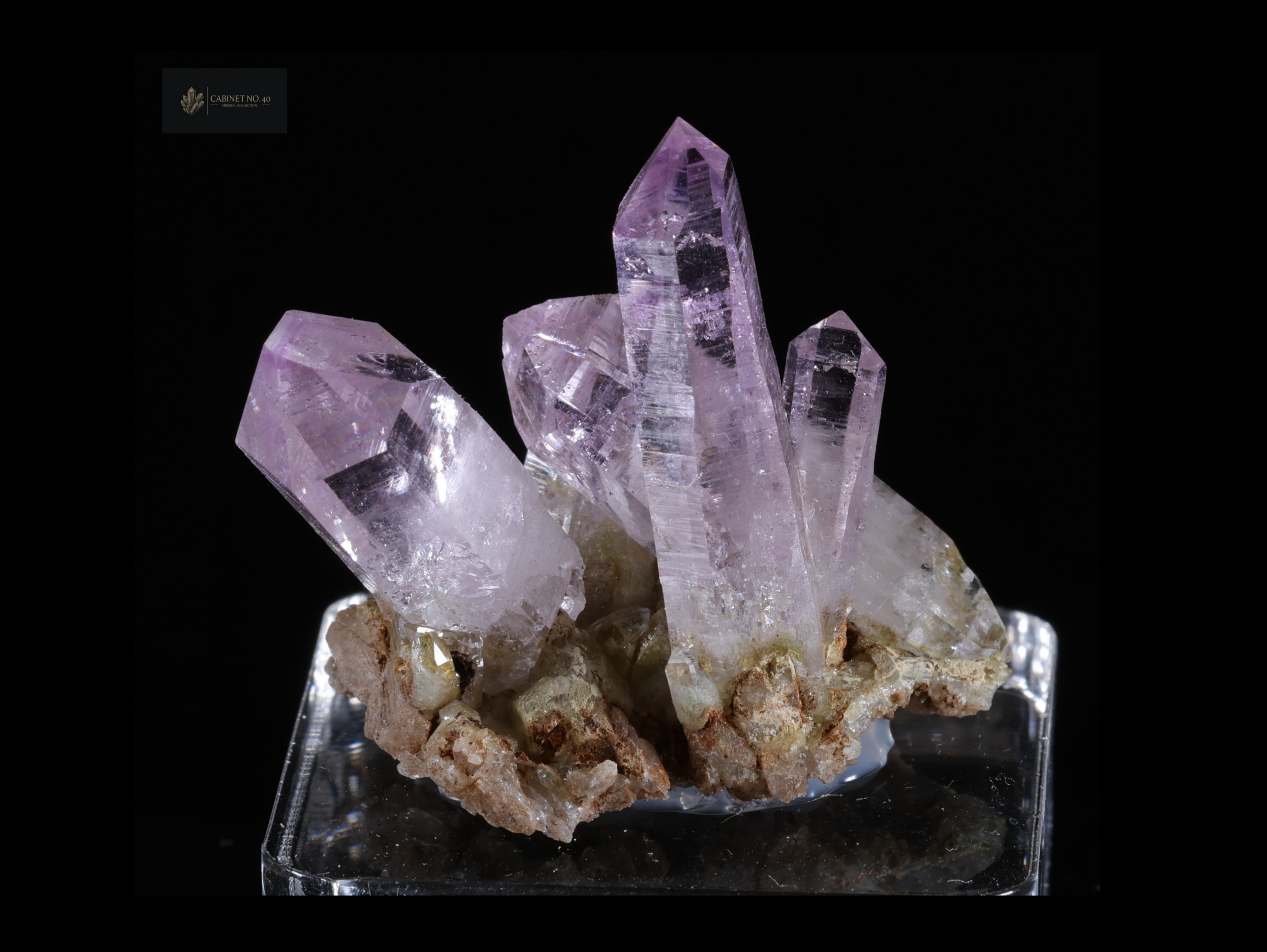
Transparent Amethyst with Delicate Purple Tips from Las Vigas

Price: 34 EUR (149 PLN)

Availability: In stock

Location: Las Vigas, Veracruz, Mexico

Size: 28 x 22 x 29 mm

Weight: 8 g

Chemical formula: SiO₂

Crystal system: Trigonal

Mohs hardness: 7.0

Characteristics Amethyst is a variety of quartz, a mineral from the silicate group. It is characterized by its violet color, which can range from a light, lilac hue to a deep, dark purple. This color is a result of the presence of iron impurities and natural ionizing radiation. Amethyst crystals typically form hexagonal prisms terminated by pyramids, often creating crystal druses or geodes. Physical Properties Amethyst exhibits a hardness of 7 on the Mohs scale, making it a relatively scratch-resistant mineral. It has a vitreous luster. It is transparent to translucent, and its density is approximately 2.65 g/cm³. It does not show cleavage, and its fracture is conchoidal. Colors and Varieties The primary color of amethyst is violet, but the intensity and shade can vary. Specimens with lavender, purple, and even reddish or brownish tints are found. Crystals with zonal coloring, where violet transitions into colorless quartz, also occur. The variety known as "cactus amethyst" or "spirit quartz" is characterized by numerous small crystals growing on the main crystal. History and Name The name "amethyst" comes from the Greek word "amethystos," meaning "not intoxicated" or "sober." Ancient Greeks believed that amethyst protected against alcoholic intoxication and wore it as an amulet. This mineral was known and valued in antiquity, used for making jewelry and ornamental objects. Mentions of amethyst appear in many cultures and historical texts. Uses The most important use of amethyst is in jewelry, where it is used to create rings, necklaces, earrings, and other ornaments. It is also a popular collector's stone, especially in the form of large geodes and crystal druses. In recent years, it has gained popularity as a decorative element in interiors.

Diagnostic features

Identification Amethyst can be identified by its characteristic violet color, a hardness of 7 on the Mohs scale, and vitreous luster. It often occurs as hexagonal crystals terminated by pyramids, forming geodes or crystal druses. Zonal coloring, which is typical for many specimens, is also a key feature. Distinguishing from Similar Minerals Amethyst can be confused with other violet minerals, such as fluorite or lepidolite. However, fluorite is much softer (hardness 4 on the Mohs scale) and exhibits perfect cleavage. Lepidolite has a pearly luster and a platy structure. Synthetic amethyst, although visually similar, lacks natural inclusions and color zoning. Crystal Forms Typical crystal forms of amethyst are hexagonal prisms terminated by pyramids. They often form aggregates such as geodes, crystal druses, as well as radial or granular clusters. Crystals can be short-prismatic or long-prismatic, depending on growth conditions.

Formation environment

Genesis Amethyst forms in low-temperature hydrothermal solutions, often in rock cavities such as geodes and fissures in volcanic and sedimentary rocks. It also forms in hydrothermal veins in igneous and metamorphic rocks. The violet color results from the incorporation of iron ions into the quartz structure and subsequent irradiation by natural ionizing radiation. Mineral Associations Amethyst often co-occurs with other siliceous minerals, such as smoky quartz, citrine, and chalcedony. It can also be found in association with calcite, barite, hematite, and various clay minerals. Localities The most important amethyst deposits are found in Brazil (Rio Grande do Sul, Bahia), Uruguay, Bolivia, Russia (Urals), Zambia, Canada, Mexico, South Korea, and the United States (Arizona, North Carolina).

For the collector

Quality Criteria The most prized amethyst specimens are characterized by an intense, uniform violet color, high transparency, and well-formed, undamaged crystals. Large geodes and crystal druses with deep color are particularly sought after. The aesthetic arrangement of crystals and the absence of visible inclusions that could lower the stone's value are also important. Popular Localities The most famous and valued amethyst specimens come from Brazil and Uruguay, where they occur as large geodes and crystal druses of intense color. Russian amethysts from the Urals are known for their deep, purple color. Specimens from Zambia, in turn, have a dark violet color with red reflections.

See mineralogical reference for Amethyst in the Knowledge Base →

View product →