SKU: P_26-3_2
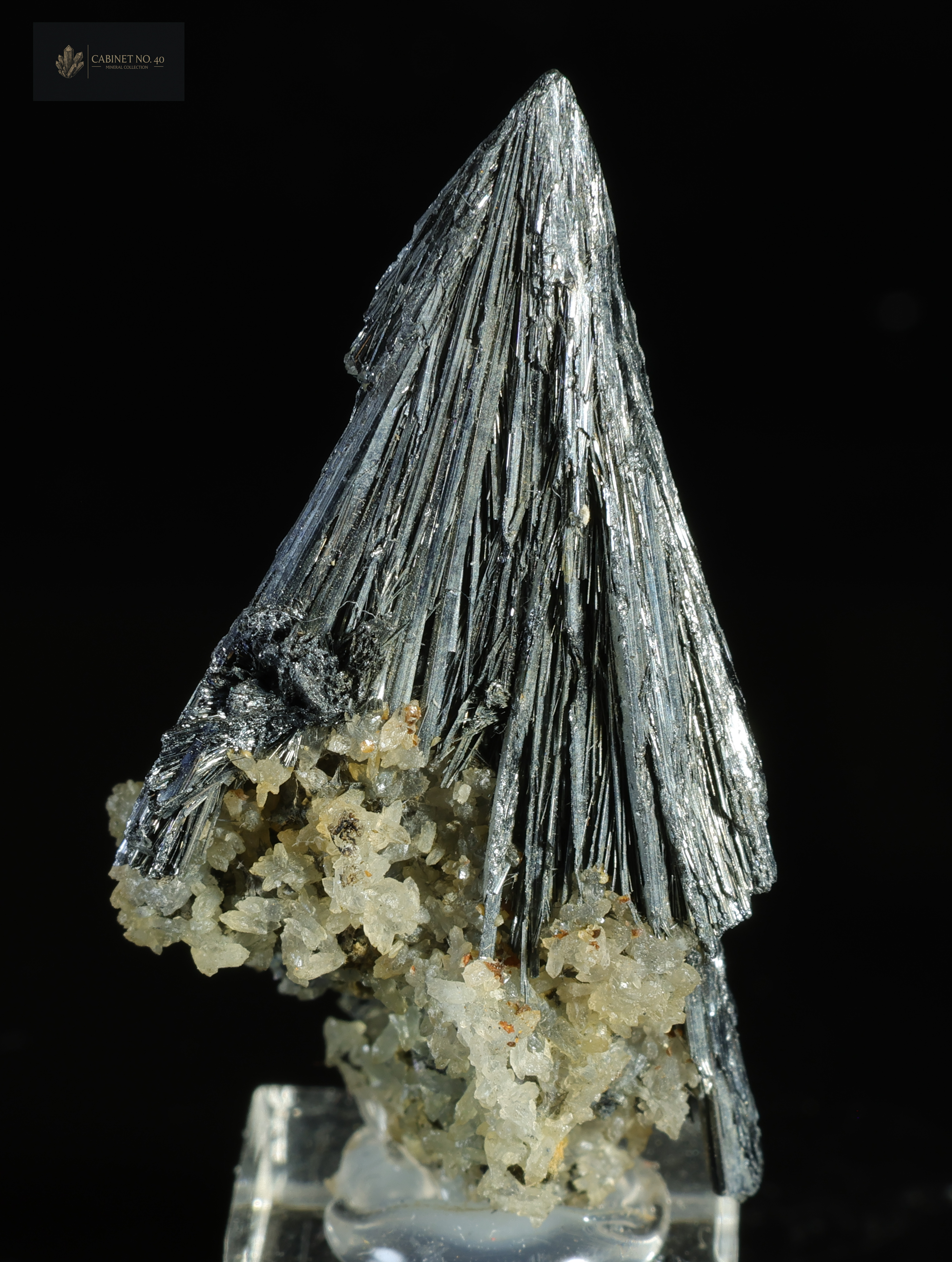
A specimen of stibnite with distinctly developed, fan-shaped clusters of needle-like crystals, arranged in a natural, sharp form. Crystals preserved in good condition, with a natural metallic luster and clear directional striations. Specimen glued to a base, can be detached upon request.
Price: 23 EUR (99 PLN)
Availability: In stock
Location: Herja Mine, Baia Mare, Maramureș County, Romania
Size: 17 x 13 x 32 mm
Weight: 200 g
Chemical formula: Sb₂S₃
Crystal system: Orthorhombic
Mohs hardness: 2.0
Characteristics Stibnite is a sulfide mineral, whose typical specimens appear as elongated, acicular or prismatic crystals with a metallic luster. It often forms radial, fibrous, or granular aggregates. Its surface may be covered with a tarnish that dulls the luster. Physical Properties Stibnite is characterized by a low Mohs hardness of 2, meaning it is a soft mineral. It has a metallic luster and a density of 4.63. It is an opaque mineral. Cleavage is perfect in one direction, which causes the crystals to easily separate along this plane. Colors and Varieties Stibnite usually occurs in a lead-gray color, often with a delicate bluish tint. The surface of the crystals may show a tarnish in the form of iridescence or a dull patina, which affects its appearance. History and Name The name stibnite comes from the Latin word "stibium", meaning antimony. This mineral was known and used since antiquity, mainly as a source of antimony and for cosmetic and medicinal purposes. The modern name was introduced in the 19th century. Uses Stibnite is the main source of antimony, which is used in the production of metal alloys (e.g., in lead for batteries, in printing alloys), in the semiconductor industry, as well as in the production of matches, paints, and flame retardants. Due to its aesthetic forms, larger stibnite specimens are valued by mineral collectors.
Identification Stibnite can be identified by its characteristic lead-gray color with a metallic luster, low hardness (it can be scratched with a fingernail), and elongated, prismatic or acicular crystals. It often forms radial aggregates. Its streak is lead-gray. Distinguishing from Similar Minerals Stibnite is sometimes confused with galena, however, galena has a higher density and forms cubic or octahedral crystals, and also has perfect cleavage in three directions. Stibnite is also more brittle and has lower hardness. Another similar mineral is bismuthinite, which, however, has a brighter, silvery-white color and is softer. Crystal Forms Stibnite most often occurs in the form of elongated, prismatic, acicular, or fibrous crystals, which can reach considerable sizes. These crystals often form radial, fan-shaped, or irregular aggregates. Granular or massive forms are less common.
Genesis Stibnite primarily forms in low-temperature hydrothermal veins, often associated with areas of volcanic activity. It also occurs in metasomatic deposits and as a product of alteration of other antimony minerals. Mineral Associations Stibnite often co-occurs with other antimony minerals, such as valentinite and kermesite. It can also be found in association with quartz, calcite, barite, cinnabar, pyrite, arsenopyrite, and galena. Localities Known stibnite deposits are found in Japan (Ichinokawa), China (Xikuangshan), Romania (Baia Mare), Slovakia (Kremnica), Italy (Sardinia), France (Massif Central), USA (California, Nevada), and Bolivia.
Quality Criteria The most valued stibnite specimens are those with well-formed, long and slender crystals with an intense metallic luster. Radial or fan-shaped aggregates that form aesthetic shapes are particularly sought after. The cleanliness of the crystal surfaces and the absence of mechanical damage are also important. Popular Localities Among the most famous and valued stibnite localities are Ichinokawa in Japan, famous for its large, perfectly formed crystals, and Xikuangshan in China, where huge deposits of this mineral occur, often in the form of impressive aggregates.
See mineralogical reference for Stibnite in the Knowledge Base →