Stibnite
Chemical formula: Sb<sup>3+</sup><sub>2</sub>S<sup>2-</sup><sub>3</sub>
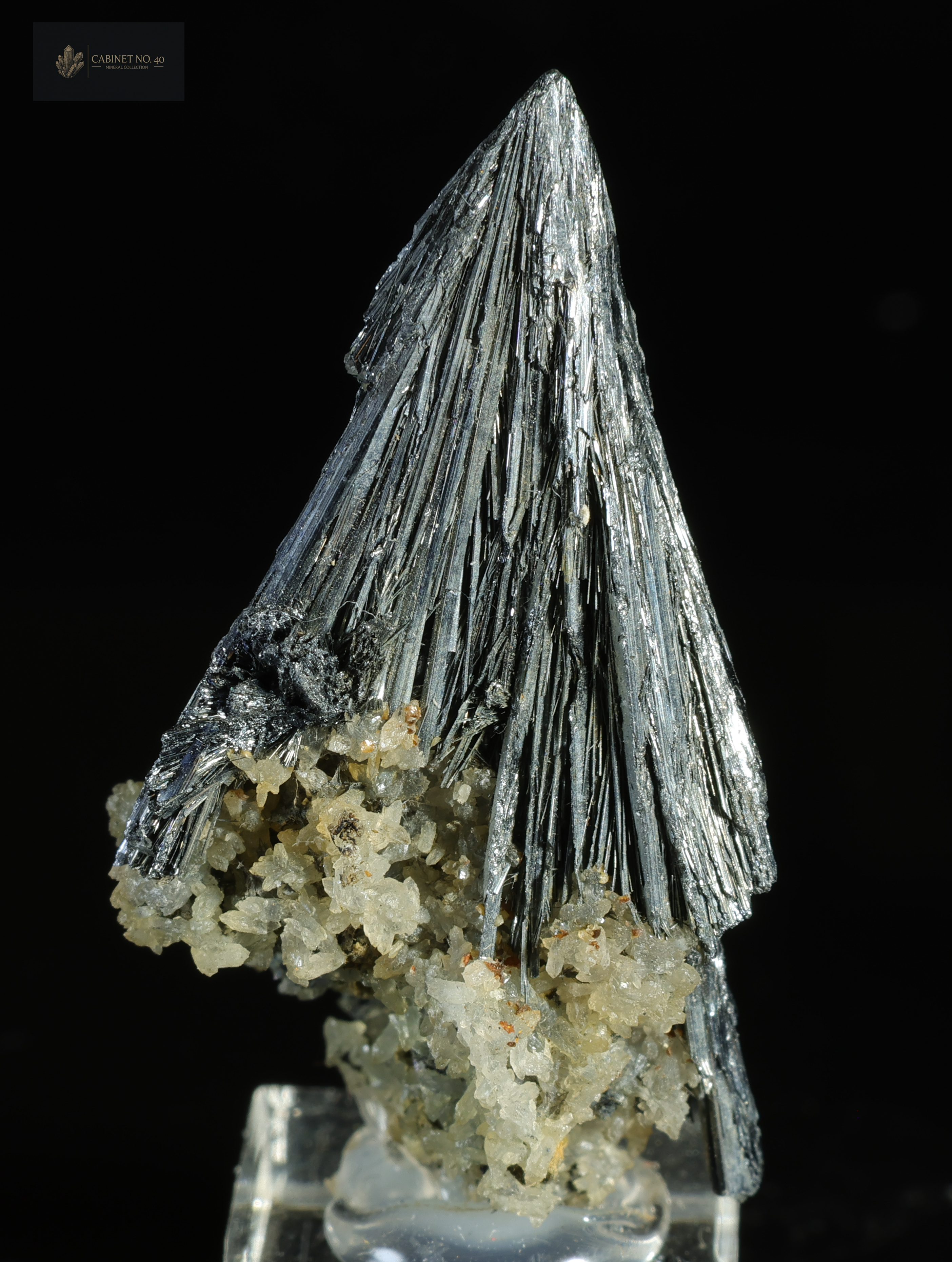
Stibnite is an antimony sulfide, characterized by a metallic luster and elongated, prismatic crystals, often forming radial or fibrous aggregates.
Properties
- Mohs hardness
- 2
- Luster
- Metaliczny
- Streak
- Lead grey
- Density
- 4.63
- Cleavage
- Perfect on {010}, imperfect on {100}{110}
- Fracture
- Nierówny
- Transparency
- Opaque
- Crystal system
- Orthorhombic
Diagnostic features
## Identification Stibnite can be identified by its characteristic lead-gray color with a metallic luster, low hardness (it can be scratched with a fingernail), and elongated, prismatic or acicular crystals. It often forms radial aggregates. Its streak is lead-gray. ## Distinguishing from Similar Minerals Stibnite is sometimes confused with galena, however, galena has a higher density and forms cubic or octahedral crystals, and also has perfect cleavage in three directions. Stibnite is also more brittle and has lower hardness. Another similar mineral is bismuthinite, which, however, has a brighter, silvery-white color and is softer. ## Crystal Forms Stibnite most often occurs in the form of elongated, prismatic, acicular, or fibrous crystals, which can reach considerable sizes. These crystals often form radial, fan-shaped, or irregular aggregates. Granular or massive forms are less common.
Geological environment
## Genesis Stibnite primarily forms in low-temperature hydrothermal veins, often associated with areas of volcanic activity. It also occurs in metasomatic deposits and as a product of alteration of other antimony minerals. ## Mineral Associations Stibnite often co-occurs with other antimony minerals, such as valentinite and kermesite. It can also be found in association with quartz, calcite, barite, cinnabar, pyrite, arsenopyrite, and galena. ## Localities Known stibnite deposits are found in Japan (Ichinokawa), China (Xikuangshan), Romania (Baia Mare), Slovakia (Kremnica), Italy (Sardinia), France (Massif Central), USA (California, Nevada), and Bolivia.
Rarity
Very Common
For collectors
## Quality Criteria The most valued stibnite specimens are those with well-formed, long and slender crystals with an intense metallic luster. Radial or fan-shaped aggregates that form aesthetic shapes are particularly sought after. The cleanliness of the crystal surfaces and the absence of mechanical damage are also important. ## Popular Localities Among the most famous and valued stibnite localities are Ichinokawa in Japan, famous for its large, perfectly formed crystals, and Xikuangshan in China, where huge deposits of this mineral occur, often in the form of impressive aggregates.
Care and storage
## Cleaning Stibnite is a soft and brittle mineral, therefore it requires gentle cleaning. It is best to use a soft brush or paintbrush to remove dust. For heavier soiling, lukewarm distilled water can be used, avoiding prolonged soaking. ## What to Avoid Avoid using any chemicals, including detergents and acids, as they can damage the mineral's surface. Stibnite is sensitive to impact and pressure, which can lead to cracks or delamination of crystals. Exposure to direct sunlight for extended periods can cause the surface to dull. High temperatures are also not recommended. ## Storage Stibnite specimens are best stored in closed display cases or boxes to protect them from dust and mechanical damage. Due to its brittleness, each specimen should be placed in a separate, soft packaging or on a stable base to prevent movement and rubbing against other minerals. It is also important to maintain a stable temperature and humidity in the storage area.