SKU: B_29_0002
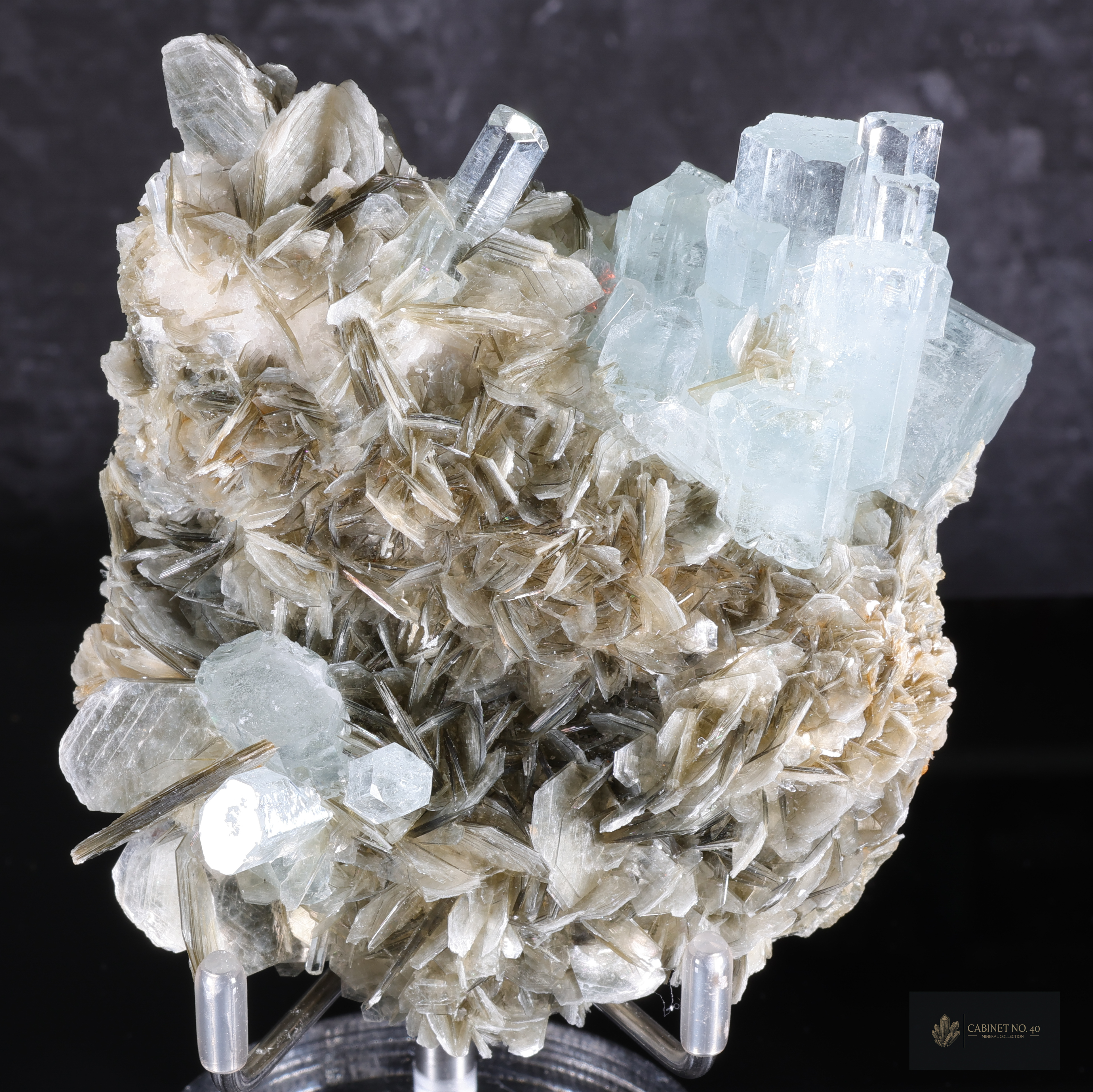
A collector's specimen of aquamarine crystals with saturated color and excellent clarity. The crystals feature sharp edges and intact terminations. Main features: blue aquamarine, high crystal purity, rich matrix. Condition: Excellent - the main terminations of the aquamarine crystals are intact - a few very tiny chips are visible under extreme magnification.
Price: 299 EUR (1299 PLN)
Availability: In stock
Location: Gilgit-Baltistan, Pakistan
Size: 74 x 91 x 39 mm
Weight: 260.9 g
Chemical formula: Be₃Al₂Si₆O₁₈
Crystal system: Hexagonal
Mohs hardness: 7.5–8.0
Characteristics Aquamarine is a variety of beryl, a mineral from the silicate group, characterized by a color ranging from light blue to blue-green. The name "aquamarine" comes from the Latin words "aqua marina", meaning "sea water", referring to its typical coloration. Aquamarine crystals often occur in prismatic, hexagonal forms, with distinct faces. Specimens can be transparent to translucent, and their color may be uneven, with a more intense hue along the crystal axis. Physical Properties Aquamarine has a hardness of 7.5-8 on the Mohs scale, making it a relatively scratch-resistant mineral. It has a vitreous to resinous luster. Its streak is white. The cleavage of aquamarine is imperfect. The fracture is conchoidal to uneven. Colors and Varieties The typical color of aquamarine is shades of blue and blue-green. The intensity of the color depends on the iron ion content. Some aquamarines can be heat-treated to intensify or change the color to a more desirable, pure blue. There are also rare varieties, such as cat's eye aquamarine, which exhibits the cat's eye effect. History and Name The name "aquamarine" was introduced in the 18th century. This mineral was known and valued in antiquity, used for making jewelry and amulets. It was believed to protect sailors and ensure safe passage. Its history is closely linked to the history of beryl, to which it belongs. Uses The main use of aquamarine is in jewelry. It is a popular gemstone, used to create rings, necklaces, earrings, and other ornaments. Larger, well-formed crystals are also sought after by mineral collectors.
Identification Aquamarine can be identified by its characteristic blue or blue-green color, vitreous luster, and hexagonal crystal habit. It is a relatively hard mineral, which can be checked by attempting to scratch glass or another mineral of known hardness with it. Distinguishing from Similar Minerals Aquamarine can be confused with topaz, euclase, and also with synthetic stones. It differs from topaz in hardness (topaz is harder) and often in color hue. Euclase is rarer and has different hardness and crystallographic system. It differs from synthetic stones by the presence of natural inclusions and growth features visible under a microscope. Crystal Forms Aquamarine most often occurs as elongated, hexagonal prisms, often terminated by flat faces or pyramids. Aggregates can be massive, granular, or radiating.
Genesis Aquamarine primarily forms in granitic pegmatites, which are igneous rocks with a high content of silica and rare elements. It can also occur in some hydrothermal veins and in metamorphic zones. It forms in environments rich in beryl and other chemical components necessary for its crystallization. Mineral Associations Aquamarine often co-occurs with other pegmatitic minerals, such as quartz, feldspars (orthoclase, albite), micas (muscovite, biotite), and tourmalines. It can also be found with garnets, topaz, and cassiterite. Localities Significant aquamarine deposits are found in Brazil (Minas Gerais), Pakistan (Gilgit-Baltistan), Nigeria, Madagascar, Russia (Urals), United States (Colorado), Mozambique, and Afghanistan. Brazil is one of the most important producers of high-quality aquamarines.
Quality Criteria The most prized aquamarine specimens are characterized by an intense, pure blue or blue-green color, high transparency, and absence of visible inclusions. Large, well-formed crystals with distinct faces and terminations are particularly sought after. Clarity and absence of fractures also affect the value of the specimen. Popular Localities The most valued aquamarine specimens come from Brazil, especially from the Minas Gerais region, where crystals of exceptional color and size are found. Other important sources include Pakistan, Afghanistan, and Nigeria, known for producing high-quality stones.
See mineralogical reference for Aquamarine in the Knowledge Base →