Aquamarine
Chemical formula: Be₃Al₂Si₆O₁₈
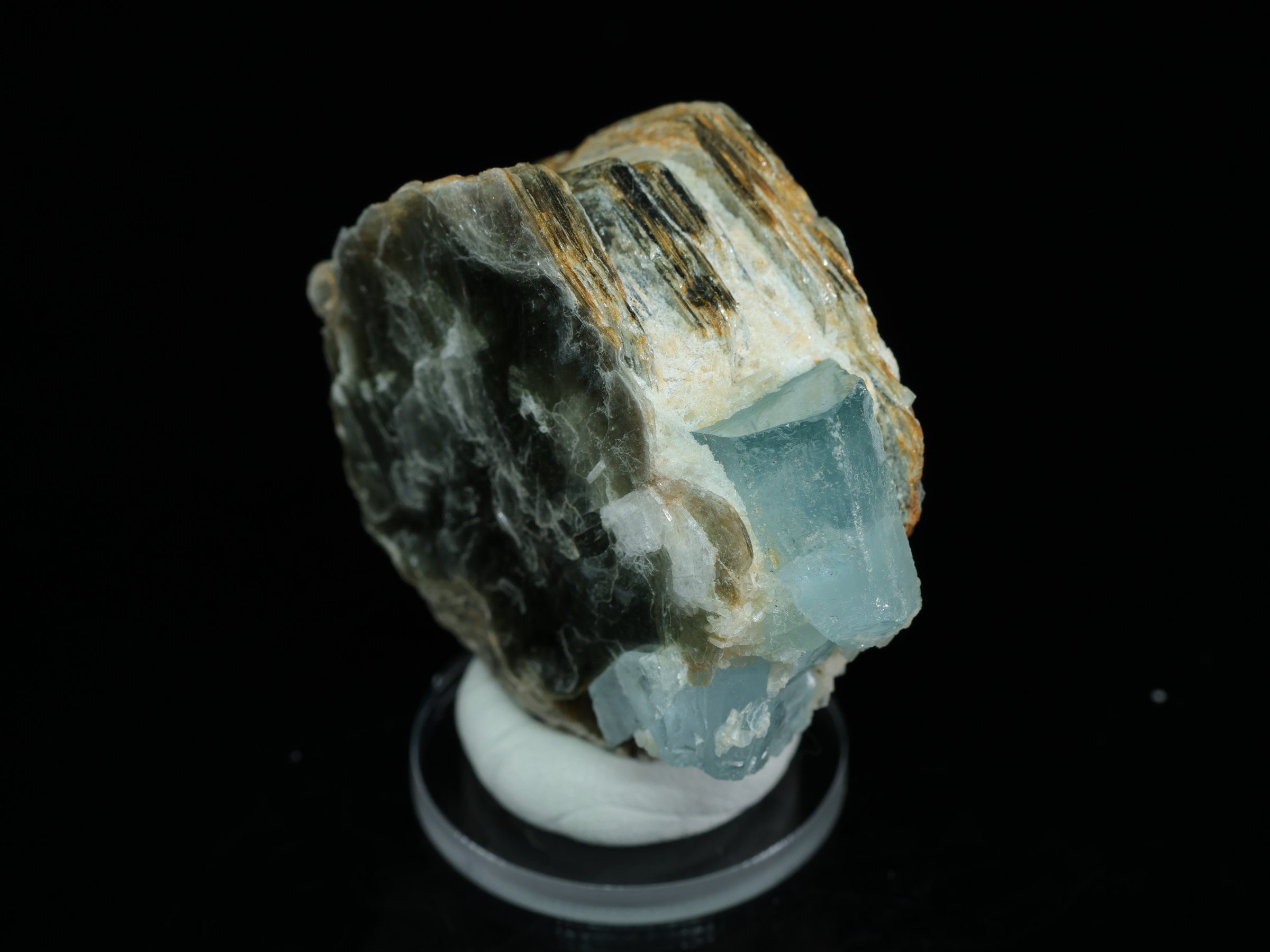
Aquamarine is a blue or blue-green variety of beryl, valued in jewelry and collecting for its color and transparency.
Properties
- Mohs hardness
- 7.5-8
- Luster
- Vitreous - Resinous
- Streak
- White
- Density
- 0
- Cleavage
- Imperfect
- Fracture
- Muszlowy do nierównego
- Transparency
- Przezroczysty do przeświecającego
- Crystal system
- Heksagonalny
Diagnostic features
## Identification Aquamarine can be identified by its characteristic blue or blue-green color, vitreous luster, and hexagonal crystal habit. It is a relatively hard mineral, which can be checked by attempting to scratch glass or another mineral of known hardness with it. ## Distinguishing from Similar Minerals Aquamarine can be confused with topaz, euclase, and also with synthetic stones. It differs from topaz in hardness (topaz is harder) and often in color hue. Euclase is rarer and has different hardness and crystallographic system. It differs from synthetic stones by the presence of natural inclusions and growth features visible under a microscope. ## Crystal Forms Aquamarine most often occurs as elongated, hexagonal prisms, often terminated by flat faces or pyramids. Aggregates can be massive, granular, or radiating.
Geological environment
## Genesis Aquamarine primarily forms in granitic pegmatites, which are igneous rocks with a high content of silica and rare elements. It can also occur in some hydrothermal veins and in metamorphic zones. It forms in environments rich in beryl and other chemical components necessary for its crystallization. ## Mineral Associations Aquamarine often co-occurs with other pegmatitic minerals, such as quartz, feldspars (orthoclase, albite), micas (muscovite, biotite), and tourmalines. It can also be found with garnets, topaz, and cassiterite. ## Localities Significant aquamarine deposits are found in Brazil (Minas Gerais), Pakistan (Gilgit-Baltistan), Nigeria, Madagascar, Russia (Urals), United States (Colorado), Mozambique, and Afghanistan. Brazil is one of the most important producers of high-quality aquamarines.
Rarity
Common
For collectors
## Quality Criteria The most prized aquamarine specimens are characterized by an intense, pure blue or blue-green color, high transparency, and absence of visible inclusions. Large, well-formed crystals with distinct faces and terminations are particularly sought after. Clarity and absence of fractures also affect the value of the specimen. ## Popular Localities The most valued aquamarine specimens come from Brazil, especially from the Minas Gerais region, where crystals of exceptional color and size are found. Other important sources include Pakistan, Afghanistan, and Nigeria, known for producing high-quality stones.
Care and storage
## Cleaning Aquamarine can be cleaned with warm water and mild soap and a soft brush. After washing, it should be thoroughly rinsed with clean water and dried with a soft cloth. Ultrasonic cleaning is also possible, but caution should be exercised, especially with specimens containing inclusions or fractures. ## What to Avoid Avoid contact of aquamarine with strong chemicals, such as acids or bases, which can damage its surface. The mineral is sensitive to sudden temperature changes, which can lead to cracks. Prolonged exposure to direct sunlight can in some cases cause color fading, so it is recommended to store it away from intense light. ## Storage Aquamarine is best stored separately from other, harder minerals to avoid scratches. It is ideal to store it in a soft pouch or a separate compartment in a jewelry box. For display, choose a location away from direct sunlight and heat sources.