Smithsonite, Hemimorphite

SKU: P_26-6_04

A very aesthetic specimen of smithsonite forming botryoidal aggregates with a silky luster on a matrix composed of fine-grained hemimorphite. Main Features: botryoidal (spherical) aggregates; bright, crystalline matrix; good exposure of aggregates.
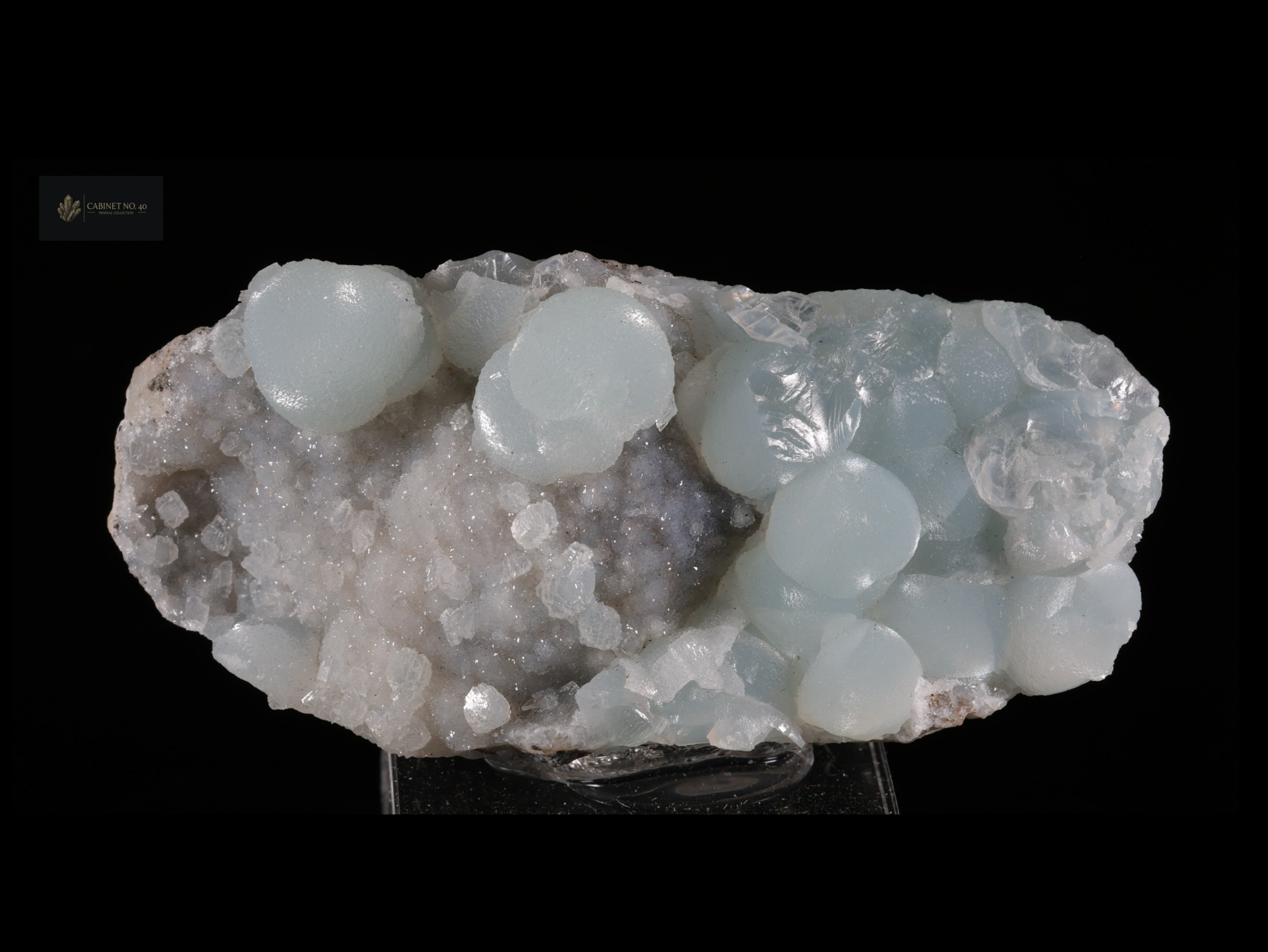
Smithsonite, Hemimorphite

Price: 60 EUR (259 PLN)

Availability: In stock

Location: Skorpion Mine, Rosh Pinah, Oranjemund Constituency, ǁKaras Region, Namibia

Size: 63 x 29 x 32 mm

Weight: 67 g

Chemical formula: Ca₂Al(AlSi₃O₁₀)(OH)₂

Crystal system: Orthorhombic

Mohs hardness: 6.0

Characteristics Prehnite is a mineral belonging to the silicate group, often found in reniform, botryoidal, or radial aggregates. Prehnite crystals are usually small, tabular or prismatic, but rarely occur as well-formed single specimens. The surface of the aggregates can be smooth or slightly granular, and their color ranges from colorless, through gray, yellow, yellowish-green, to white. Less commonly, specimens with pale brown or very rarely pale blue hues are found. This mineral often exhibits zonal coloration. Physical Properties The Mohs hardness of prehnite is 6-6.5, making it a relatively hard mineral. It has a good vitreous to pearly luster, especially on fracture surfaces. It is a translucent mineral. The specific gravity of prehnite is approximately 2.8 g/cm³. Colors and Varieties Prehnite occurs in a wide range of colors, from colorless and white, through shades of gray, to yellow and yellowish-green. The most prized specimens have an intense, apple-green coloration. Pale brown varieties are rare, and pale blue varieties are very rare. No specific commercial varieties are distinguished beyond the general color description. History and Name Prehnite was first described in 1788 by Abraham Gottlob Werner and named after Colonel Hendrik von Prehn, a Dutch military commander and mineral collector, who first brought specimens of this mineral from the Cape of Good Hope in South Africa. Uses Prehnite is primarily valued as a collector's stone due to its attractive forms and colors. High-quality specimens with intense coloration are used in jewelry for making cabochons, beads, and carvings. It is also sought after by sculptors for creating small figurines and ornaments.

Diagnostic features

Identification Prehnite can be identified by its characteristic reniform, botryoidal, or radial aggregates, often with a greenish coloration. Its vitreous to pearly luster and Mohs hardness of 6-6.5 are also helpful in identification. It often occurs in basaltic cavities and other volcanic rocks. Distinguishing from Similar Minerals Prehnite is sometimes confused with chalcedony, although chalcedony is usually more homogeneous and does not exhibit such a distinct radial structure. It can also be confused with some varieties of jadeite or nephrite, but prehnite is usually more transparent and has a different hardness. Differentiation from serpentine is possible due to prehnite's greater hardness and its characteristic structure. Crystal Forms Prehnite most often forms reniform, botryoidal, spherical, or radial aggregates. Crystals are usually tabular or prismatic, but rarely occur as well-formed, single specimens. It often forms concretions or coatings on other minerals.

Formation environment

Genesis Prehnite forms under low-temperature hydrothermal conditions, often in fractures and cavities of volcanic rocks, such as basalts, andesites, and diabases. It also forms in some metamorphic rocks, especially in the prehnite-pumpellyite facies, where it is a product of the alteration of plagioclase and other calcium-aluminum minerals. Mineral Associations Prehnite often co-occurs with zeolites (such as stilbite, heulandite, laumontite), calcite, apophyllite, epidote, quartz, pumpellyite, and native copper. In some deposits, it may be associated with garnets. Localities Known prehnite deposits are found in many places around the world. The most important include: South Africa (Karoo region, where it was first discovered), India (Deccan Traps), Australia (Broken Hill, Northern Territory), United States (New Jersey, Virginia), Canada (Quebec), Scotland, France, and China.

For the collector

Quality Criteria The most prized prehnite specimens are those with an intense, uniform, apple-green coloration. The aesthetics of the aggregate are also important – well-formed reniform, botryoidal, or radial shapes are highly sought after. Transparency and the absence of visible inclusions also increase the value of the specimen. Large, well-formed specimens are particularly valuable. Popular Localities The most prized prehnite specimens come from South Africa, especially from the Karoo region, where beautiful, green aggregates occur. India, from the Deccan Traps region, also provides high-quality specimens. Other important localities include Australia (Broken Hill) and the United States (New Jersey).

See mineralogical reference for Prehnite in the Knowledge Base →

View product →