SKU: B_36_0069
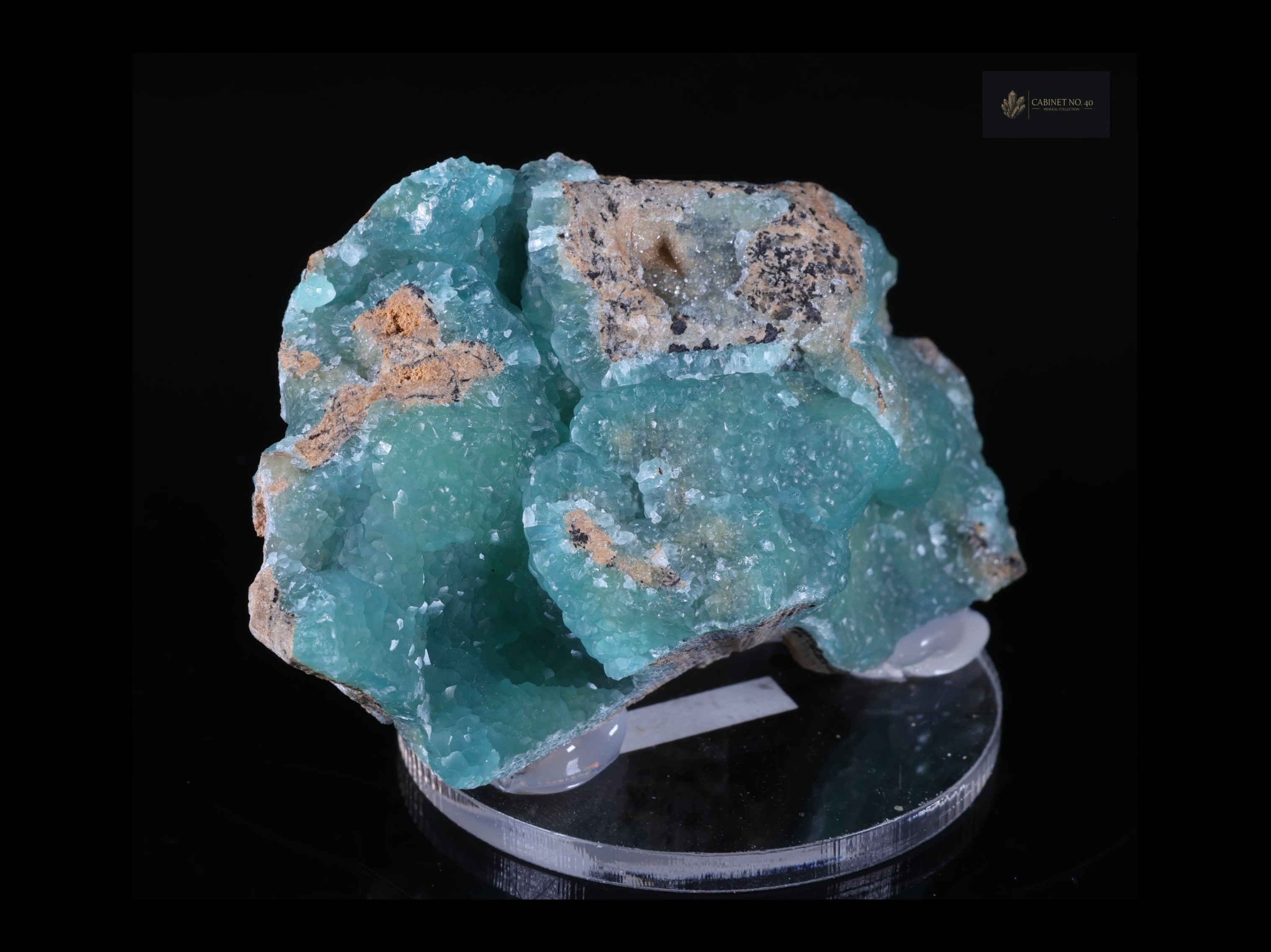
Specimen of smithsonite with a saturated, sea-green color, exhibiting the classic botryoidal form typical for this location. The surface of the clusters is highly crystallized, which causes the specimen to sparkle intensely under various lighting angles. Main Features: saturated sea green; sparkling surface; distinct botryoidal structure. Condition: Fair.
Price: 37 EUR (159 PLN)
Availability: In stock
Location: Yanga Koubenza quarries, Mfouati, Mfouati District, Bouenza Department, Republic of the Congo
Size: 60 x 32 x 37 mm
Weight: 81 g
Chemical formula: ZnCO₃
Mohs hardness: 4.0–4.5
Characteristics Smithsonite is a mineral from the carbonate group, being zinc carbonate. It most often occurs in reniform, botryoidal, or stalactitic aggregates, less frequently as well-formed crystals. The surface of the aggregates can be smooth or have a delicate, granular texture. Its appearance varies from transparent to translucent masses, often with attractive colors. Physical Properties Smithsonite is characterized by a Mohs hardness of 4-4.5. It has a vitreous to pearly luster. Its specific gravity is 4.42. This mineral is translucent, and its streak is white. Colors and Varieties Smithsonite occurs in a wide range of colors, including white, gray, yellow, green (often apple-green), blue, pink, purple, bluish-gray, and brown. The color depends on impurities of other elements; for example, copper gives it blue and green hues, and cadmium gives it yellow. In transmitted light, it can be colorless or slightly tinted. History and Name The mineral was named after James Smithson, a British chemist and mineralogist, who first distinguished it from hemimorphite. Smithsonite was formally described in 1832. Uses Smithsonite is primarily a collector's mineral due to its attractive colors and forms. It is also a zinc ore, although its industrial importance is less than that of sphalerite.
Identification Smithsonite can be identified by its characteristic reniform, botryoidal, or stalactitic forms. It often occurs in attractive, pastel colors. Its hardness (4-4.5 on the Mohs scale) and white streak are also helpful in identification. Distinguishing from Similar Minerals Smithsonite is sometimes confused with hemimorphite, with which it co-occurs. They can be distinguished by hardness (hemimorphite is harder, 4.5-5 on the Mohs scale) and reaction to hydrochloric acid – smithsonite reacts, releasing carbon dioxide, while hemimorphite does not. Another similar mineral is calcite, which is significantly softer and has a different density. Crystal Forms Smithsonite crystals are rare, having a rhombohedral or scalenohedral habit. Most often, it forms aggregates with reniform, botryoidal, stalactitic, crusty, spherical, or earthy habits.
Genesis Smithsonite is a secondary mineral, forming in the oxidation zones of zinc deposits. It forms as a result of the weathering of primary zinc minerals, such as sphalerite, in the presence of carbonates. It often occurs in limestones and dolomites, where zinc-rich solutions react with carbonates to form smithsonite. Mineral Associations Smithsonite often co-occurs with other minerals from the oxidation zone, such as hemimorphite, cerussite, anglesite, malachite, azurite, calcite, limonite, and goethite. Localities Known for beautiful smithsonite specimens are localities in Tsumeb (Namibia), Kelly Mine in Socorro County (New Mexico, USA), Laurion (Greece), Broken Hill (Australia), Sardinia (Italy), and Choix (Mexico).
Quality Criteria The most prized smithsonite specimens are those with intense and uniform color, especially blue, green, or pink. The form of the aggregate is also important – well-formed, reniform, or botryoidal shapes with a smooth, lustrous surface are highly sought after. The size of the specimen and the absence of mechanical damage also affect its collector's value. Popular Localities The most prized smithsonite specimens come from Tsumeb in Namibia, known for its blue and green varieties, and from the Kelly Mine in New Mexico (USA), where characteristic apple-green specimens occur.
See mineralogical reference for Smithsonite in the Knowledge Base →