Silvery-gray Protochabournéite from Monte Arsiccio

SKU: S_00058

A very rare specimen of Protochabournéite originating from its type locality. On a light matrix, there is a very distinct concentration of this extremely rare mineral. Protochabournéite has formed here as a dark gray, massive aggregate with a metallic luster, located in the upper part of the specimen and strongly contrasting with the background of the host rock. Main Features: extremely rare mineral; Type Locality; exposed, metallic concentration of ore on a light matrix; high systematic value Condition: Good.
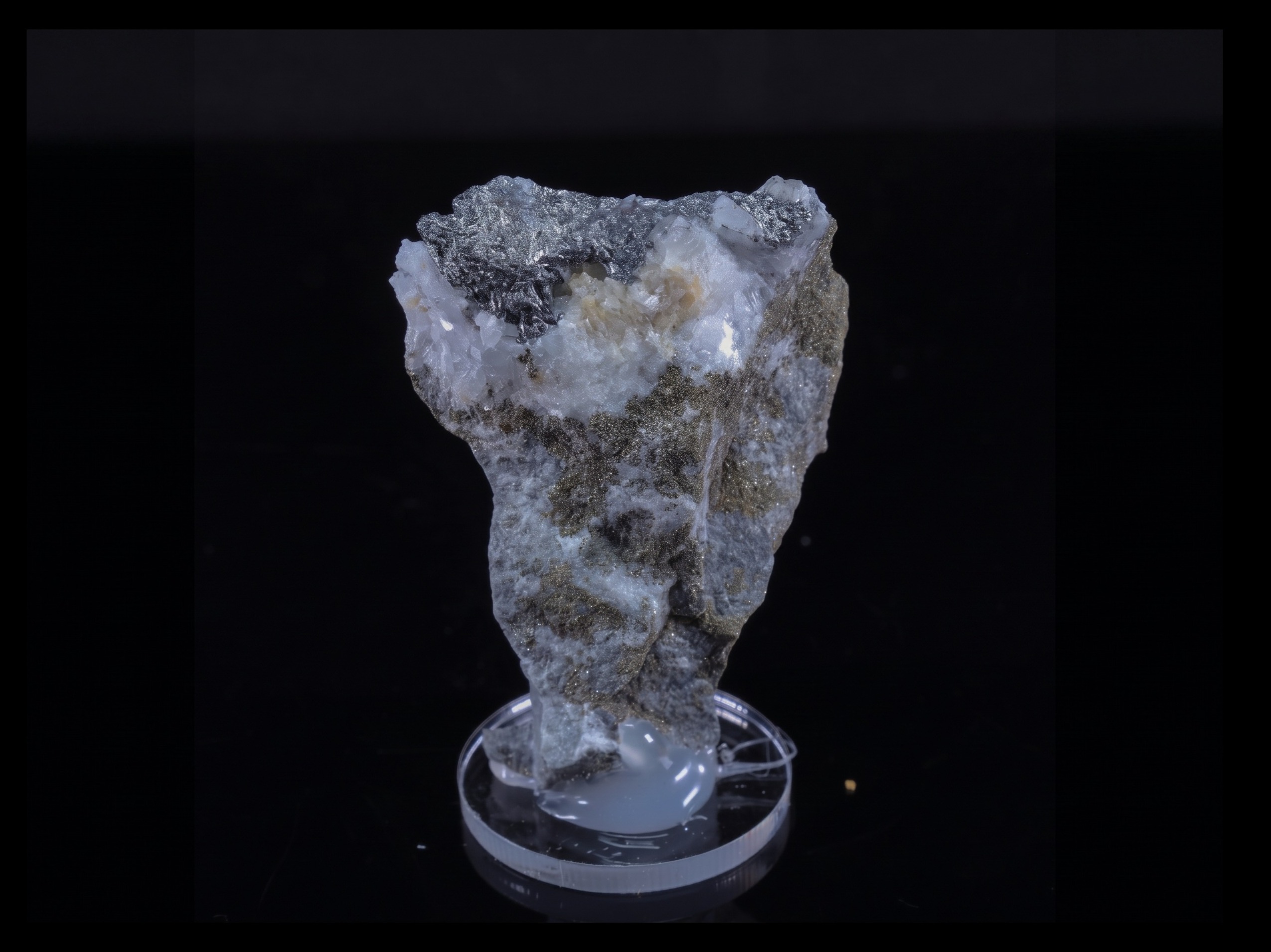
Silvery-gray Protochabournéite from Monte Arsiccio

Price: 57 EUR (249 PLN)

Availability: In stock

Location: Monte Arsiccio Mine, Sant'Anna di Stazzema, Stazzema, Lucca Province, Tuscany, Italy

Size: 50 x 35 x 110 mm

Weight: 39 g

Chemical formula: Tl₄-xPb₂+₂xSb₂₀-x-yAsyS₃₄ (with 0.02 ≤ x ≤ 0.34, 5.71 ≤ y ≤ 6.69)

Crystal system: Trigonalny

Mohs hardness: 2.5

Characteristics Protochabournéite is a sulfosalt mineral with a complex chemical composition, containing thallium, lead, antimony, and arsenic. It typically occurs as small, black crystals or aggregates, which are opaque. Its appearance is typical of many sulfosalts, making identification difficult without detailed examination. Physical Properties This mineral is characterized by a black streak and metallic luster. It is opaque, meaning light does not pass through its structure. The density of protochabournéite is 5.083 g/cm³, which is a relatively high value, typical for minerals containing heavy metals. Colors and Varieties Protochabournéite occurs exclusively in black. No color varieties or commercial forms of this mineral are known. History and Name The name protochabournéite refers to its relationship with chabournéite, another sulfosalt mineral. It was described as a new mineral, emphasizing its unique composition and crystal structure. Uses Protochabournéite has no practical industrial applications due to its rarity and chemical composition. It is exclusively a collector's and scientific mineral, valuable to researchers of sulfosalt minerals.

Diagnostic features

Identification Protochabournéite can be identified by its black color, metallic luster, and high density. However, due to its similarity to other sulfosalts, accurate identification requires specialized laboratory tests, such as chemical composition analysis and X-ray diffraction. Distinguishing from Similar Minerals Protochabournéite can be confused with other black sulfosalts, such as chabournéite, boulangerite, or galena. It differs from them in its detailed chemical composition and crystal structure, which can only be determined using advanced analytical techniques. Galena has distinct cleavage, which protochabournéite does not exhibit to the same extent. Crystal Forms Protochabournéite typically forms small, tabular or prismatic crystals, often occurring in aggregates. Its crystals are usually small and not always well-formed.

Formation environment

Genesis Protochabournéite forms in low-temperature hydrothermal environments, often in polymetallic deposits where other sulfosalt minerals occur. Its presence is associated with the presence of thallium, lead, antimony, and arsenic in hydrothermal solutions. Mineral Associations Protochabournéite coexists with other sulfosalt minerals, such as chabournéite, rebulite, pierrotite, as well as ore minerals like galena, sphalerite, and pyrite. It can also occur with quartz and calcite as gangue minerals. Localities The most important occurrences of protochabournéite are found in the Alps, especially in the Binn Valley region of Switzerland, which is a classic locality for many rare sulfosalt minerals.

For the collector

Quality Criteria The most prized protochabournéite specimens are those that exhibit well-formed crystals, even if small. The purity of the specimen, absence of mechanical damage, and distinct luster are also important. Specimens in matrix, with associated minerals, can also be attractive to collectors. Popular Localities The most sought-after protochabournéite specimens come from the Binn Valley in Switzerland, which is known for the occurrence of many rare and unique sulfosalt minerals.

See mineralogical reference for Protochabournéite in the Knowledge Base →

View product →