SKU: 0252_4-MA
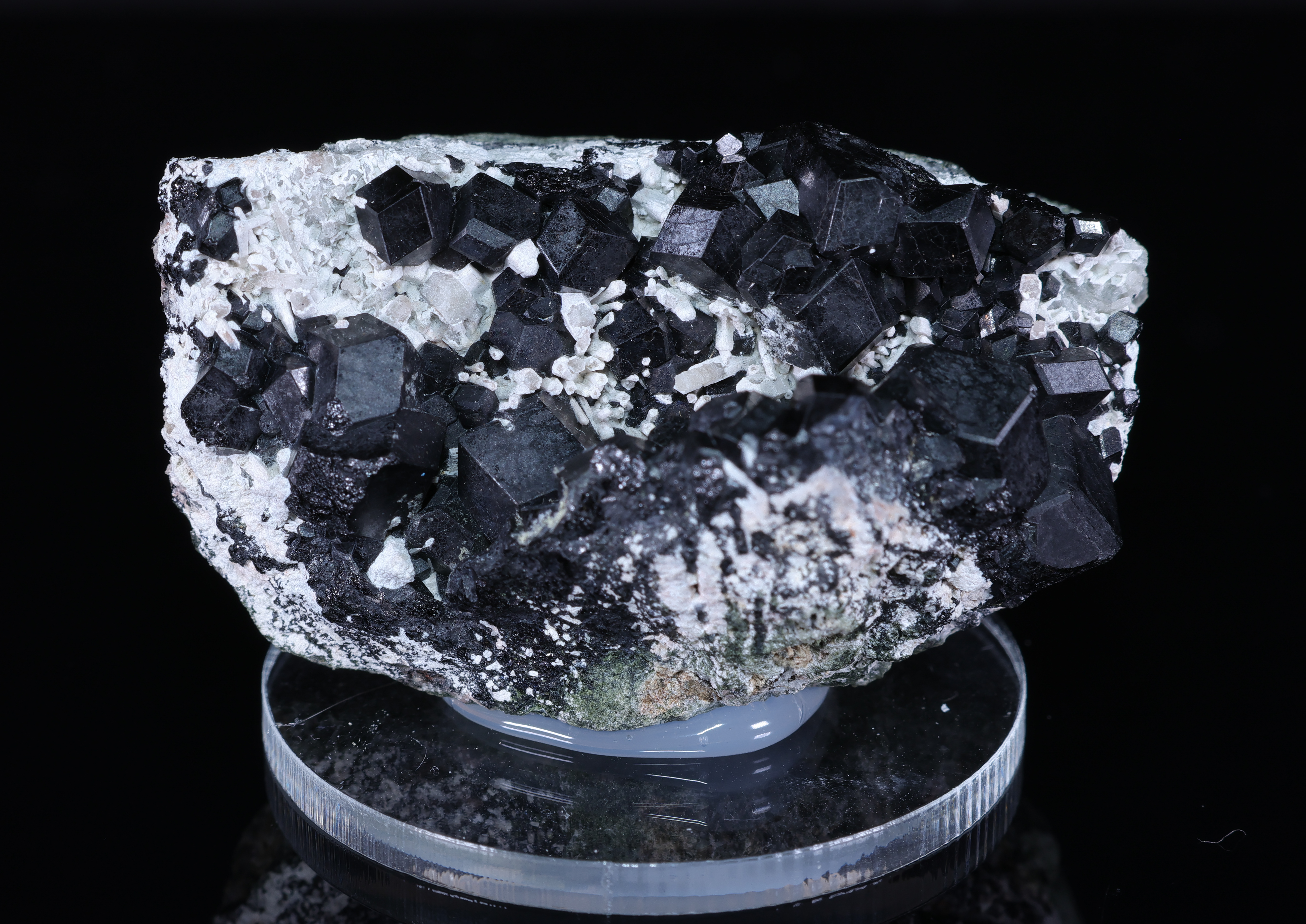
A highly aesthetic specimen of the rare, titanium-rich garnet - schorlomite, set against a contrasting white nepheline matrix. The specimen features numerous, well-formed crystals in the shape of rhombohedral dodecahedra, characterized by a deep black color and distinct luster. Main Features: deep black color of the crystals; high luster of schorlomite; strong contrast with the white matrix; rare variety of garnet; ex coll. K.Urbanik. Condition: Very good - the main crystals in the central part are intact.
Price: 41 EUR (179 PLN)
Availability: In stock
Location: Jebel Bou-Agrao, Morocco
Size: 48 x 33 x 30 mm
Weight: 67 g
Chemical formula: Ca₃Ti₂(Si₂O₇)₂O₂
Crystal system: Isometric
Mohs hardness: 6–7
Mineral group: Garnet Group
Rarity: Rare
Characteristics Schorlomite is a mineral belonging to the garnet group, distinguished by its dark, usually black color, although it can also be grayish-black or deep reddish-brown. It often occurs as well-formed crystals with a rhombic dodecahedral or icositetrahedral habit, typical of garnets. The crystal surface can be dull or exhibit a vitreous to metallic luster. Schorlomite specimens are typically opaque. Physical Properties The Mohs hardness of schorlomite ranges from 7 to 7.5, making it a relatively hard mineral. It has a specific gravity of approximately 3.862 g/cm³. The luster is vitreous, sometimes with a tendency towards metallic. This mineral is opaque. Colors and Varieties The dominant color of schorlomite is black or grayish-black. It can also take on shades of deep reddish-brown. Sometimes the crystal surface may be covered with a coating, giving it a bluish tint. History and Name Schorlomite was described in 1846. The mineral's name comes from the German word "Schorl," which historically referred to black, acicular minerals, including black tourmalines. Schorlomite was named due to its visual resemblance to some forms of tourmaline, even though chemically and structurally it belongs to the garnets. Uses Schorlomite has no significant industrial applications. It is a mineral primarily valued by collectors due to its rarity, dark color, and well-formed crystals.
Identification Schorlomite can be identified by its characteristic black color, vitreous to metallic luster, and crystal habit typical of garnets, most often rhombic dodecahedra. A hardness of 7-7.5 on the Mohs scale is also an important diagnostic feature. The streak of the mineral is black to reddish-orange or orange-brown. Distinguishing from Similar Minerals Schorlomite can be confused with other black minerals, such as black tourmaline (schorl) or black spinel. It is distinguished from schorl by the absence of the characteristic triangular cross-section of tourmalines and different hardness and density. It differs from spinel in chemical composition and slightly different density. A streak test can be helpful in differentiation. Crystal Forms Schorlomite most commonly forms isometric crystals with a rhombic dodecahedral {110} or icositetrahedral {211} habit, often with rounded edges. It can also occur as granular aggregates.
Genesis Schorlomite is a mineral found in igneous rocks, especially in alkaline igneous rocks such as nepheline syenites and phonolites, as well as in some carbonatites. It can also form in metasomatic contact rocks. Mineral Associations Schorlomite often co-occurs with other minerals typical of alkaline rocks, such as nepheline, aegirine, arfvedsonite, as well as with other garnets and titanites. Localities Known localities of schorlomite include Russia (Kola Peninsula, Urals), Canada (Quebec), USA (Arkansas), Norway, and Italy (near Rome).
Quality Criteria The most prized schorlomite specimens are those that exhibit well-formed, distinct crystals with an intense, uniform black color and clear luster. Crystal size is also important, with larger, undamaged specimens being more desirable. Surface purity and the absence of visible inclusions of other minerals increase collectible value. Popular Localities Particularly valued schorlomite specimens come from the Kola Peninsula in Russia, where large and well-formed crystals are found. Other important sources include Canada (e.g., the Mont Saint-Hilaire area in Quebec) and some localities in the USA.
See mineralogical reference for Schorlomite in the Knowledge Base →