SKU: 0286_2
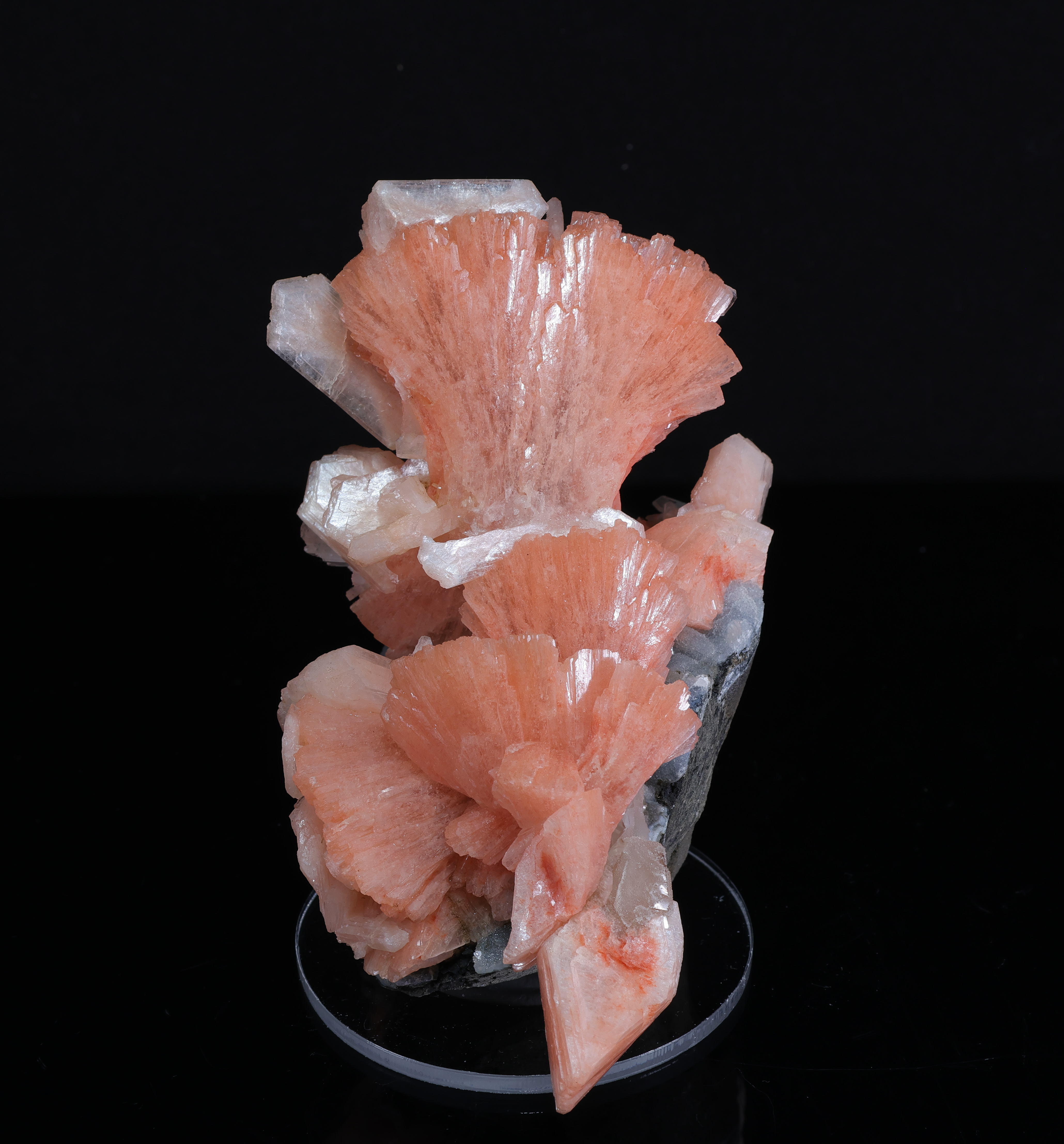
A very aesthetic specimen of salmon-colored heulandite from India, formed in the shape of large, fan-like aggregates of crystals with a distinct, pearly luster. Saturated, pink-salmon crystals dominate a relatively small fragment of dark matrix, creating a spatial, towering composition with excellent vertical exposure. Main Features: salmon color; fan-like crystal shape; pearly luster; dominance of crystals over matrix; vertical, sculptural exposure. Condition: Very good. The specimen has been locally repaired.
Price: 46 EUR (199 PLN)
Availability: In stock
Location: -, India
Size: 60 x 70 x 115 mm
Weight: 275 g
Chemical formula: (Ca,Na)₂-₃Al₃(Al,Si)₂Si₁₃O₃₆·12H₂O
Crystal system: Monoclinic
Mohs hardness: 3.5-4
Rarity: Common
Characteristics Heulandite is a mineral belonging to the zeolite group, which are silicates with a complex structure. It typically occurs as tabular, wedge-shaped, or pseudohexagonal crystals, often forming sheaf-like or rosette-like aggregates. Crystal surfaces may be striated. The color of heulandite is variable, ranging from colorless, white, gray, through yellow, orange, pink, to reddish or brown. It often exhibits a pearly luster on cleavage surfaces. Physical Properties The hardness of heulandite on the Mohs scale is 3.5-4. This mineral is characterized by a vitreous to pearly luster, especially on cleavage surfaces. It is transparent to translucent. The density of heulandite ranges from 2.18 to 2.22 g/cm³. Colors and Varieties Heulandite occurs in a wide range of colors, including colorless, white, gray, yellow, orange, pink, reddish, and brown. The color is often associated with the presence of impurities. No specific, commercial varieties of heulandite are distinguished, however, differences in coloration and crystal form are valued by collectors. History and Name The name heulandite was given in 1822 by August Breithaupt in honor of the British mineral collector, John Henry Heuland. This mineral was previously known by other names, such as "blad zeolite" or "tabular stilbite," before it was recognized as a distinct mineral species. Applications Heulandite, like other zeolites, is used as an adsorbent, ion exchanger, and catalyst in the chemical industry. Due to its porous structure, it is used in gas and liquid purification processes. Specimens with well-formed crystals are prized in collecting.
Identification Heulandite can be identified by its characteristic crystal habit, which is often tabular, wedge-shaped, or pseudohexagonal. It often forms sheaf-like or rosette-like aggregates. The pearly luster on cleavage surfaces is also a diagnostic feature. A hardness of 3.5-4 on the Mohs scale helps distinguish it from harder minerals. Distinguishing from similar minerals Heulandite is sometimes confused with stilbite, another zeolite, which also forms tabular crystals with a pearly luster. The difference lies in crystal symmetry: heulandite has monoclinic symmetry, while stilbite often forms characteristic sheaf-like or fan-shaped aggregates. Accurate distinction requires optical examination or X-ray diffraction. Apophyllite can also be similar, but has a different hardness and crystallographic system. Crystal forms Heulandite most often occurs as well-formed, tabular crystals, often rhombic or wedge-shaped. Crystals can be elongated along one axis. It often forms radial, sheaf-like, fan-shaped, or rosette-like aggregates. Aggregates can be massive or granular.
Genesis Heulandite is a typical secondary mineral, forming under low-temperature hydrothermal conditions. It commonly occurs in gas vesicles and fractures in volcanic rocks, such as basalts, andesites, and rhyolites. It can also form in sediments, as a product of diagenesis or as a result of rock weathering. It is also found in hydrothermal veins and in contact metamorphic zones. Mineral associations Heulandite often co-occurs with other zeolites, such as stilbite, chabazite, laumontite, and analcime. It is also accompanied by calcite, quartz, apophyllite, prehnite, and celadonite. Depending on the geological environment, it can be associated with chalcedony, opal, gypsum, and other secondary minerals. Localities Known heulandite localities are in India (Deccan Traps, especially around Nashik and Pune), where beautiful, large crystals occur in basaltic vesicles. Other important localities include Iceland, the Faroe Islands, Scotland, Northern Ireland, New Zealand, Australia, the United States (Oregon, Washington, California), Canada (Nova Scotia), and Italy (around Vicenza). In Poland, heulandite is rarer but known from the areas of Strzegom and Turoszów.
Quality criteria The most prized heulandite specimens are those with well-formed, large, and undamaged crystals. The intensity and uniformity of color, as well as transparency, are also important. Specimens with rare crystal forms or aesthetic aggregates are particularly sought after. Contrast with the matrix or co-occurrence with other attractive minerals also increases collector value. Market prices Heulandite prices are highly varied and depend on the quality, size, and rarity of the specimen. Small, common specimens can cost from several tens to one hundred Polish zlotys. Very well-formed, large crystals with intense color, especially from India, can reach prices from several hundred to even several thousand Polish zlotys. Popular localities The most prized heulandite specimens come from India, especially from the Deccan region, where they occur in basaltic vesicles. Specimens from Iceland and the Faroe Islands are also highly valued for their aesthetics and form. Other popular localities are those that provide well-formed crystals, such as some places in the United States and Italy.
See mineralogical reference for Heulandite in the Knowledge Base →