SKU: S_00138
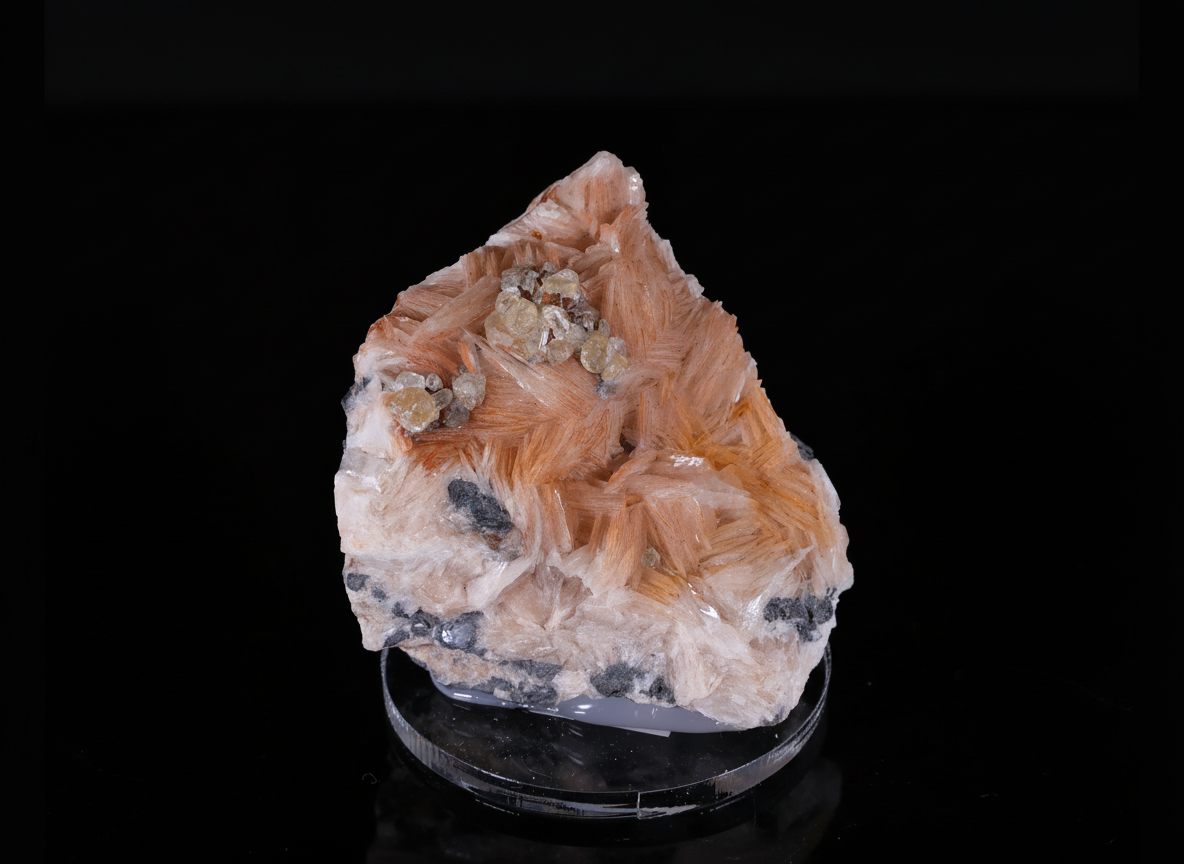
A classic and very aesthetic paragenesis from the Moroccan Mibladen region. The main part of the specimen consists of densely intergrown, lamellar baryte crystals of a distinct salmon-orange color. Fine, but highly vitreous and translucent yellowish cerussite crystals are clearly visible on the surface of the baryte, forming beautiful twins in the center. A valuable asset of the cerussite crystals on this specimen is their distinct fluorescence under UV light. Main Features: salmon-orange, lamellar baryte; vitreous cerussite twins; distinct cerussite fluorescence in UV; metallic galena (matrix). Condition: Good plus. The front part of the specimen with cerussite crystals is in excellent condition, and the cerussites themselves are intact.
Price: 23 EUR (99 PLN)
Availability: In stock
Location: Mibladen, Midelt Province, Drâa-Tafilalet Region, Morocco
Size: 22 x 46 x 38 mm
Weight: 80 g
Chemical formula: Ba(SO₄)
Mohs hardness: 3
Characteristics Baryte is a barium sulfate, often forming well-developed crystals with a tabular or prismatic habit, as well as massive, granular, fibrous, radial, or reniform aggregates. Typical specimens can be colorless, white, yellow, brown, gray, or even blue, often with a pearly luster on cleavage surfaces. Physical Properties This mineral is characterized by a hardness of 3 on the Mohs scale, meaning it is relatively soft. Its density is 4.50, which is a high value for a non-metallic mineral. The luster of baryte is vitreous to resinous, and pearly on cleavage surfaces. The streak is white. Baryte can be transparent, translucent, or opaque. Colors and Varieties Baryte occurs in a wide range of colors, from colorless and white, through yellow, brown, gray, to blue. In transmitted light, it is often colorless, but can also be colored yellow, brown, green, or blue. No specific commercial varieties are distinguished, however, the diversity of colors and crystal forms makes each specimen unique. History and Name The name baryte comes from the Greek word "barys", meaning "heavy", which refers to its significant density. This mineral has been known for a long time, and its properties were used in antiquity, although not always under the same name. The modern name was introduced in the 18th century. Applications Baryte finds wide application in industry. It is the main source of barium, used for the production of barium compounds. Due to its high density, it is used as a weighting agent in drilling muds for oil and gas exploration. It is also used as a filler in paints, rubber, paper, and as a shield against X-rays in medicine.
Identification Baryte can be identified by its relatively low hardness (3 on the Mohs scale), high density (it is distinctly heavier than most similarly looking minerals), and characteristic cleavage. It often occurs as tabular crystals or lamellar aggregates. A white streak is also a diagnostic feature. Distinguishing from Similar Minerals Baryte can be confused with calcite, celestine, or gypsum. It is distinguished from calcite by its lack of reaction with hydrochloric acid and higher density. From celestine, which is isostructural with baryte, it is distinguished by a flame test (barium colors the flame green-yellow, strontium red). It is distinguished from gypsum by its higher hardness and density. Crystal Forms Baryte most often forms tabular crystals, often rhombic in shape, as well as prismatic ones. It also occurs as lamellar, granular, massive, fibrous, radial (so-called "baryte roses"), and reniform aggregates.
Genesis Baryte forms in a wide range of geological environments. It is a common hydrothermal mineral, occurring in ore veins, where it crystallizes from hydrothermal solutions. It can also form in sedimentary carbonate rocks, in Mississippi Valley Type (MVT) deposits, and in igneous rocks, especially in carbonatites and alkaline rocks. It also occurs in the oxidation zones of sulfide deposits. Mineral Associations Baryte often co-occurs with many other minerals, depending on the environment of formation. In hydrothermal veins, it is often accompanied by galena, sphalerite, chalcopyrite, fluorite, quartz, calcite, and dolomite. In sedimentary rocks, it can occur with calcite, dolomite, and gypsum. In MVT deposits, it often co-occurs with fluorite and galena. Locations Known baryte localities are found worldwide. Important locations include: Frizington in England, where beautiful blue crystals occur; Cave-in-Rock in Illinois, USA, known for large, transparent crystals; Baia Sprie in Romania; Freiberg in Germany; and numerous places in China, Morocco, and Brazil.
Quality Criteria The collector's value of baryte depends on several factors. The most prized are well-formed, large, and transparent crystals with intense coloration, especially blue or yellow. The aesthetics of the specimen are also important, meaning the arrangement of crystals on the matrix and the absence of mechanical damage. Specimens with rare crystal forms or in association with other attractive minerals are also of great interest. Popular Localities Among the most valued baryte localities are those that provide specimens of exceptional aesthetics and quality. These include: Frizington in England (blue barytes), Cave-in-Rock in Illinois, USA (large, transparent crystals), Baia Sprie in Romania, and some locations in Morocco and China, where specimens of diverse colors and forms are found.
See mineralogical reference for Baryte in the Knowledge Base →