SKU: B_26_0031
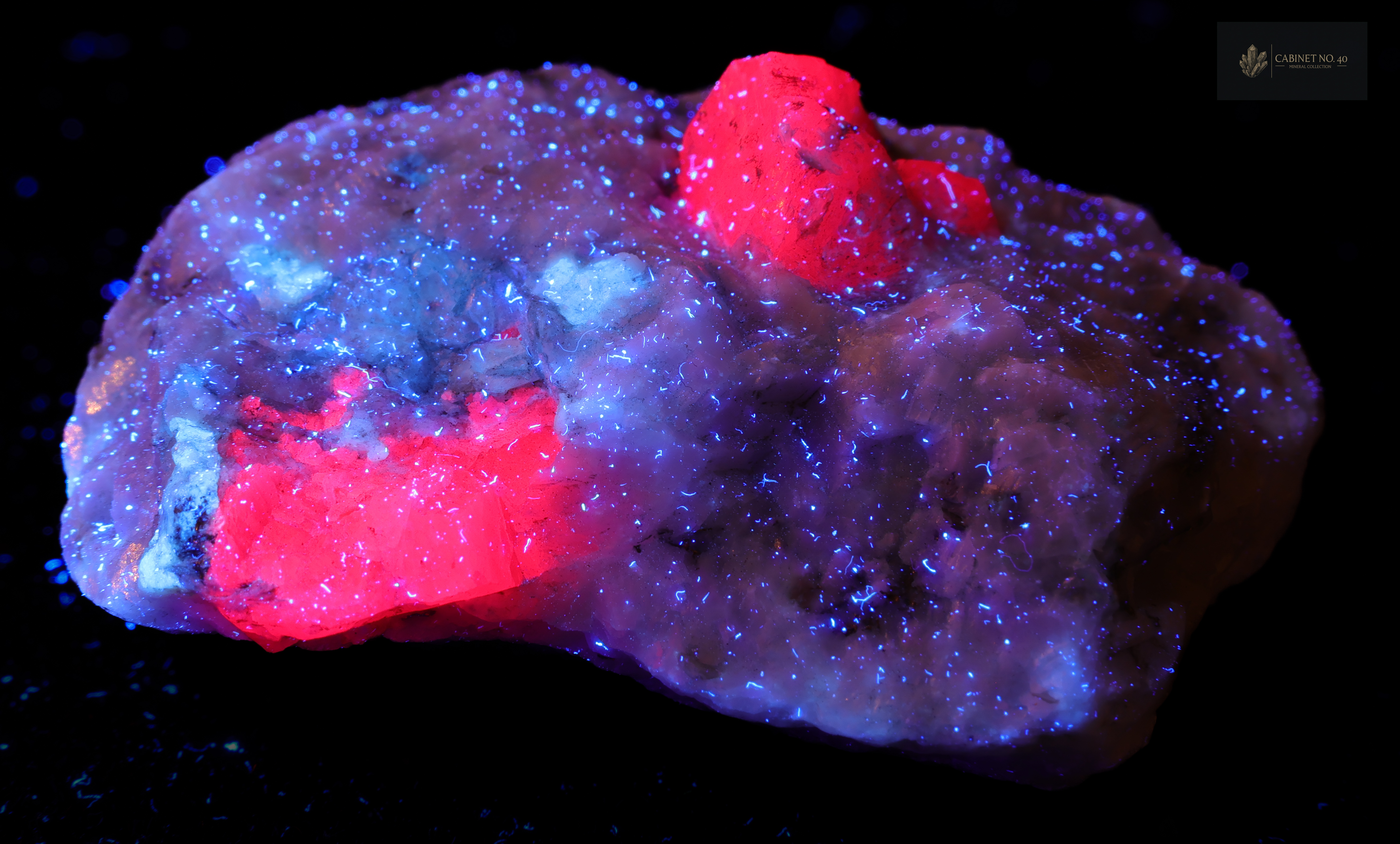
A collector's specimen. Two visible ruby crystals embedded in a light-colored, massive matrix, creating a clear color contrast and an easily recognizable character for the specimen. Under UV light, it exhibits intense red fluorescence.
Price: 46 EUR (199 PLN)
Availability: In stock
Location: Jegdalek, Afghanistan
Size: 43 x 35 x 23 mm
Weight: 40.4 g
Chemical formula: Al₂O₃
Crystal system: Trigonal
Mohs hardness: 9.0
Rarity: Uncommon
Characteristics Ruby is a red variety of corundum, an aluminum oxide. Its color ranges from pink to deep red, often with a purple hue. Typical ruby specimens occur as hexagonal prisms or tabular crystals, often with rounded edges. Crystals can be embedded in the host rock or occur as loose grains. It is characterized by an adamantine to vitreous luster. Physical Properties Ruby is one of the hardest minerals, reaching 9 on the Mohs scale. It has a density in the range of 3.97-4.05 g/cm³. It is brittle and exhibits no cleavage, meaning it fractures irregularly. The fracture is conchoidal to uneven. Colors and Varieties The color of ruby is caused by the presence of chromium in the crystal structure. Shades of red can vary greatly, from light pink to dark red, often with an admixture of violet or brown. The most prized rubies are those with an intense, deep red, referred to as “pigeon's blood”. History and Name The name “ruby” comes from the Latin word “ruber”, meaning red. This mineral has been known and valued since antiquity, mentioned in Sanskrit and biblical texts. For centuries, it has been a symbol of power, love, and wealth. Many cultures attributed protective and healing properties to it. Uses Ruby is primarily a prized gemstone, used in jewelry making. Due to its hardness, synthetic corundum, including ruby, is used in industry as an abrasive material and in the production of precision mechanical components, such as watch bearings and lasers.
Identification Ruby can be identified by its characteristic red color, high hardness (scratches most minerals except diamond), and vitreous to adamantine luster. It often exhibits strong fluorescence under ultraviolet light, glowing red. Ruby crystals typically have a hexagonal habit. Distinguishing from Similar Minerals Ruby is sometimes confused with garnet, spinel, tourmaline (rubellite), and topaz. It can be distinguished from garnet and spinel by its hardness (ruby is harder). Garnet usually does not exhibit fluorescence. Ruby differs from tourmaline in its crystallographic system and lack of distinct cleavage. Topaz is also harder but has a different color and cleavage. Hardness testing and observation of fluorescence are key in diagnosis. Crystal Forms Ruby most commonly occurs as hexagonal prisms, tabular crystals, or barrel-shaped crystals. Crystals can be well-formed, with distinct faces, or have rounded edges. It also often forms granular or massive aggregates in the host rock.
Genesis Ruby forms in metamorphic rocks, such as marbles, gneisses, and schists, as a result of high-temperature and high-pressure processes. It can also occur in igneous rocks, especially in pegmatites and basalts. It is often found in alluvial secondary deposits, where it is resistant to weathering and transport. Mineral Associations Ruby often co-occurs with other minerals, such as marl, muscovite, biotite, phlogopite, spinel, garnet, zircon, rutile, and calcite. In alluvial deposits, it is accompanied by other heavy minerals, such as gold or sapphire. Locations The most important ruby deposits are located in Myanmar (Mogok Valley, Mong Hsu), Thailand, Sri Lanka, Tanzania, Vietnam, Madagascar, Afghanistan, and Pakistan. Smaller deposits also occur in other countries, including the USA (North Carolina, Montana) and Australia.
Quality Criteria The most important quality criteria for collector's rubies are color, transparency, size, and crystal form. Specimens with intense, deep red color, without visible inclusions and fractures, are most valued. Well-formed, large crystals with distinct faces are particularly sought after. Specimens embedded in an aesthetic matrix also have high collector's value. Popular Localities The most prized ruby specimens come from Myanmar, especially from the Mogok Valley, where rubies of the famous “pigeon's blood” color are mined. Other important sources include Thailand, Sri Lanka, and Tanzania, which also supply high-quality stones.
See mineralogical reference for Ruby in the Knowledge Base →