SKU: B_26_0032
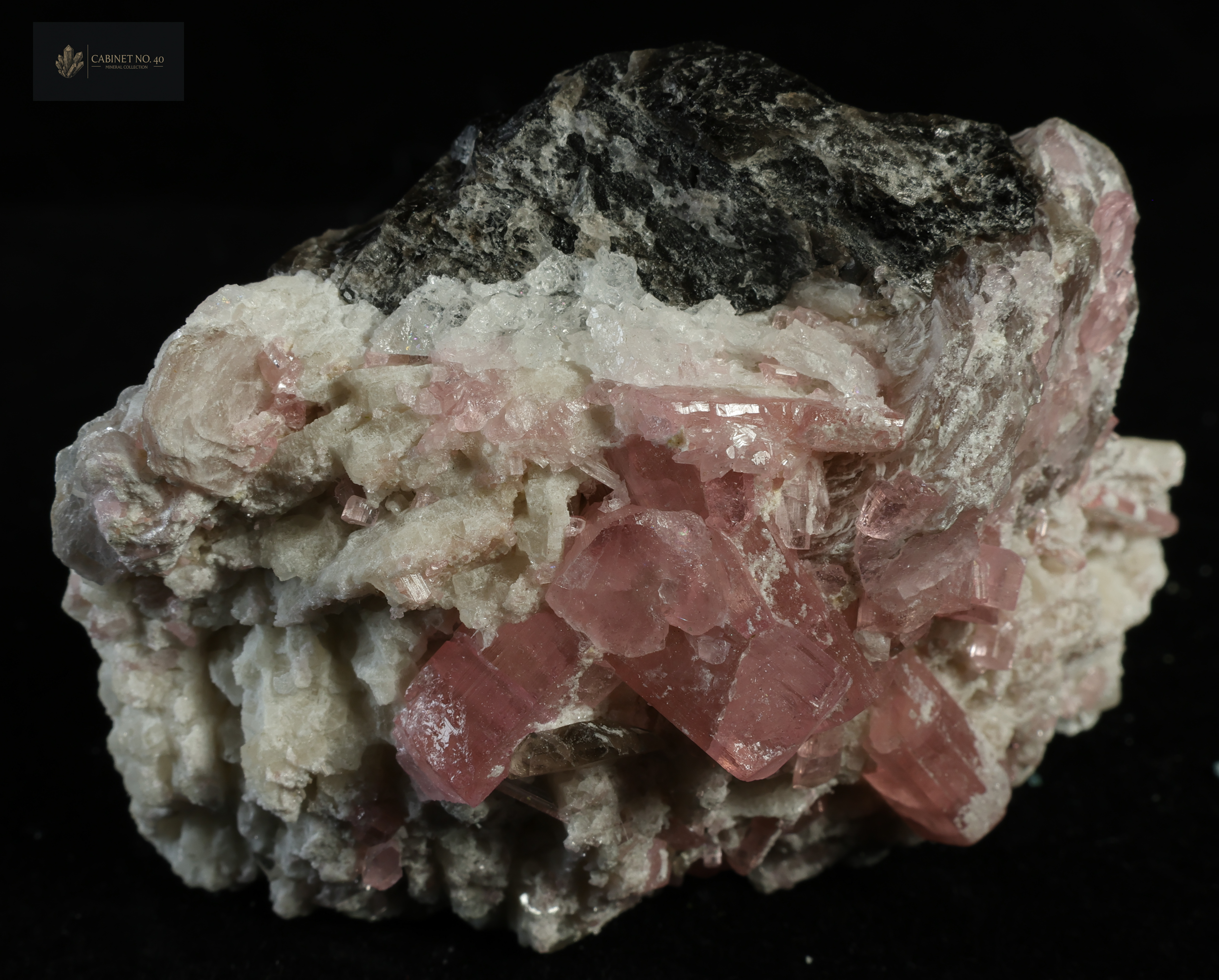
A collector's specimen, based on the contrasting arrangement of pink tourmaline crystals with a light matrix and darker parts of the host rock. Rubellite crystals have a color ranging from pink to pink-salmon, with visible prismatic structure. The terminations are partially developed, irregular in places, with minor chipping.
Price: 25 EUR (109 PLN)
Availability: In stock
Location: Kunar, Afghanistan
Size: 60 x 34 x 43 mm
Weight: 90.5 g
Chemical formula: Na(Li,Al)₃Al₆Si₆O₁₈(BO₃)₃(OH)₄
Crystal system: Trigonal
Mohs hardness: 7.0–7.5
Rarity: Uncommon
Characteristics Rubellite is a trade and collector's name for pink, red, or violet-red varieties of elbaite, which belongs to the tourmaline group. It occurs as elongated, prismatic, or columnar crystals with a triangular cross-section, often with characteristic striations along the faces. The color of rubellite results from the presence of manganese in its crystal structure. Crystals can be transparent to translucent, and their color intensity varies, often with lighter or colorless zones. Physical Properties Rubellite has a Mohs hardness of 7-7.5, making it a relatively scratch-resistant mineral. It possesses a vitreous luster. It is transparent to translucent. The density of rubellite ranges from 3.02-3.26 g/cm³. Colors and Varieties The color of rubellite ranges from light pink, through intense red, to violet-red. Pure red specimens are the most desired. Crystals with color zoning can occur, where part of the crystal is pink or red, and another part is colorless or a different shade. History and Name The name "rubellite" comes from the Latin word "rubellus", meaning reddish, which refers to the characteristic color of the mineral. It is a trade name used for centuries to describe red tourmalines, often confused with rubies before the development of modern mineralogy. Applications Rubellite is a valuable gemstone used in jewelry making, such as rings, necklaces, and earrings. Due to its color and hardness, it is often cut into various shapes. Specimens with high transparency and intense color are particularly sought after. It is also a popular collector's mineral, especially in the form of well-formed crystals on matrix.
Identification Rubellite can be identified by its characteristic pink to red color and the typical columnar or prismatic habit with a triangular cross-section, characteristic of tourmalines. Longitudinal striations on crystal faces are often visible. A hardness of 7-7.5 on the Mohs scale is also a diagnostic feature. Distinguishing from similar minerals Rubellite can be confused with ruby, garnet (especially almandine or pyrope), and spinel. It is distinguished from ruby by the absence of cleavage and a different crystal structure. It is distinguished from garnets and spinels by the triangular cross-section of its crystals and often visible striations. Tourmalines are also characterized by pyroelectricity and piezoelectricity, which can be an auxiliary feature in identification. Crystal forms Rubellite usually occurs as elongated, columnar, or prismatic crystals. It often forms parallel or radial aggregates. Crystals are typically hexagonal in cross-section, but due to their internal structure, their cross-section is often rounded and close to a triangle.
Genesis Rubellite, as a variety of elbaite, forms mainly in granitic pegmatites, which are coarse-grained igneous rocks. It forms in the final stages of magma crystallization, under conditions rich in lithium, boron, and other trace elements that give it its characteristic color. It can also occur in some hydrothermal veins. Mineral associations Rubellite often co-occurs with other pegmatitic minerals, such as quartz, feldspars (orthoclase, albite, microcline), muscovite, lepidolite, beryl (including morganite and aquamarine), and other tourmaline varieties (e.g., green verdelite, blue indicolite). Localities Numerous localities worldwide are known for rubellite occurrences. The most important include Brazil (especially the states of Minas Gerais and Paraíba), the United States (California, Maine), Madagascar, Afghanistan, Pakistan, Nigeria, Mozambique, and Russia (Urals).
Quality criteria The most prized rubellite specimens are characterized by an intense, pure red or pink color, high transparency, and the absence of visible inclusions. Well-formed, undamaged crystals, especially on an attractive matrix, are particularly sought after. Crystal size also affects its value, with larger, good-quality specimens being more expensive. Popular localities The most prized rubellite specimens come from Brazil, especially from the famous pegmatites of Minas Gerais, and from Pakistan and Afghanistan, where crystals of exceptional color and clarity are found. Specimens from California (USA) are also highly regarded by collectors.
See mineralogical reference for Rubellite in the Knowledge Base →