Red-orange crystals of Wulfenite from Red Cloud Mine

SKU: 0259_3-XX

A high-quality specimen of Wulfenite from the legendary Red Cloud Mine in Arizona. The centerpiece of the specimen is a dominant, sharply edged crystal with an intense orange-red color, characterized by high transparency and a strong luster. Specimens from Red Cloud are considered the world standard for Wulfenite. Main Features: intense orange-red color; sharp, tabular crystals; high luster; world-class location; ex coll. K. Urbanik. Condition: Very good - the main crystal is intact, with sharp edges and excellent clarity; smaller crystals on the matrix are mostly complete.
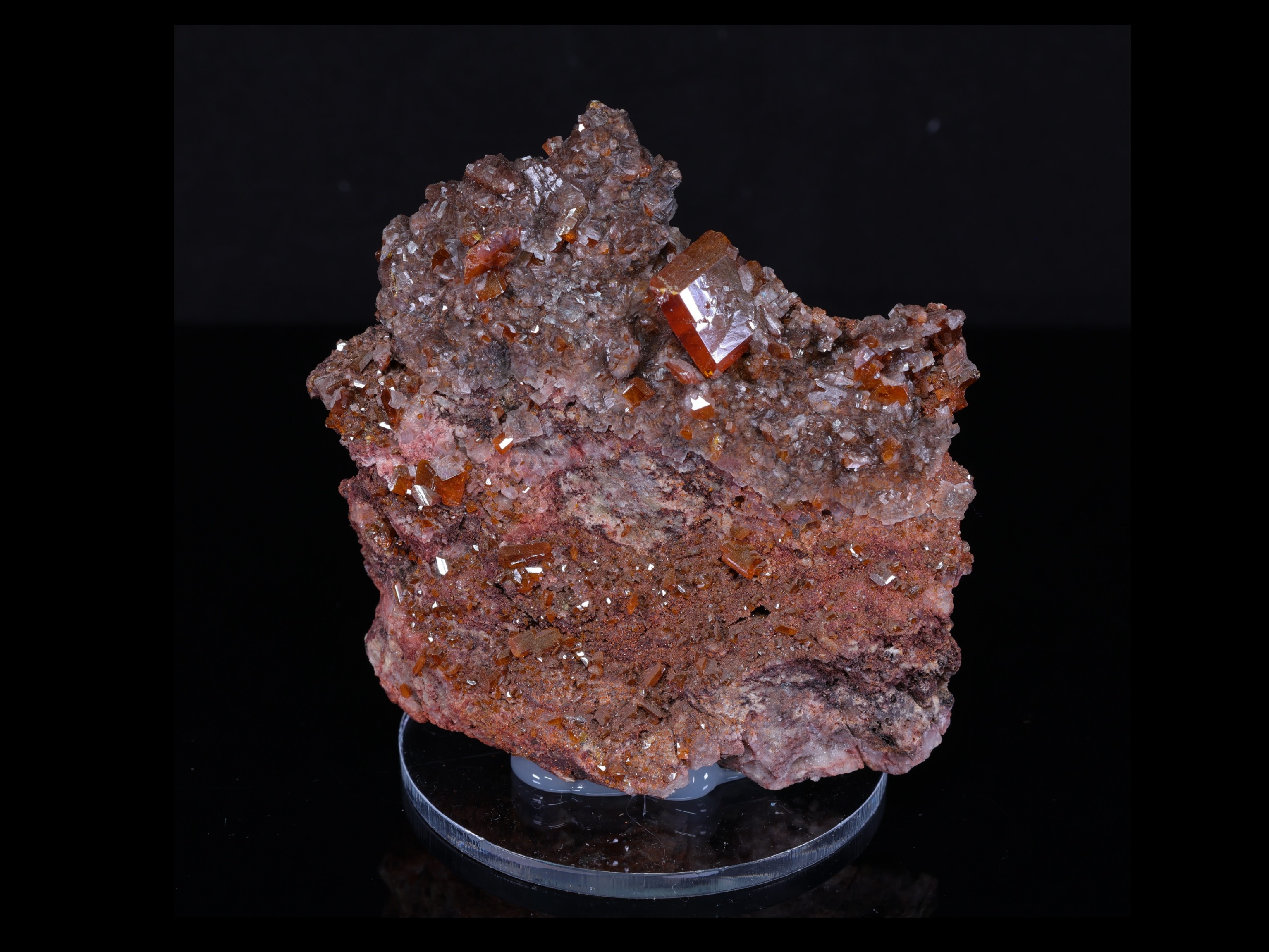
Red-orange crystals of Wulfenite from Red Cloud Mine

Price: 195 EUR (849 PLN)

Availability: In stock

Location: Red Cloud Mine, Silver Mining District, La Paz County, Arizona, USA

Size: 60 x 20 x 65 mm

Weight: 78 g

Chemical formula: PbMoO₄

Crystal system: Tetragonal

Mohs hardness: 2.75–3

Mineral group: Monazite Group Minerals

Rarity: Uncommon

Characteristics Wulfenite is a lead molybdate, often occurring as thin, square or octahedral crystals. These crystals are typically flattened, with distinct faces and sharp edges, giving them a characteristic appearance. It often forms tabular aggregates, less commonly prismatic. The crystal surface can be smooth and lustrous. Physical Properties Wulfenite has a Mohs hardness of 2.5-3, making it a relatively soft mineral. Its luster is resinous to adamantine, and its streak is white. The density of wulfenite is approximately 6.5 g/cm³. This mineral is transparent, translucent, or opaque. Colors and Varieties The most common colors of wulfenite are shades of yellow, orange-yellow, honey-yellow, and reddish-orange. Rarer specimens are colorless, gray, brown, olive-green, and even black. The intensity of the color can vary, from pale yellow to deep, saturated orange. History and Name The mineral was described in 1845. The name wulfenite comes from Franz Xaver von Wulfen (1728-1805), an Austrian mineralogist and botanist, who first described this mineral. Uses Wulfenite is a prized collector's mineral due to its attractive colors and well-formed crystals. It has no significant industrial applications.

Diagnostic features

Identification Wulfenite can be identified by its characteristic, often tabular or pyramidal crystals, which usually have intense yellow to orange colors. Resinous to adamantine luster and low hardness (2.5-3 on the Mohs scale) are also diagnostic features. Distinguishing from Similar Minerals This mineral can be confused with mimetite or vanadinite due to similar colors and occurrence environments. However, wulfenite typically has more flattened, tabular crystals, while mimetite and vanadinite often form prismatic or barrel-shaped crystals. Crystal habit is a key distinguishing feature. Crystal Forms Wulfenite most often forms tabular crystals, often thin and square or rhombic. Pyramidal, bipyramidal, and less commonly prismatic crystals may also occur. Aggregates can be granular or encrusting.

Formation environment

Genesis Wulfenite is a secondary mineral, forming in the oxidation zones of lead ore deposits. It forms as a result of reactions between molybdenum-bearing solutions and lead minerals, such as galena. It occurs in paragenesis with other secondary minerals characteristic of the oxidation zone. Mineral Associations Wulfenite often co-occurs with minerals such as cerussite, anglesite, galena, limonite, calcite, barite, and vanadinite. Localities Known wulfenite localities are found in many places around the world. The most important include: Tsumeb in Namibia, Red Cloud Mine in Arizona (USA), Los Lamentos in Mexico, Bleiberg in Austria, and Kary-Oba in Kazakhstan.

For the collector

Quality Criteria The most prized wulfenite specimens are those with well-formed, large, transparent crystals of intense, uniform color, especially orange or reddish-orange. Specimens with crystals set on an aesthetic matrix, creating contrasting compositions, are particularly sought after. Clarity and lack of mechanical damage to the crystals also affect value. Popular Localities The most highly valued wulfenite specimens come from localities such as the Red Cloud Mine in Arizona (USA), known for its large, bright red crystals, and Tsumeb in Namibia, where specimens of exceptional transparency and color have been found. Mexican deposits, especially Los Lamentos, also yield high-quality wulfenites.

See mineralogical reference for Wulfenite in the Knowledge Base →

View product →