Red grossular hessonite with clinochlore from Italy

SKU: S_00137

The specimen presents a classic paragenesis from these Italian metamorphosed rocks. In a wide, shallow depression of the hard matrix, a rich cluster of small, but extremely lustrous garnet crystals - grossular in the hessonite variety - has formed. The crystals have a deep, reddish-brown color and a sharp, glassy luster that beautifully reflects light. They are directly accompanied by dark green, scaly aggregates of clinochlore, creating a distinct color and structural contrast with the shiny surface of the garnets. Main Features: variety of grossular (hessonite); deep, reddish-brown color; strong, glassy luster of the crystals; contrasting green aggregates of clinochlore. Condition: Very good. The hessonite crystals in the rock depression are well-protected, sharp, and intact, ensuring their exceptional luster. Most of the clinochlore aggregates also remain in good condition.
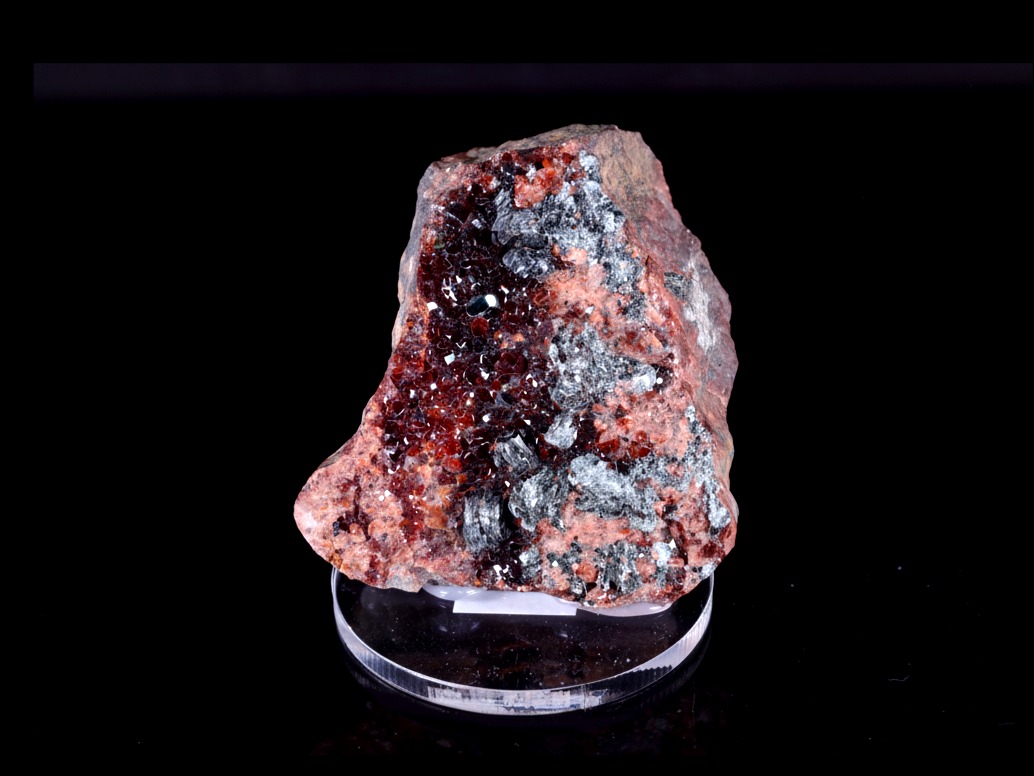
Red grossular hessonite with clinochlore from Italy

Price: 25 EUR (109 PLN)

Availability: In stock

Location: Rocca della Marasca, Urbe, Savona Province, Liguria, Italy

Size: 18 x 50 x 48 mm

Weight: 60 g

Chemical formula: Ca₃Al₂(SiO₄)₃

Mohs hardness: 7-7.5

Characteristics Hessonite is a variety of grossular garnet, a mineral belonging to the silicate group. Typical hessonite specimens occur in orange-yellow, reddish-brown hues, and also in the rarer color described as "aurora red". It often exhibits a characteristic, somewhat vitreous luster. Hessonite crystals can be isometric, often in the form of rhombic dodecahedra or icositetrahedra. In larger specimens, inclusions are sometimes observed, which can give the stones a unique appearance. Physical Properties Hessonite is characterized by a Mohs hardness of 7-7.5, which makes it relatively scratch-resistant. It has a vitreous luster. It is transparent to translucent. Its specific gravity is approximately 3.62 g/cm³. Colors and Varieties Hessonite colors cover a wide range of shades, from honey-yellow, through orange, to reddish-brown. The name "hessonite" refers precisely to these characteristic colors, often compared to cinnamon, hence it is sometimes called "cinnamon stone". The intensity of the color depends on the iron and manganese content in the mineral's structure. History and Name The name "hessonite" comes from the Greek word "hesson", meaning "inferior" or "weaker", referring to its lower hardness and density compared to other garnet varieties. This mineral was known and valued in antiquity, used as an ornamental stone. Its presence in jewelry and historical artifacts testifies to a long tradition of its use. Applications The main application of hessonite is in jewelry. Due to its hardness, attractive colors, and luster, it is a popular ornamental stone, used for making rings, necklaces, and other jewelry items. It is also valued by mineral collectors for its well-formed crystals and aesthetic appearance.

Diagnostic features

Identification Hessonite can be identified by its characteristic color, which ranges from orange-yellow to reddish-brown. It often exhibits a vitreous luster. To confirm identification, a hardness test (7-7.5 on the Mohs scale) and specific gravity measurement (approximately 3.62 g/cm³) can be performed. Distinguishing from Similar Minerals Hessonite can be confused with other garnets, such as spessartine, as well as with some varieties of zircon or chrysoberyl. It is usually distinguished from spessartine by a slightly darker and more reddish color. It can be distinguished from zircon based on density and refractive index. Chrysoberyl usually has higher hardness and a different color. Crystal Forms Hessonite most often occurs as well-formed crystals with a rhombic dodecahedral or icositetrahedral habit. It can also form granular or massive aggregates.

Formation environment

Genesis Hessonite primarily forms in metamorphic rocks, such as skarns and marbles, which are the result of contact or regional metamorphism. It forms under conditions of high temperatures and pressures, where recrystallization of calcium- and aluminum-rich minerals occurs. Mineral Associations Hessonite often co-occurs with other minerals typical of metamorphic environments, such as diopside, vesuvianite, wollastonite, calcite, quartz, and other garnet varieties. Localities Significant hessonite deposits are found in Sri Lanka, where high-quality specimens are mined. Other important localities include Brazil, Canada (Quebec), Mexico (Coahuila state), Russia (Urals), Tanzania, Pakistan, Italy, and the United States (California, Vermont).

For the collector

Quality Criteria The most prized hessonite specimens are characterized by intense, uniform color, high transparency, and the absence of visible inclusions. Well-formed crystals with distinct faces and sharp edges are particularly sought after by collectors. The size of the stone also affects its value, with larger, good-quality specimens being rarer and more expensive. Popular Localities Sri Lanka is historically and remains one of the most important sources of high-quality hessonite. Specimens from this region are valued for their color and clarity. Other popular localities that yield interesting specimens include Brazil and Tanzania.

See mineralogical reference for Hessonite in the Knowledge Base →

View product →