SKU: S_00013
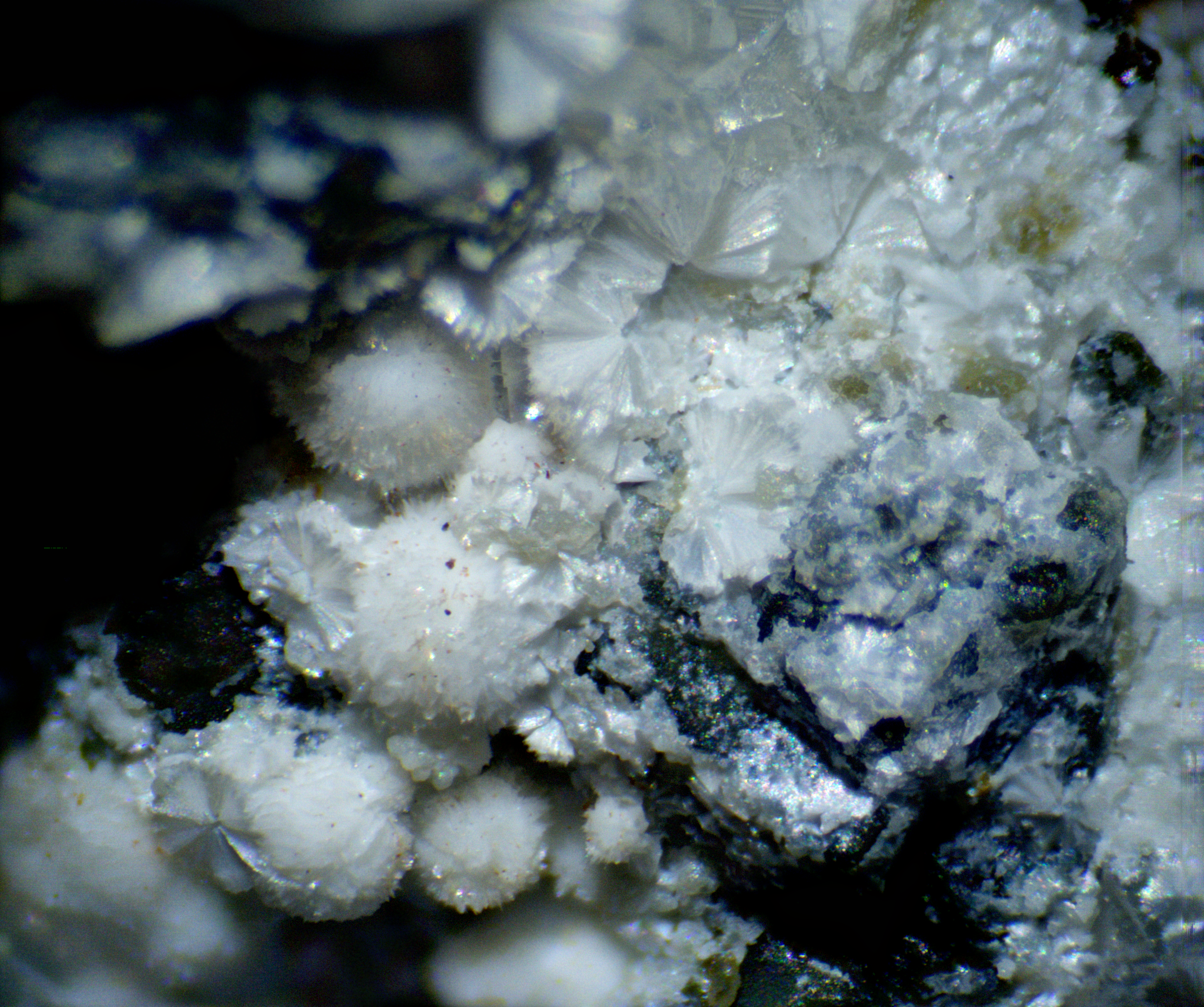
A rare mineral from a classic German locality in the Eifel region. The mineral forms exceptionally aesthetic, white aggregates. The specimen reveals its full beauty under magnification. Main Features: rare zeolite species; classic locality; high contrast with the matrix. Condition: Very good - delicate and brittle aggregates of Cowlesite are naturally protected in the recesses of the matrix, preserving their intact structure and original luster.
Price: 27 EUR (119 PLN)
Availability: In stock
Location: Heimbach, Germany
Size: 23 x 30 x 16 mm
Weight: 200 g
Chemical formula: CaAl₂Si₃O₁₀·5-6H₂O
Crystal system: Ortorombowy
Mohs hardness: 5-5.5
Characteristics Cowlesite is a mineral from the zeolite group, typically forming radial, fibrous, or lamellar aggregates, often arranged in spherical clusters. Specimens are usually white or colorless, with a vitreous luster. Crystals are generally small, microscopic, making observation difficult without magnification. This mineral is valued by collectors for its rarity and delicate crystalline forms. Physical Properties Cowlesite has a Mohs hardness of 5-5.5. It exhibits perfect cleavage along the {010} plane. The specific gravity of this mineral is approximately 2.14. Cowlesite's luster is vitreous, and its streak is white. It is a transparent mineral. Colors and Varieties Cowlesite most commonly occurs in white or is colorless. No specific color varieties or trade names for this mineral are known. History and Name Cowlesite was discovered in 1975. The mineral is named after the American mineralogist and collector, John Cowles, who found the first specimens in the Goble quarry in Oregon, USA. This discovery was significant for expanding knowledge about zeolites and their occurrences. Uses Cowlesite has no industrial applications due to its rarity and small crystal sizes. It is a mineral of purely collectible and scientific importance, of interest to mineralogists and enthusiasts.
Identification Cowlesite can be identified by its characteristic radial or spherical aggregates, which are often white or colorless. Microscopic crystals with a vitreous luster are typical for this mineral. Accurate identification often requires laboratory tests, such as X-ray diffraction. Distinguishing from Similar Minerals Cowlesite can be confused with other zeolites, such as chabazite or heulandite, which also form white or colorless crystals. However, it differs from them in details of its crystal structure and chemical composition. Differentiation in the field is difficult and often requires specialized knowledge and equipment. Crystal Forms Cowlesite most commonly occurs as radial fibrous or lamellar aggregates, which often arrange into spherical clusters. Crystals are usually very small, microscopic, with a tabular or acicular habit.
Genesis Cowlesite is a secondary mineral, forming in low-temperature hydrothermal environments, often in fractures and cavities in volcanic rocks, especially basalts. It crystallizes from solutions rich in calcium, aluminum, and silicon, in the presence of water. Mineral Associations Cowlesite often co-occurs with other zeolites, such as chabazite, heulandite, stilbite, analcime, as well as with calcite, apophyllite, and quartz. It also occurs in association with clay minerals. Localities The most important cowlesite localities are in the United States, especially the Goble quarry in Oregon, where it was discovered. Other known localities include Iceland, India (Deccan Traps), Australia, New Zealand, and Russia.
Quality Criteria The most prized cowlesite specimens are those that display well-formed, radial or spherical aggregates with distinct crystallization and a clear, white or colorless hue. Large, aesthetic clusters on a matrix are particularly sought after. Purity and absence of mechanical damage also contribute to the specimen's value. Popular Localities The most valued cowlesite specimens typically come from the Goble quarry in Oregon, USA, due to the historical significance of this site and the quality of the finds there. Other localities, such as those in India or Iceland, also provide interesting specimens.
See mineralogical reference for Cowlesite in the Knowledge Base →