SKU: B_20_0006
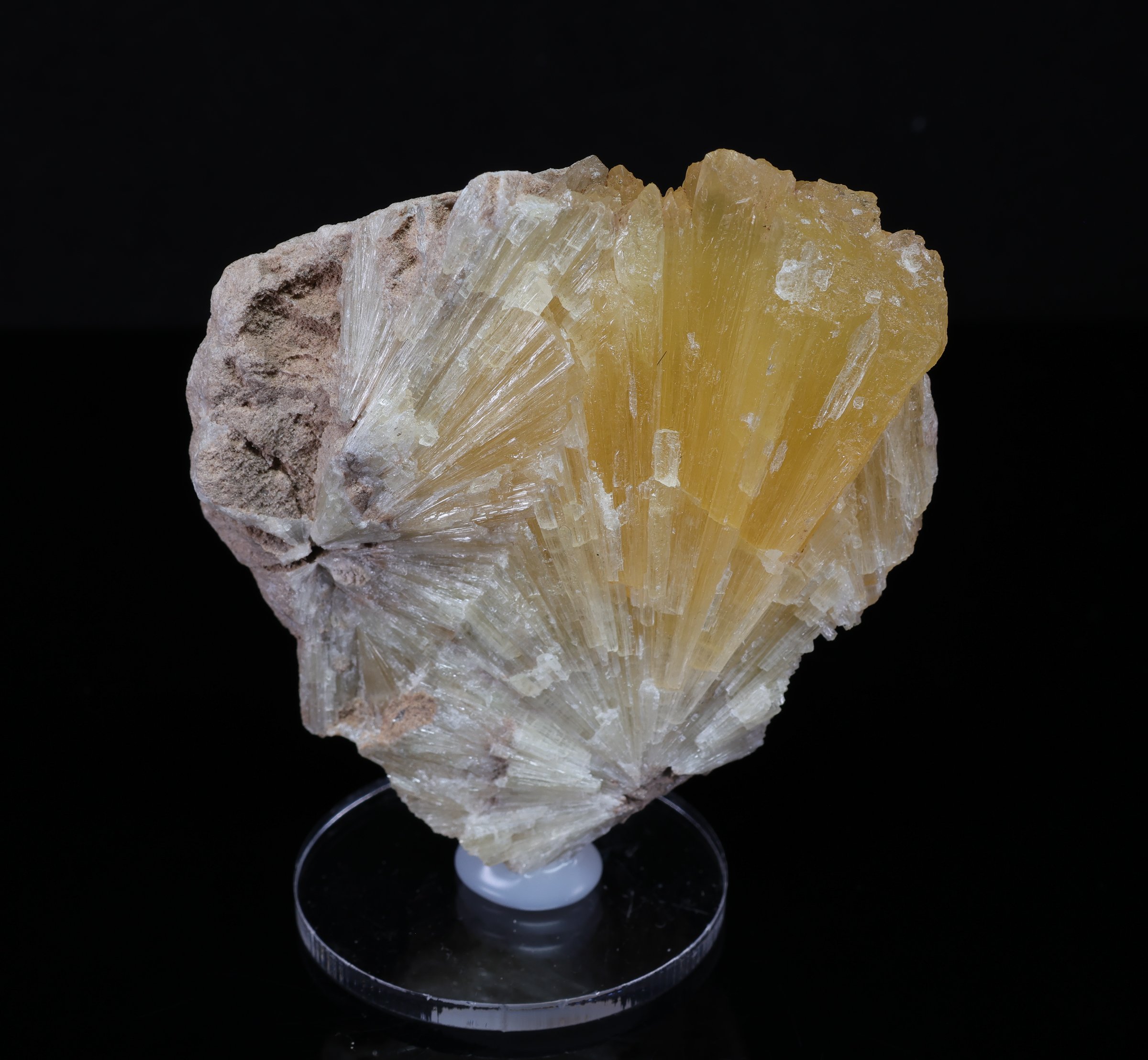
A specimen of calcite from Pakistan with a distinct radiating crystallization pattern. Elongated, intergrown crystals form a structure resembling an open fan, which grows directly on a light matrix. The coloration of the mineral is zoned - smoothly transitioning from whitish at the base to a saturated honey-yellow hue at the edges. The greatest asset of the specimen is its extremely strong, bright fluorescence and pronounced phosphorescence under UV light. Main Features: radiating, fan-like morphology; distinct, two-colored zoning; strong reaction under UV light. Condition: Good - natural irregularities and minor abrasions are visible on the outer edges of the fan.
Price: 16 EUR (69 PLN)
Availability: In stock
Location: -, Pakistan
Size: 65 x 22 x 67 mm
Weight: 107.4 g
Chemical formula: Ca(CO₃)
Mohs hardness: 3
Characteristics Calcite is a carbonate mineral, a variety of calcium carbonate, which occurs in many geological environments. Typical calcite specimens can take on very diverse forms, from well-developed crystals, through massive, granular, and speleothem aggregates, to stalactites and stalagmites. It often forms rhombohedra, scalenohedra, or prismatic crystals, which can reach considerable sizes. Crystal surfaces can be smooth and shiny, but may also show striations or other growth structures. Physical Properties Calcite is characterized by a hardness of 3 on the Mohs scale, which means it is relatively soft and can be scratched by a copper wire. It has perfect cleavage, forming rhombohedral fragments. Calcite's luster is vitreous, and its density is 2.7102 g/cm³. This mineral is transparent to translucent, and its streak is white. Colors and Varieties Calcite occurs in a very wide range of colors, which is a result of the presence of various impurities. It can be white, yellow, red, orange, blue, green, brown, gray, and even black or colorless. The colorless, transparent variety of calcite, exhibiting strong birefringence, is known as Iceland spar. History and Name The name calcite comes from the Greek word "chalx", meaning lime. This mineral has been known and used since antiquity, mainly as a building and sculptural material. Its optical properties, especially birefringence, were described in the 17th century by Erasmus Bartholin, which was of significant importance for the development of optics. Applications Calcite has wide industrial applications. It is the main component of limestones and marbles, used as building materials, aggregates, and raw material for cement and lime production. Iceland spar, due to its optical properties, was historically used in polarizers and other optical instruments. Calcite is also a valued collectible mineral due to its variety of forms and colors.
Identification Calcite can be identified by its relatively low hardness (3 on the Mohs scale), which allows it to be scratched by a copper wire. Its excellent cleavage in three directions, forming rhombohedral fragments, is also characteristic. The reaction with hydrochloric acid (even dilute) is strong and visible as intense effervescence, which is a diagnostic feature for carbonates. Many varieties of calcite also exhibit birefringence, especially visible in transparent crystals. Distinguishing from Similar Minerals Calcite can be confused with dolomite, aragonite, or gypsum. It is distinguished from dolomite by its stronger reaction with cold, dilute hydrochloric acid (dolomite reacts weaker or requires heating). From aragonite, which has the same chemical composition but a different crystal structure, it is distinguished by its hardness (aragonite is harder, 3.5-4) and lack of perfect cleavage. Calcite is harder than gypsum (hardness 2) and reacts with acids. Crystal Forms Calcite forms very diverse crystal forms. The most common are rhombohedra, scalenohedra (crystals with the shape of double pyramids), and prismatic crystals. It can also occur in tabular, acicular forms, and also form granular, massive, fibrous, speleothem aggregates (stalactites, stalagmites), and concretions.
Genesis Calcite is one of the most widespread minerals on Earth, forming under a wide range of geological conditions. It is the main component of sedimentary rocks such as limestones and chalk, which form in marine environments from the accumulation of marine organism remains (shells, skeletons). In metamorphic rocks, such as marbles, calcite forms as a result of the recrystallization of limestones under high temperature and pressure. It also occurs in hydrothermal veins, in fractures of igneous and metamorphic rocks, where it crystallizes from aqueous solutions. It is also a common mineral in caves, forming speleothems, stalactites, and stalagmites. Mineral Associations Calcite often co-occurs with many other minerals, depending on the geological environment. In limestones and marbles, it is accompanied by dolomite, quartz, pyrite, and clay minerals. In hydrothermal veins, it can occur with quartz, fluorite, barite, galena, sphalerite, and other ore minerals. In caves, it forms alone or in association with aragonite. Localities Calcite is a global mineral, occurring on all continents. Numerous localities are known worldwide, including Mexico (Naica, Chihuahua - famous giant crystals), USA (Missouri, Illinois, Tennessee), Iceland (Iceland spar), Great Britain (Cumbria), Germany (Harz), Romania, China, and many other countries. In Poland, calcite occurs in the Tatra Mountains, Pieniny Mountains, Świętokrzyskie Mountains, and in metal ore deposits in Lower Silesia.
Quality Criteria Collectors value calcite specimens for their aesthetics, rarity of form, intensity of color, and transparency. The most sought after are well-formed, large, and undamaged crystals, especially those with rare or unusual habits (e.g., scalenohedra, rhombohedra with sharp edges). Transparent crystals, especially Iceland spar, are highly prized for their optical properties. Specimens with interesting inclusions or in association with other attractive minerals also increase in value. Purity and lack of mechanical damage are crucial for assessing quality. Popular Localities Among the most prized calcite localities are those that yield spectacular crystals. The Mexican Naica caves are famous for their giant calcite crystals. Other important localities include mines in Missouri and Illinois (USA), where large, well-formed crystals have been found, as well as Iceland, a source of high-quality Iceland spar. European deposits, such as those in Cumbria (Great Britain) or the Harz region (Germany), have also yielded many valuable specimens.
See mineralogical reference for Calcite in the Knowledge Base →