SKU: S_00134
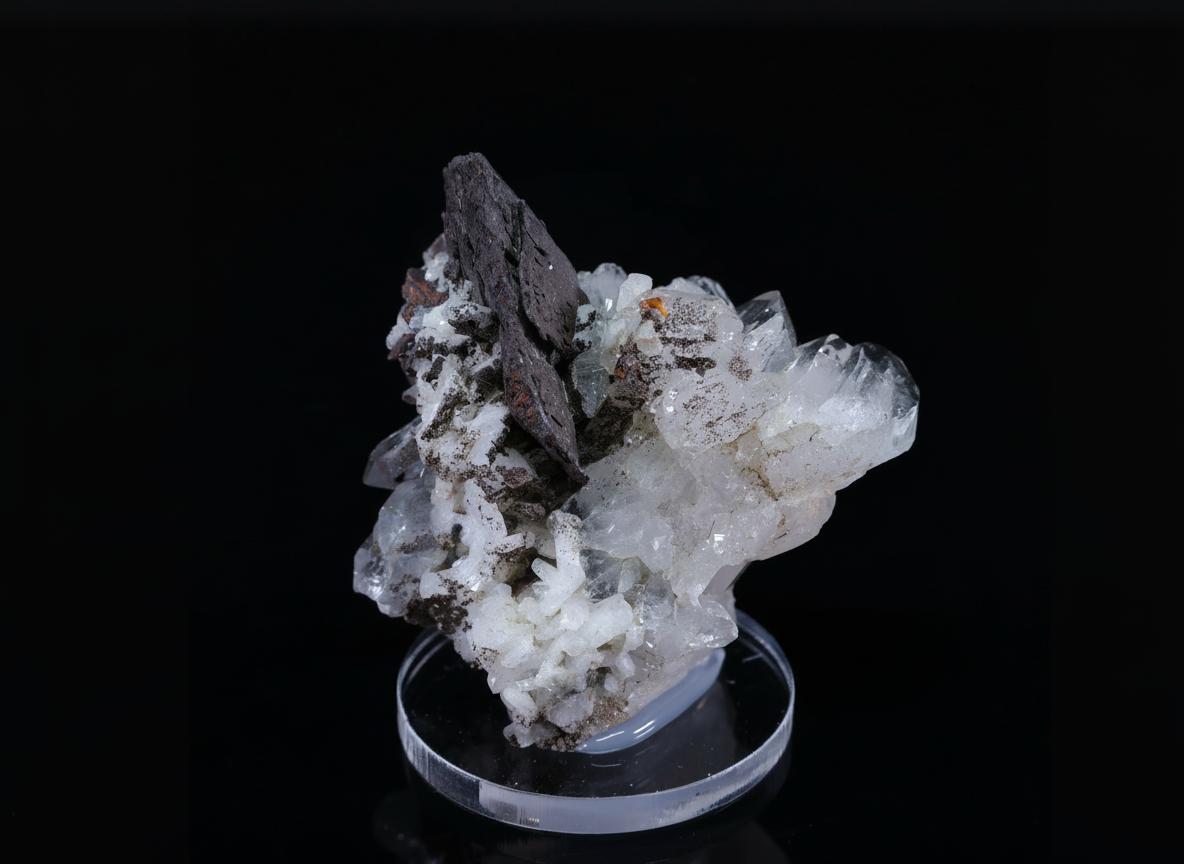
A three-dimensional specimen showcasing the classic combination of quartz and siderite. The focal point of the composition is a dominant, dark brown crystal of siderite with a characteristic habit. It is prominently displayed and set on a light matrix formed by aggregates of partially transparent quartz crystals and small feldspars. Main Features: exposed crystal of siderite with a disc-like habit; strong contrast between the dark siderite and the light quartz and feldspars; classic pegmatitic paragenesis; three-dimensional structure Condition: Good.
Price: 18 EUR (79 PLN)
Availability: In stock
Location: Skardu, Gilgit-Baltistan, Pakistan
Size: 40 x 23 x 37 mm
Weight: 28 g
Chemical formula: Fe(CO₃)
Mohs hardness: 3.5-4.5
Characteristics Siderite is an iron carbonate mineral belonging to the calcite group. It occurs as rhombohedral crystals, often with rounded edges, as well as in granular, massive, spherical, or radial forms. The color of siderite is variable, from yellowish-brown to grayish-brown, pale yellow, gray, brown, green, red, black, and rarely colorless. The surface of the mineral may exhibit iridescence. In transmitted light, siderite is colorless to yellow and yellowish-brown. Physical Properties Siderite is characterized by a Mohs hardness of 3.5-4.5. It has a vitreous luster. Its density is 3.96 g/cm³. The cleavage of siderite is perfect along rhombohedral planes. The streak of the mineral is white, and its transparency is translucent. Colors and Varieties Siderite occurs in a wide range of colors, including yellowish-brown, grayish-brown, pale yellow, gray, brown, green, red, and black. Colorless specimens are rare. The coloration often results from the presence of manganese or magnesium impurities, as well as from the oxidation of iron. History and Name The name siderite comes from the Greek word "sideros," meaning iron, which refers to the chemical composition of the mineral. The mineral was described in 1845 by the Austrian mineralogist Wilhelm von Haidinger. Uses Siderite is an iron ore mineral, although its importance as an ore is less than that of hematite or magnetite. It is also used as a collector's stone, especially specimens with well-formed crystals and attractive color.
Identification Siderite can be identified by its characteristic hardness (3.5-4.5 on the Mohs scale), vitreous luster, and perfect rhombohedral cleavage. It often occurs in granular aggregates or as rhombohedral crystals with variable color, from yellowish-brown to gray and black. A white streak is also a diagnostic feature. Distinguishing from Similar Minerals Siderite is sometimes confused with calcite, magnesite, or dolomite due to similar crystallographic habit and cleavage. It can be distinguished from calcite by its higher density and lack of reaction with dilute hydrochloric acid (siderite reacts with hot hydrochloric acid). It is distinguished from dolomite and magnesite by the presence of iron in its chemical composition, which affects its color and density. Crystal Forms Siderite most commonly forms rhombohedral crystals, often with rounded edges or curved faces. It also occurs as granular, massive, spherical (spherulitic), or radial aggregates. Sometimes it forms crusts or concretions.
Genesis Siderite forms in various geological environments. It often occurs in hydrothermal veins, where it crystallizes from iron- and carbonate-rich solutions. It can also form in sedimentary iron deposits, in reducing environments where iron precipitates from aqueous solutions. It is also found in metamorphic rocks and in some coal deposits. Mineral Associations Siderite often co-occurs with other carbonate minerals, such as calcite, dolomite, and ankerite. It can also be found in association with quartz, pyrite, chalcopyrite, galena, sphalerite, and various iron minerals such as hematite and goethite. Localities Known occurrences of siderite are found in many places around the world. Important deposits are located in Austria (Erzberg), Germany (Harz), Great Britain (Cornwall), United States (Colorado, California), Canada, Brazil, and China.
Quality Criteria The most valued siderite specimens are those with well-formed, large, and aesthetically pleasing crystals, especially rhombohedral forms. An attractive color, especially intense yellowish-brown, red, or green, increases its collector's value. Specimens with rare aggregate forms, such as spherulitic aggregates, and those that co-occur with other interesting minerals are also prized. Popular Localities Particularly prized siderite specimens come from Erzberg in Austria, where large, well-formed crystals are found. Other popular localities include mines in Harz, Germany, and Cornwall, Great Britain. Specimens from Colorado, USA, are also highly regarded by collectors.
See mineralogical reference for Siderite in the Knowledge Base →