Purple crystals of Scapolite from Afghanistan

SKU: B_40_0015

The specimen exhibits a striking contrast of purple crystals set in a lighter, white matrix. It showcases a centrally located, dark purple crystal with a translucent structure, along with smaller forms scattered along the host rock. Main features: saturated purple color; strong contrast with the light matrix; presence of a more pronounced, elongated crystal. Condition: Good.
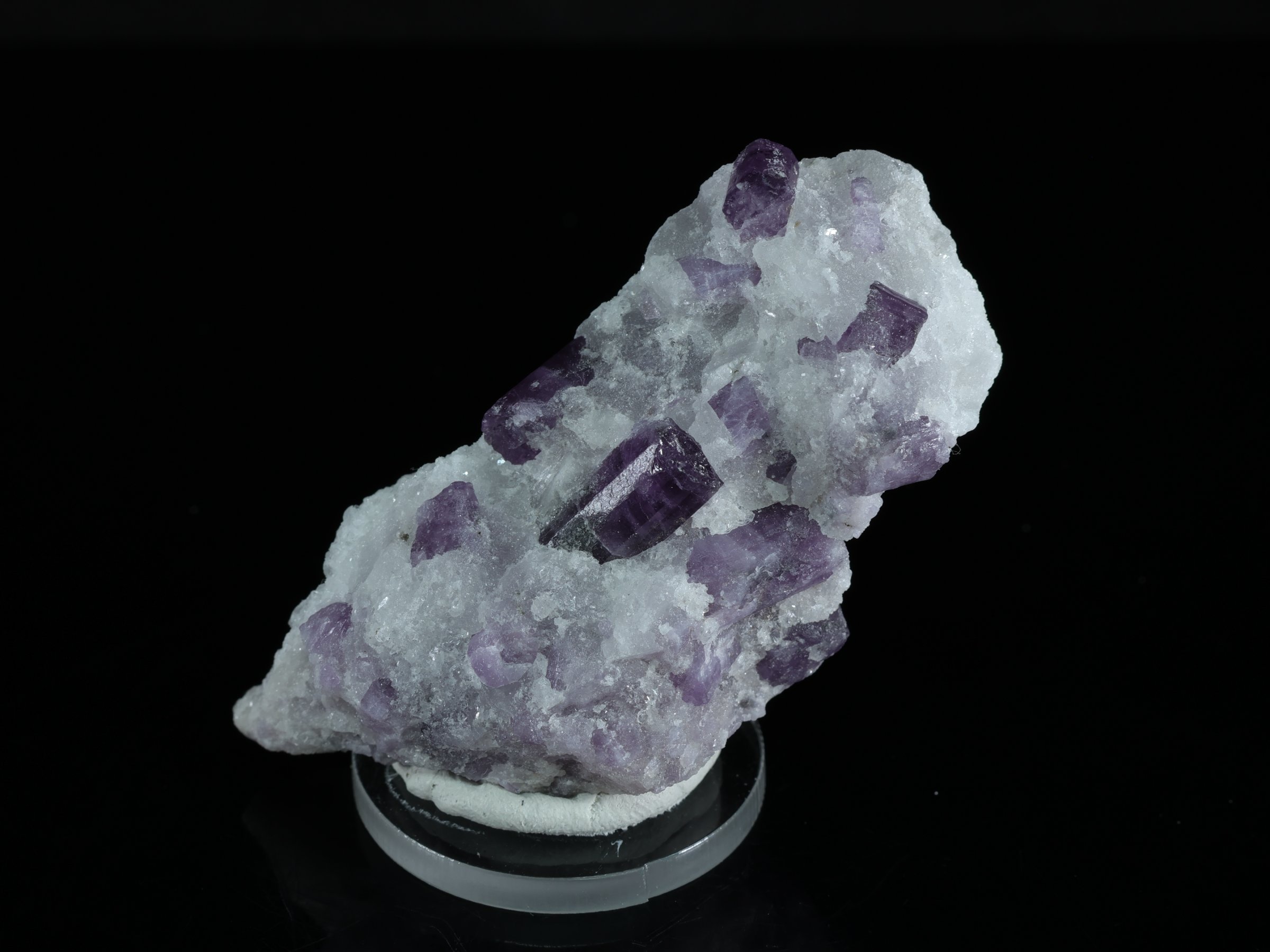
Purple crystals of Scapolite from Afghanistan

Price: 27 EUR (119 PLN)

Availability: In stock

Location: -, Afghanistan

Size: 31 x 22 x 62 mm

Weight: 33.1 g

Chemical formula: (Na,Ca)₄(Al,Si)₁₂O₂₄(Cl,CO₃,SO₄)

Mohs hardness: 5-6

Characteristics Scapolite is a mineral belonging to the silicate group, characterized by a variable chemical composition, being a solid solution of two end-members: marialite and meionite. Typical scapolite specimens occur as elongated, prismatic or tabular crystals, often with distinct striations along the longer axis. It can also form granular aggregates or massive forms. Its appearance is diverse, depending on its chemical composition and formation conditions. Physical Properties Scapolite has a hardness ranging from 5-6 on the Mohs scale. Its luster is vitreous to pearly, especially on cleavage surfaces. This mineral can be transparent, translucent, or opaque. The density of scapolite varies depending on its chemical composition. Colors and Varieties Scapolite occurs in a wide range of colors, most commonly white, gray, yellow, pink, purple, green, and even colorless. The color is often associated with the presence of trace element impurities. Some varieties exhibit chatoyancy (cat's eye effect) or asterism. Commercial varieties include, for example, purple scapolite from Tanzania, valued in jewelry. History and Name The name "scapolite" comes from the Greek word "skapos," meaning "rod" or "stem," which refers to the commonly observed prismatic habit of its crystals. The mineral was first described in 1800 by José Bonifácio de Andrada e Silva. Applications Scapolite rarely finds industrial application. Transparent and well-colored varieties are occasionally used in jewelry as ornamental stones, especially those exhibiting optical effects such as cat's eye. It is primarily a collector's mineral, valued for its diversity of colors and crystal forms.

Diagnostic features

Identification Scapolite can be identified by its characteristic prismatic or tabular habit, often with distinct striations. It occurs in a wide range of colors, and its Mohs hardness is 5-6. It often exhibits a vitreous or pearly luster. Distinguishing from Similar Minerals Scapolite can be confused with some plagioclase feldspars, tourmalines, or apatite. It is distinguished from plagioclase by the absence of characteristic twinning. It differs from tourmalines by crystal symmetry and the lack of a triangular cross-section. It is distinguished from apatite by its greater hardness. Crystal Forms Scapolite forms prismatic, acicular, or tabular crystals, often terminated pyramidally. Crystal faces are often longitudinally striated. It also occurs as granular aggregates, massive forms, or radial aggregates.

Formation environment

Genesis Scapolite primarily forms in metamorphic rocks, such as marbles, gneisses, and schists, as a result of calcic or sodic metasomatism. It can also occur in pegmatites, especially in contact zones with limestones, and in some igneous rocks, such as gabbros and diorites. Mineral Associations Scapolite often co-occurs with minerals such as calcite, diopside, garnet, hornblende, plagioclase, epidote, titanite, and apatite. Localities Significant scapolite deposits are found in many places around the world. Important localities include: Mogok in Myanmar (Burma), where purple and yellow crystals have been found; Itremo in Madagascar; Quebec Province in Canada; Minas Gerais in Brazil; and various locations in Tanzania, Norway, and the USA.

For the collector

Quality Criteria The most prized scapolite specimens are those with well-formed, transparent crystals of intense and uniform coloration. Specimens with a cat's eye effect or asterism are particularly sought after. The size of the crystals, their clarity, and the absence of mechanical damage also affect their collector's value. Popular Localities Among the most valued scapolite localities are Mogok in Myanmar, known for its purple and yellow crystals, and Itremo in Madagascar, where transparent, yellow, and pink specimens occur. Other important locations include Minas Gerais in Brazil and various localities in Tanzania, which supply high-quality jewelry material.

See mineralogical reference for Scapolite in the Knowledge Base →

View product →