Pink Adamite (Mn) from Ojuela Mine

SKU: S_00055

A specimen of the rarer, manganese-rich variety of adamite from a classic location. It features a centrally positioned, glassy crystal with a distinct violet-pink color, emerging from a brown matrix. The morphology of the main crystal and smaller side crystals is sharp, and their transparency is high, which is clearly visible under magnification. An additional, very attractive feature of the specimen is its strong, bright green fluorescence under UV light. Main Features: violet-pink color (manganese variety); high transparency and luster; strong green fluorescence in UV; contrasting matrix; classic location. Condition: Very good. The main adamite crystal is excellently exposed and preserved.
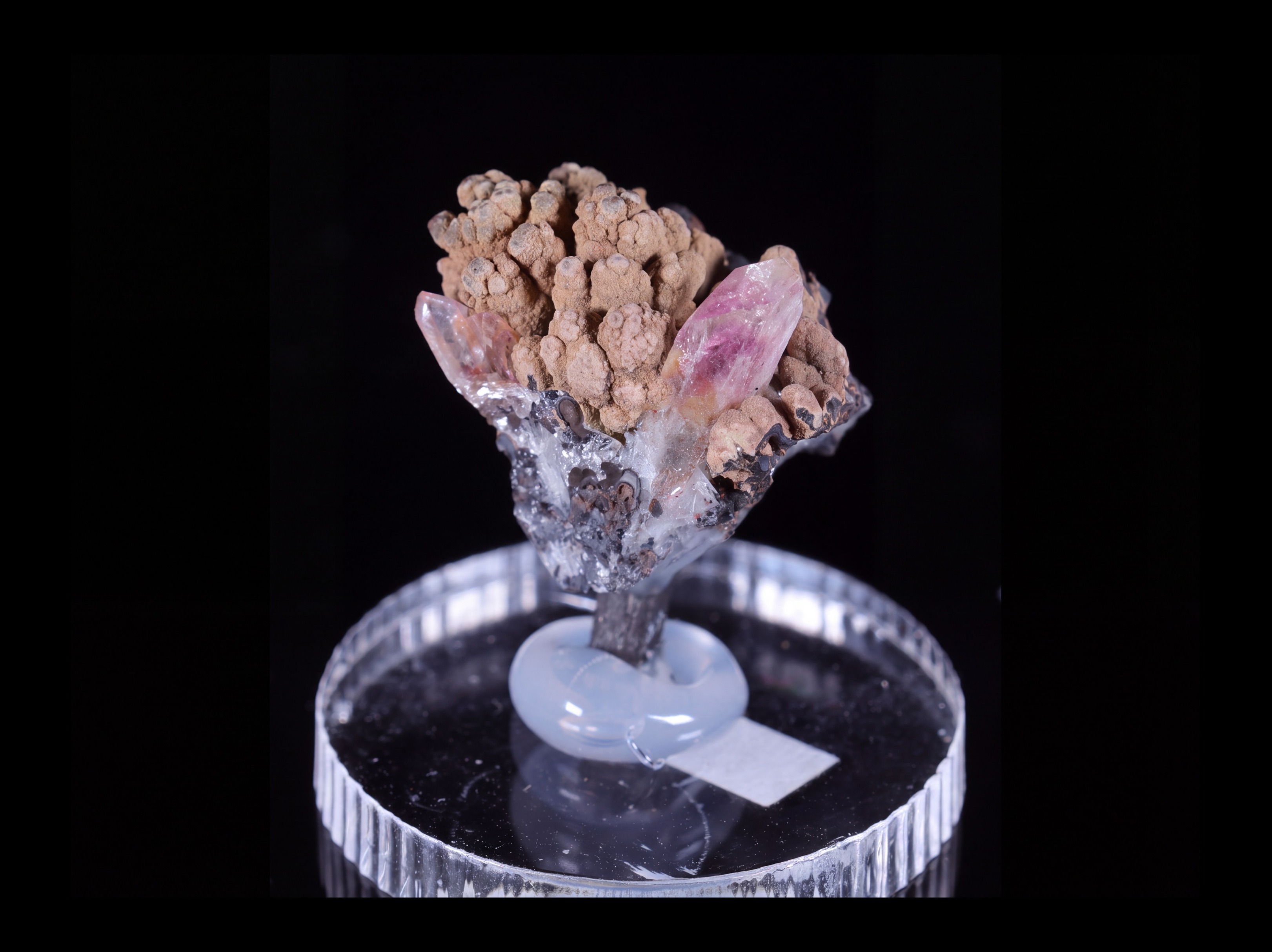
Pink Adamite (Mn) from Ojuela Mine

Price: 39 EUR (169 PLN)

Availability: In stock

Location: Ojuela Mine, Mapimi, Durango, Mexico

Size: 15 x 10 x 10 mm

Weight: 1 g

Chemical formula: Zn₂(AsO₄)(OH)

Crystal system: Orthorhombic

Mohs hardness: 3.5

Characteristics Adamite is a zinc arsenate with a hydroxyl group. It usually occurs as small, well-formed crystals, often forming radial aggregates, reniform or botryoidal crusts. Typical specimens are characterized by intense, often bright green or yellow color, which makes it attractive to collectors. Crystals can be transparent to translucent, with a distinct vitreous luster. Physical Properties Adamite's hardness on the Mohs scale is 3.5, which means it is a relatively soft mineral. It has a vitreous luster. It is transparent to translucent. The specific gravity is 4.32. Colors and Varieties Adamite occurs in a wide range of colors, although green and yellow specimens are the most prized. It can be colorless, white, pale yellow, honey-yellow, brownish-yellow, reddish-pink. Blue, pale green to green varieties also occur, often exhibiting color zoning. Copper-bearing varieties take on a bright green color, while those containing cobalt can be bright pink or purple. History and Name The mineral was discovered in 1866 and named after the French mineralogist Gilbert Joseph Adam, who first collected and described this mineral in a mine in Chañarcillo, Chile. Uses Adamite has no industrial uses. It is a mineral valued exclusively by collectors for its aesthetic qualities, intense colors, and often occurring fluorescence under ultraviolet light.

Diagnostic features

Identification Adamite can be identified by its characteristic colors, especially bright green or yellow, and its typical vitreous luster. It often forms radial or reniform aggregates, as well as small, well-formed crystals. An important diagnostic feature is its fluorescence under UV light, often intensely green or yellow. Distinguishing from Similar Minerals Adamite is sometimes confused with olivenite, which is also a copper and zinc arsenate, but usually has a darker green color and a different crystal habit. Aurichalcite can also be similar, but it usually has a lighter, more bluish-green color and is much softer. Differentiation often requires laboratory tests, such as chemical composition analysis. Crystal Forms Adamite crystallizes in the orthorhombic system. Crystals are usually small, prismatic or tabular, often forming radial, reniform, spherical, or botryoidal aggregates. Aggregates can be massive or granular.

Formation environment

Genesis Adamite is a secondary mineral, formed in the oxidation zones of zinc ore deposits, where arsenic-rich hydrothermal solutions react with zinc minerals. It occurs in paragenesis with other minerals of the oxidation zone. Mineral Associations Adamite often co-occurs with minerals such as limonite, hemimorphite, smithsonite, malachite, azurite, calcite, quartz, and gypsum. Localities Known adamite localities include the mines in Mapimí, Durango, Mexico, where some of the most beautiful specimens have been found. Other important occurrences are Tsumeb in Namibia, Laurion in Greece, Cap Garonne in France, and Broken Hill in Australia.

For the collector

Quality Criteria The most prized adamite specimens are characterized by intense, bright color (especially green or yellow), good crystal transparency, and distinct luster. The size and aesthetics of crystal aggregates, as well as the absence of mechanical damage, are also important. Specimens exhibiting strong fluorescence are particularly sought after. Popular Localities The most sought-after adamite specimens come from the Ojuela mine in Mapimí, Mexico, famous for its large, well-formed crystals of beautiful color. Other prized localities include Tsumeb in Namibia, known for rare color varieties, and Laurion in Greece.

See mineralogical reference for Adamite in the Knowledge Base →

View product →