SKU: P_26-3_8
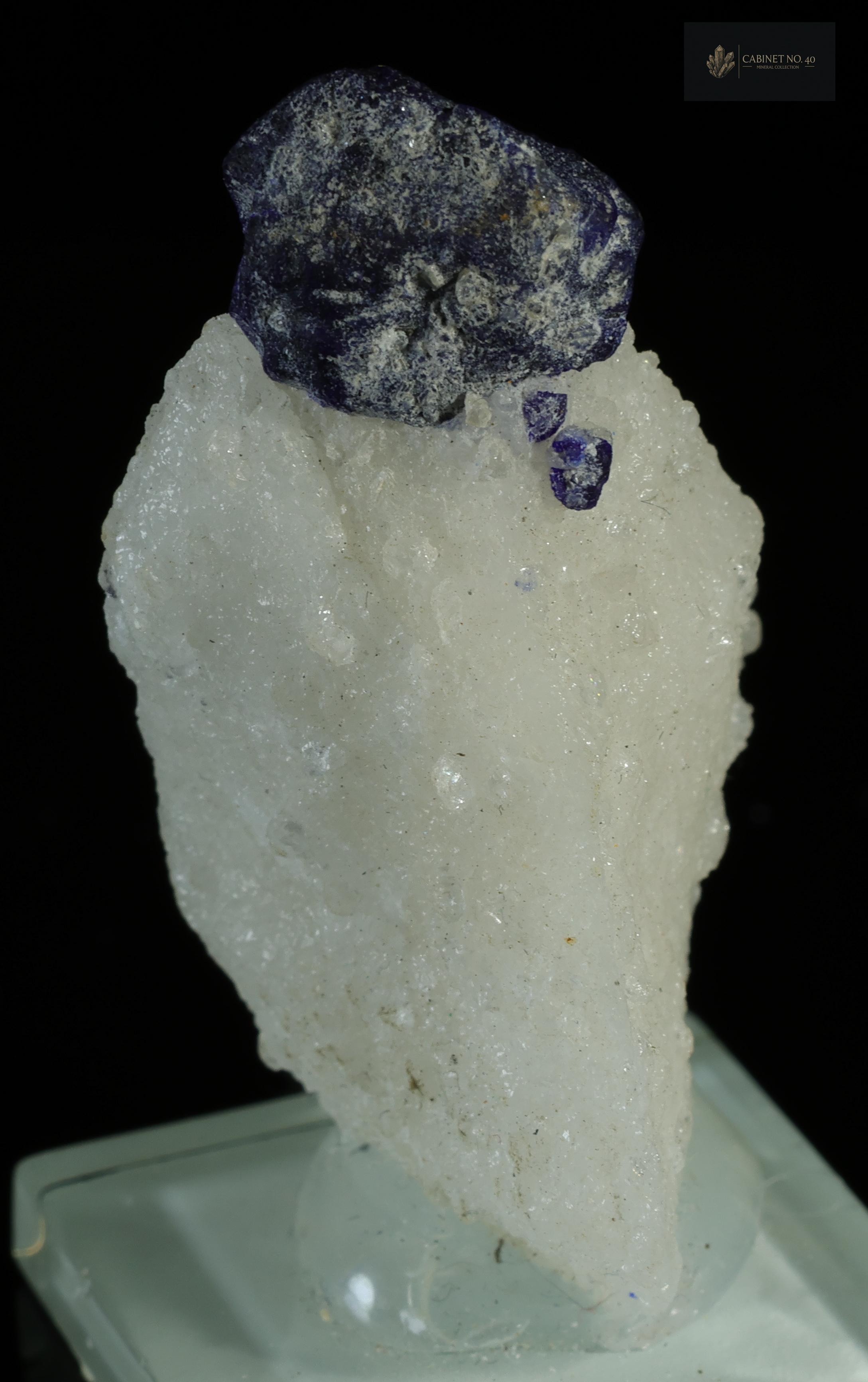
Well-isolated crystal of lazurite on a marble matrix. Specimen from a famous location known since antiquity. Specimen glued to a base, we can detach it upon request.
Price: 34 EUR (149 PLN)
Availability: In stock
Location: Ladjuar Medam, Sar-e-Sang, Kuran wa Munjan District, Badakhshan, Afghanistan
Size: 17 x 15 x 36 mm
Weight: 200 g
Chemical formula: (Na,Ca)₈(AlSiO₄)₆(SO₄,S,Cl)₂
Mohs hardness: 5.0–5.5
Characteristics Lapis lazuli is a mineral belonging to the silicate group, specifically to the sodalite group. It usually occurs as compact, granular masses, and less frequently forms well-developed rhombic dodecahedral crystals. Its most characteristic feature is an intense, deep blue hue, often with a hint of purple. This color is a result of the presence of sulfur in the mineral's structure. Lapis lazuli is the main component of the metamorphic rock lapis lazuli, in which it often co-occurs with pyrite, calcite, and diopside, forming visually attractive compositions. Physical Properties Lapis lazuli is characterized by a Mohs hardness of 5-5.5. It has a vitreous to greasy luster, and its fracture is uneven. This mineral is opaque. The density of lapis lazuli is approximately 2.38-2.42 g/cm³. Colors and Varieties The typical color of lapis lazuli is an intense blue, often described as ultramarine. Shades can range from light blue to dark navy, sometimes with a purple tint. The presence of pyrite inclusions gives lapis lazuli golden flecks, which is a desirable feature in jewelry. No specific varieties of lapis lazuli are distinguished, however, its quality and value are closely related to the intensity and uniformity of its color. History and Name The name lapis lazuli comes from the Persian word “lazhward,” meaning “blue” or “sky.” This mineral was known and valued in antiquity, used for making jewelry, ornaments, and as a pigment (ultramarine) in painting. Its history dates back thousands of years, with the oldest known deposits in Afghanistan being exploited as early as the 7th millennium BCE. Uses Lapis lazuli is primarily a prized ornamental and gemstone. It is used to make cabochons, beads, sculptures, and inlays. Historically, powdered lapis lazuli was used as a valuable ultramarine pigment in painting, especially in the Middle Ages and Renaissance.
Identification Lapis lazuli is most easily recognized by its characteristic, intense blue color. The often-present pyrite inclusions in the form of golden flecks are also a strong diagnostic feature, especially in the case of lapis lazuli. This mineral is opaque and has a vitreous to greasy luster. Distinguishing from Similar Minerals Lapis lazuli can be confused with other blue minerals, such as azurite, sodalite, or dumortierite. Azurite is usually darker, has a more violet hue, and lower hardness. Sodalite is often lighter, has whiter calcite inclusions, and does not contain pyrite. Dumortierite is harder and has a more fibrous structure. A key feature distinguishing lapis lazuli from sodalite is the presence of pyrite in lapis lazuli and its deeper, more saturated color. Crystal Forms Lapis lazuli rarely forms well-developed crystals, which usually take the form of rhombic dodecahedra. Most often, it occurs as compact, granular, or massive aggregates, which are the main component of lapis lazuli.
Genesis Lapis lazuli forms as a result of contact metamorphism of limestones or dolomites that have been subjected to hot hydrothermal solutions. This process occurs at high temperatures and under pressure, leading to the recrystallization of parent rocks and the formation of new minerals, including lapis lazuli. It requires the presence of sulfur in the environment of its formation. Mineral Associations Lapis lazuli often co-occurs with other minerals such as calcite, pyrite, diopside, haüyne, sodalite, forsterite, and muscovite. The presence of pyrite is particularly characteristic of lapis lazuli, where it forms golden inclusions. Calcite can occur as white veins or patches within the lapis lazuli mass. Localities The most important and well-known deposits of lapis lazuli are located in Afghanistan, in the Badakhshan province, where it has been mined for thousands of years. Other significant localities include the Baikal Mountains in Russia, Chile (Ovalle), Burma (Myanmar), United States (Colorado, California), Canada (Baffin Island), and Pakistan.
Quality Criteria The most prized specimens of lapis lazuli are characterized by an intense, uniform, deep blue color, often with a slight violet tint. A minimal amount of white calcite inclusions, which lower the stone's value, is also important. The presence of small, evenly distributed golden pyrite inclusions is desirable and enhances the attractiveness of the specimen. Color purity and the absence of cracks are key factors influencing collectible quality. Popular Localities The most sought-after lapis lazuli specimens come from the historic deposits in Sar-e-Sang, Afghanistan, which are famous for their intensely blue and high-quality stones. Specimens from the Baikal region in Russia and from Chile are also highly valued.
See mineralogical reference for Lapis Lazuli in the Knowledge Base →