Metallic Galena and Sphalerite from the Pomorzany Mine

SKU: W_2_0016

A classic ore specimen from the now-closed Pomorzany Mine. It features shiny, metallic aggregates of galena, occurring alongside dark sphalerite. The minerals form a compact, heavy mass with a structure typical of Olkusz deposits. Main Features: Polish location (Olkusz); distinct metallic luster of galena; rich zinc-lead ore; specimen from a closed mine. Condition: Very good. The specimen is raw, with clearly visible cleavage planes of galena. The structure is compact and stable.
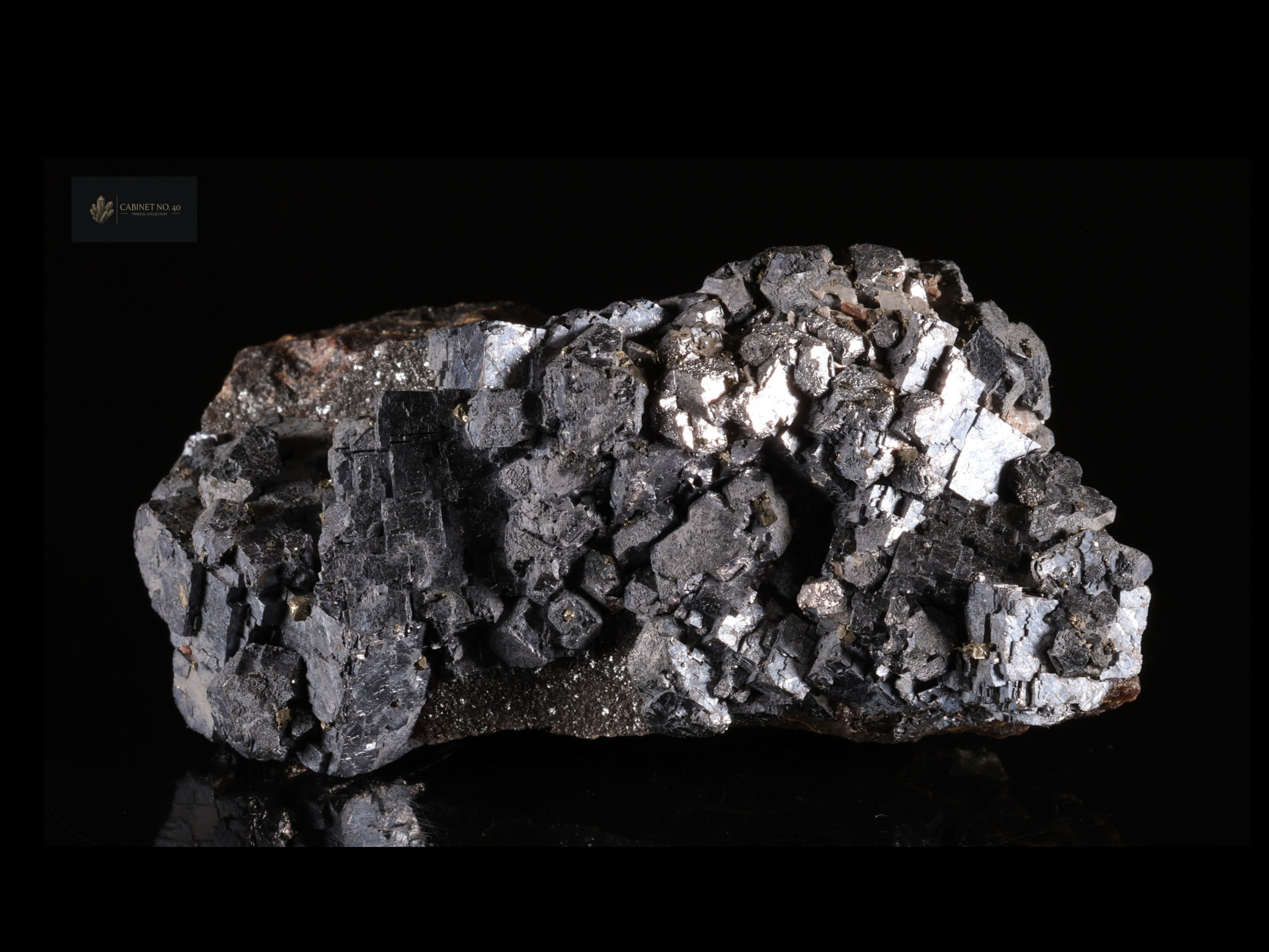
Metallic Galena and Sphalerite from the Pomorzany Mine

Price: 43 EUR (189 PLN)

Availability: In stock

Location: Pomorzany Mine, Olkusz, Poland

Size: 46 x 23 x 20 mm

Weight: 43.6 g

Chemical formula: PbS

Crystal system: Cubic

Mohs hardness: 2.5

Characteristics Galena is a sulfide mineral with the chemical formula PbS, representing the most important source of lead. Typical galena specimens are characterized by a metallic luster and a lead-gray color. It often occurs as well-formed crystals with a cubic or octahedral habit, as well as in the form of massive, granular, or fibrous aggregates. Fresh fracture surfaces are bright and shiny, but dull over time due to oxidation. Physical Properties The hardness of galena on the Mohs scale is 2.5, which means it is a relatively soft mineral, scratchable with a fingernail. It exhibits a distinct metallic luster. It is opaque. The density of galena is high, at 7.60 g/cm³, which is a diagnostic feature. It has perfect cleavage in three directions, forming perpendicular planes, which often manifests as stepped fractures. Colors and Varieties Galena usually takes on a lead-gray color, sometimes with a bluish or purplish tarnish on the surface due to weathering. There are no significant color varieties of galena, however, the degree of surface oxidation can affect its appearance, giving it a duller, darker shade. History and Name The name "galena" comes from the Latin word galena, which originally referred to lead ore or slag formed during lead smelting. This mineral was known and used in antiquity, mainly as a source of lead for the production of pipes, vessels, and as an ingredient in cosmetics (e.g., for eye makeup in Egypt). Pliny the Elder, in his work "Natural History," described galena as one of the minerals containing lead. Uses Galena is primarily the most important lead ore. Lead is used in industry for the production of batteries, cables, ammunition, alloys, and as a shielding material against X-ray and gamma radiation. In the past, galena was also used as an ingredient in ceramic glazes and early radio detectors (so-called crystal detectors).

Diagnostic features

Identification Galena can be identified by its characteristic lead-gray color, metallic luster, and high density. A key diagnostic feature is its perfect cleavage in three perpendicular directions, leading to the formation of cubes or stepped fractures. The streak of galena is lead-gray, which distinguishes it from many other minerals of similar appearance. Distinguishing from Similar Minerals Galena can be confused with other minerals with a metallic luster and dark color, such as argentite, tetrahedrite, or stibnite. It is distinguished from argentite (Ag₂S) by its distinct, perfect cleavage and higher density. Tetrahedrite (Cu₁₂Sb₄S₁₃) usually has a darker, black color and lacks cleavage. Stibnite (Sb₂S₃) forms elongated, acicular crystals and has a lower density. Pyrrhotite (Fe₁₋ₓS) has a brownish color and is magnetic, which distinguishes it from galena. Crystal Forms Galena most commonly occurs as cubes, octahedra, or combinations of these forms. It often forms massive, granular, or compact aggregates. Bladed or fibrous habits can also be found. Crystals often exhibit twinning, which further complicates their morphology.

Formation environment

Genesis Galena forms in a wide range of geological environments, most commonly in medium- and low-temperature hydrothermal veins associated with magmatic intrusions. It also occurs in metasomatic deposits, where hydrothermal solutions react with carbonate rocks, forming MVT (Mississippi Valley Type) deposits. It can also form in sedimentary deposits as a result of diagenetic and epigenetic processes. Mineral Associations Galena often co-occurs with other sulfide minerals, such as sphalerite (ZnS), chalcopyrite (CuFeS₂), and pyrite (FeS₂). It is also frequently accompanied by ore minerals such as native silver, argentite, as well as gangue minerals such as quartz, calcite, barite, and fluorite. In oxidation zones, galena can alter into secondary minerals such as cerussite (PbCO₃) and anglesite (PbSO₄). Localities Known galena deposits occur worldwide. Important localities include: Broken Hill in Australia, Freiberg in Germany, Coeur d'Alene in the USA (Idaho), Sullivan in Canada (British Columbia), Madan in Bulgaria, and various regions of Mexico and Peru. In Poland, galena occurs in zinc and lead ore deposits in the Upper Silesian region and in the Świętokrzyskie Mountains.

For the collector

Quality Criteria Collectors value galena specimens for well-formed, large, and undamaged crystals with a distinct metallic luster. Cubes and octahedra with sharp edges and smooth surfaces are particularly sought after. The attractiveness is also enhanced by the co-occurrence with other contrasting minerals, such as sphalerite, pyrite, or calcite, creating aesthetic compositions. The purity and absence of weathering coatings on the crystal surfaces also affect the value of the specimen. Popular Localities The most prized galena specimens come from localities such as: Madan in Bulgaria, where large, lustrous crystals are found; Joplin in the USA (Missouri), famous for excellent cubes; and Naica in Mexico, known for gigantic galena crystals often co-occurring with other minerals. Deposits in Broken Hill, Australia, also provide high-quality specimens.

See mineralogical reference for Galena in the Knowledge Base →

View product →