SKU: P_26-7_28
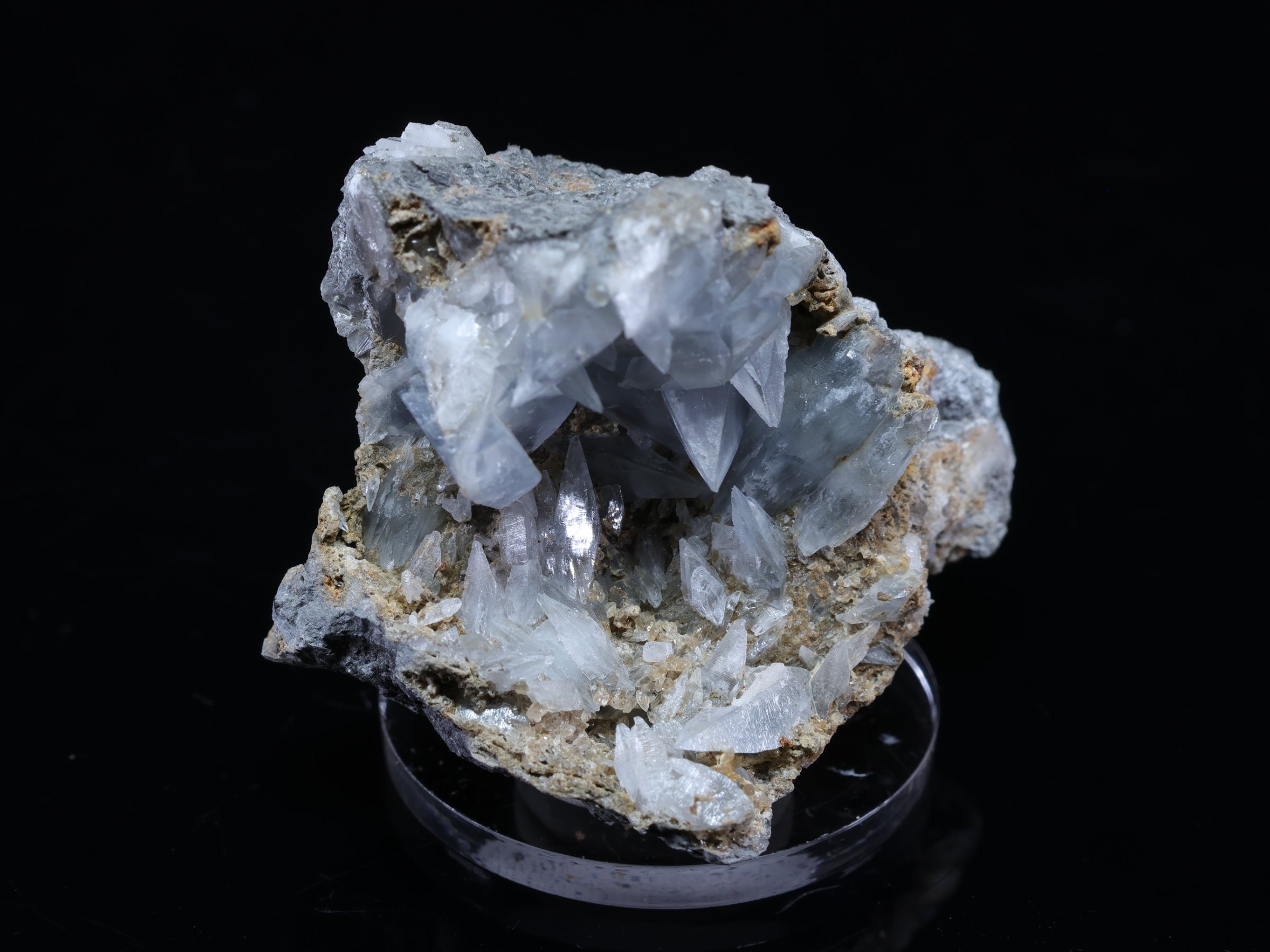
Inside the cavity, sharp, wedge-shaped crystals of light bluish-gray color and distinct vitreous luster are visible. Translucent forms grow directly from the dense, dark matrix, creating a natural lining of the microcrystalline depression. Main features: pale blue celestine in a rock cavity; sharp, translucent crystals with vitreous luster; contrasting gray matrix. Condition: Good.
Price: 23 EUR (99 PLN)
Availability: In stock
Location: Jochenberg Quarry, Bad Kösen, Naumburg (Saale), Burgenlandkreis, Saxony-Anhalt, Germany
Size: 45 x 29 x 32 mm
Weight: 50.6 g
Chemical formula: SrS⁶⁺O₄
Mohs hardness: 3-3.5
Characteristics Celestine is a mineral belonging to the sulfate group, with strontium sulfate as its main component. It typically forms tabular or prismatic crystals, often found in druses or geodes. The color of celestine is most commonly blue, ranging from light to intense blue, although colorless, white, reddish-brown, greenish, or gray specimens are also found. Celestine crystals are characterized by a vitreous luster and are often transparent or translucent. Physical Properties The Mohs hardness of celestine is 3-3.5, making it a relatively soft mineral. It has perfect cleavage in one direction ({001}) and good cleavage in another ({210}). The specific gravity of celestine is 3.96 g/cm³. This mineral exhibits a white streak. Colors and Varieties The most desirable celestine specimens have an intense blue color, which is often associated with trace amounts of gold. In addition to blue, colorless, white, gray, greenish, and even reddish-brown celestine varieties exist. The color in transmitted light is usually colorless or slightly tinted. History and Name The name celestine comes from the Latin word "caelestis", meaning "heavenly", which refers to the often-encountered blue color of this mineral. The mineral was described in 1791. Uses Celestine is the main source of strontium, which is used in industry for the production of fireworks (giving them a red color), in the ceramic and glass industries, and in medicine. Celestine crystals, especially those with intense blue color and good transparency, are valued by mineral collectors.
Identification Celestine can be identified by its characteristic blue color, vitreous luster, and relatively low hardness (3-3.5 on the Mohs scale). It often occurs as well-formed tabular or prismatic crystals, forming druses or geodes. Distinguishing from Similar Minerals Celestine can be confused with baryte, which is also a sulfate and has similar physical properties and crystal habit. However, baryte is heavier (baryte's density is about 4.5 g/cm³ compared to celestine's 3.96 g/cm³) and usually does not exhibit such an intense blue color. Another mineral with which celestine is sometimes confused is fluorite, but fluorite is harder (4 on the Mohs scale) and has different cleavage. Crystal Forms Celestine most often forms tabular, prismatic, or isometric crystals. They often occur as radial or fibrous aggregates, as well as in the form of crusts and concretions. In geodes, celestine forms beautiful crystal druses.
Genesis Celestine forms mainly in sedimentary rocks, especially in limestones, dolomites, and marls, where it crystallizes from hydrothermal solutions or as a result of diagenetic processes. It often occurs in geodes and rock fissures. It can also form in evaporite deposits. Mineral Associations Celestine often co-occurs with other minerals such as calcite, gypsum, anhydrite, baryte, fluorite, native sulfur, and various clay minerals. Localities Localities known for beautiful celestine specimens include Madagascar (especially the Sakoany region, where large, intensely blue crystals are found), the United States (Ohio, Michigan, Texas), Mexico (Durango), the United Kingdom (Bristol), Italy (Sicily), and Poland (Tarnobrzeg area).
Quality Criteria The most valued celestine specimens are those with intense, uniform blue color, high transparency, and well-formed, large crystals. The aesthetics of crystal aggregates, their arrangement on the matrix, and the absence of mechanical damage are also important. Popular Localities The most sought-after specimens by collectors come from Madagascar, especially from the Sakoany region, where geodes with large, blue crystals are found. Other valued localities include Ohio in the USA and Mexico.
See mineralogical reference for Celestine in the Knowledge Base →