Intensely Green Emerald from Pakistan

SKU: B_29_0021

Collector's specimen - bright green crystal of emerald set on a light matrix. Main features: Intense green, contrast with the matrix, compact size. Condition: Good - the emerald is securely set.
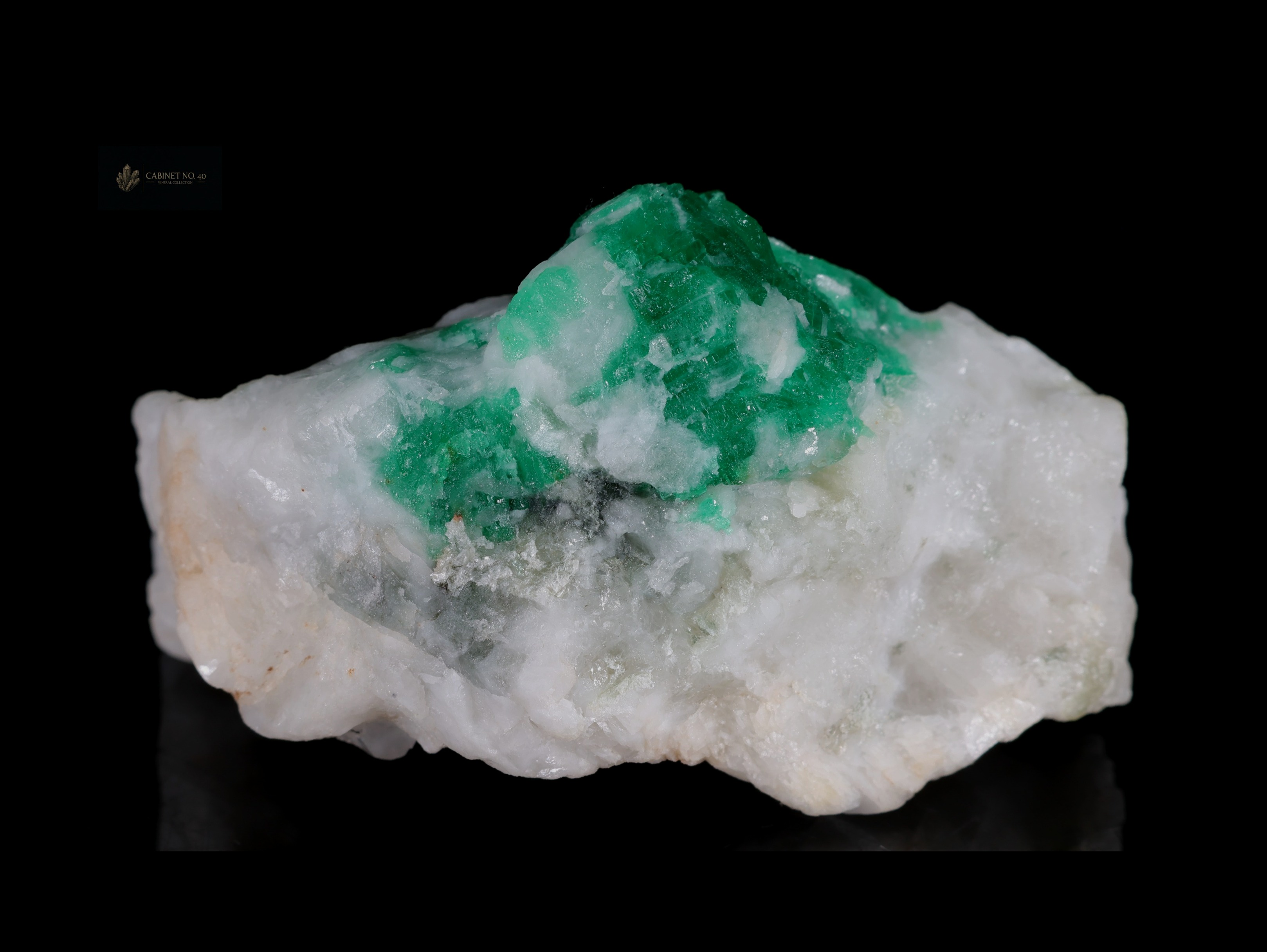
Intensely Green Emerald from Pakistan

Price: 57 EUR (249 PLN)

Availability: In stock

Location: -, Pakistan

Size: 46 x 30 x 27 mm

Weight: 34.4 g

Chemical formula: Be₃Al₂Si₆O₁₈

Crystal system: Hexagonal

Mohs hardness: 7.5–8.0

Characteristics Emerald is a green variety of beryl, a silicate mineral, whose color comes from trace amounts of chromium, and sometimes vanadium. Typical specimens exhibit an intense, vivid green, often with subtle bluish or yellowish hues. Emerald crystals usually have a prismatic, hexagonal habit, often with visible prism and basal faces. Many emeralds contain inclusions, called "jardin" (garden) by jewelers, which are accepted and even desired, attesting to the natural origin of the stone. Physical Properties Emerald is characterized by a Mohs hardness of 7.5-8, making it relatively scratch-resistant, although it is more brittle than other gemstones of similar hardness. The luster of emerald is vitreous. This mineral is transparent to translucent, and its density typically ranges from 2.67-2.78 g/cm³. Colors and Varieties The color of emerald is its most important feature, and stones with a deep, saturated green are the most valued. Color variations result from differences in chromium and vanadium concentrations. There are no specific commercial varieties of emerald beyond the general term "emerald" for green beryls. History and Name The name "emerald" comes from the Greek word "smaragdos," meaning "green stone." This mineral was mined as early as ancient Egypt, and Cleopatra was famous for her love of emeralds. It was valued by many civilizations, including the Incas and Aztecs, who considered it a sacred stone. Emeralds from Colombia, especially those from the Muzo and Chivor mines, have been known for centuries and are considered among the best in the world. Uses Emerald is primarily a prized gemstone, used in jewelry to create ornaments. Due to its color and rarity, it is one of the four precious gemstones alongside diamond, ruby, and sapphire.

Diagnostic features

Identification Emerald can be identified by its characteristic green color, vitreous luster, and hexagonal crystal habit. The presence of "jardin" type inclusions is often a good indicator of natural origin. A hardness test can help distinguish it from softer minerals. Distinguishing from Similar Minerals Emerald can be confused with other green minerals, such as diopside, tourmaline, demantoid garnet, or green sapphire. It is distinguished from diopside and tourmaline by its higher hardness. It differs from demantoid garnet and green sapphire in chemical composition and optical properties. Synthetic emeralds are also common and require specialized gemological examination for identification. Crystal Forms Emerald most commonly occurs as well-formed crystals with a prismatic, hexagonal habit. It often forms aggregates embedded in the host rock. Crystals can be short-prismatic or long-prismatic, with clearly defined prism and basal faces.

Formation environment

Genesis Emerald forms under specific geological conditions, typically in pegmatites, pneumatolytic quartz veins, and in mica and biotite schists, where chromium or vanadium elements, essential for the green color, are present. It forms as a result of hydrothermal processes, often in contact zones of granitic intrusions with ultramafic rocks. Mineral Associations Emerald often co-occurs with quartz, feldspar, muscovite, biotite, fluorite, pyrite, and calcite. In some deposits, it is also accompanied by other beryl minerals, such as aquamarine. Localities The most famous and prized emerald deposits are located in Colombia (Muzo, Chivor, Coscuez), Zambia (Kagem), Brazil (Minas Gerais), Russia (Urals), Pakistan, and Afghanistan. Smaller deposits also occur in other countries, such as Madagascar, Nigeria, and the United States.

For the collector

Quality Criteria The most important quality criteria for emerald are color, clarity, cut, and carat weight. The most desirable stones are those with an intense, deep green, without eye-visible inclusions, although minor inclusions are accepted as proof of naturalness. The emerald cut, specially developed for this stone, aims to maximize its color and minimize the risk of damage. Large, clean stones of excellent color are the most valuable. Market Prices Emerald prices vary widely and depend on many factors, such as color, clarity, carat weight, origin, and cut quality. High-quality Colombian emeralds can fetch very high prices per carat, often exceeding the prices of diamonds of similar weight. Zambian emeralds are also highly valued. Smaller stones of lower clarity are significantly cheaper. Popular Localities The most prized emerald specimens come from Colombia, especially from the Muzo and Chivor mines, known for stones of exceptional color and clarity. Zambian emeralds are also highly sought after due to their intense, slightly bluish-green color. Russian emeralds from the Urals, though rarer on the market, are also highly regarded.

See mineralogical reference for Emerald in the Knowledge Base →

View product →