SKU: P_26-4_5
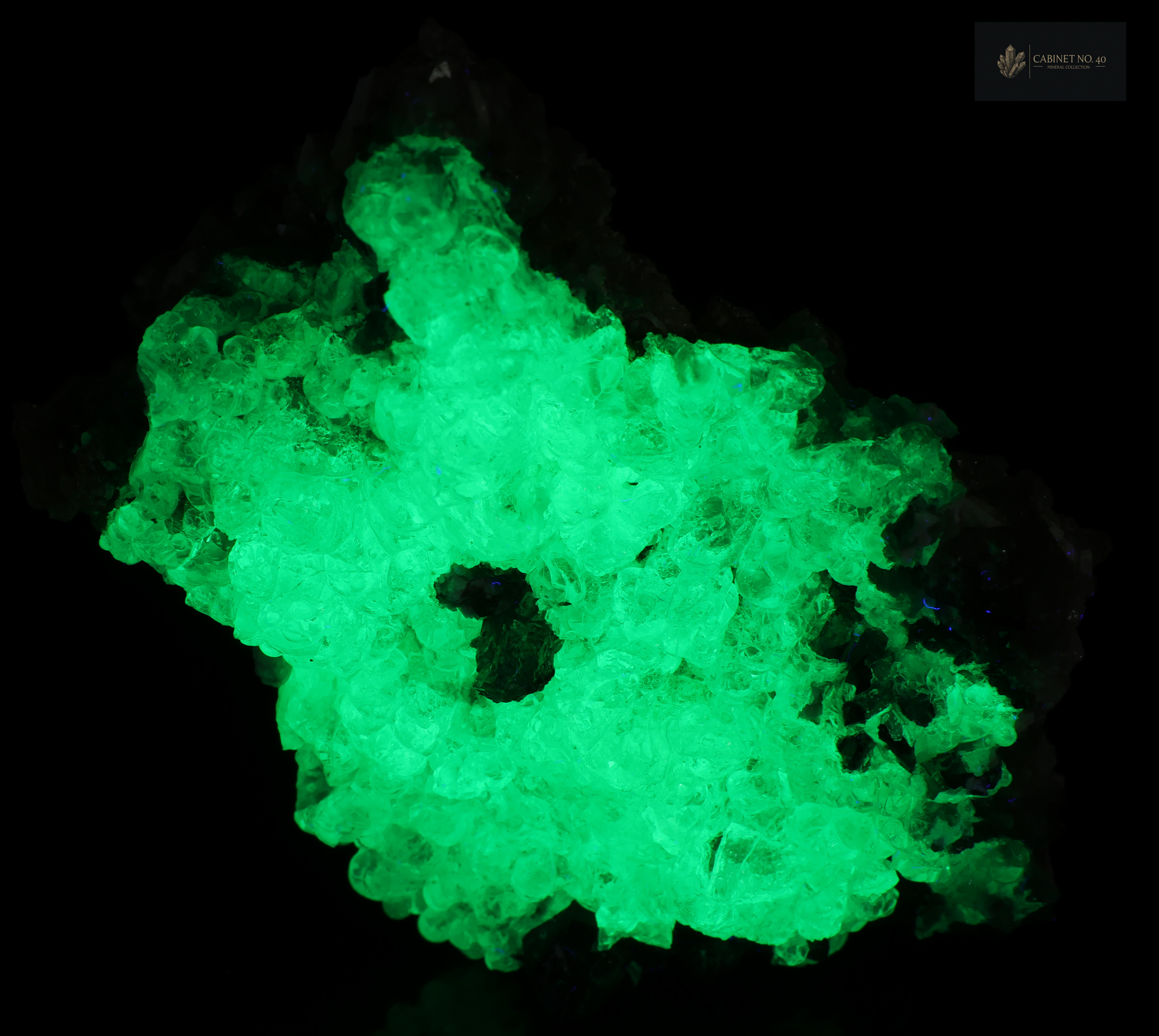
The specimen is characterized by a fine-crystalline formation of aggregates, creating a greenish, glassy coating on a darker substrate. Under UV light, the specimen exhibits intense green fluorescence, which is a typical and sought-after feature for hyalite from this location.
Price: 27 EUR (119 PLN)
Availability: In stock
Location: Erongo Mountains, Erongo Region, Namibia
Size: 55 x 43 x 20 mm
Weight: 45.5 g
Chemical formula: SiO₂·nH₂O
Mohs hardness: 5.5–6.5
Characteristics Hyalite, also known as glass opal, is an amorphous variety of opal, meaning it lacks an ordered crystalline structure. It typically forms transparent or translucent coatings, crusts, concretions, or spherical aggregates resembling dewdrops or glass. Its surface is often smooth and glassy, giving it a characteristic appearance. It can occur as thin layers covering other minerals or as standalone, botryoidal forms. Physical Properties Hyalite has a Mohs hardness of 5.5 to 6. It possesses a vitreous luster and is transparent to translucent. It does not exhibit cleavage due to its amorphous nature, and its fracture is conchoidal. The density of hyalite is variable but typically ranges from 1.9-2.3 g/cm³. Colors and Varieties Most commonly, hyalite is colorless or whitish, although it can take on delicate shades of blue, green, or yellow, often due to the presence of inclusions or fluorescence. A characteristic feature of many hyalite specimens is strong fluorescence under ultraviolet light, usually green or blue-green, caused by the presence of trace amounts of uranium. History and Name The name "hyalite" comes from the Greek word "hyalos," meaning glass, referring to its glassy appearance. This mineral was known and described in antiquity, but its scientific classification as a variety of opal occurred later. Uses Hyalite has no significant industrial applications. It is primarily valued by mineral collectors, especially specimens exhibiting strong fluorescence. It is sometimes used in jewelry as an ornamental stone, though less frequently than other opal varieties due to the lack of iridescence.
Identification Hyalite can be identified by its glassy, colorless or whitish appearance, often resembling glass drops or ice. A key diagnostic feature is the absence of cleavage and a conchoidal fracture. Many specimens exhibit strong green or blue-green fluorescence under UV light, which is very helpful for identification. Distinguishing from similar minerals Hyalite is sometimes confused with chalcedony or quartz, but it is distinguished by its lack of crystalline structure and lower hardness than quartz. It differs from other varieties of opal, such as precious opal, by the absence of iridescence. From natural glass, such as obsidian, hyalite differs in chemical composition and genesis. Crystal forms Hyalite does not form crystals in the mineralogical sense, as it is amorphous. It occurs as crusts, coatings, concretions, botryoidal aggregates, grape-like clusters, or stalactites, often covering the surfaces of other minerals.
Genesis Hyalite forms at low temperatures, usually as a result of precipitation from silica-rich solutions. It often occurs in weathering zones of volcanic rocks, especially basalts and rhyolites, where it forms in voids and fissures. It can also form in pegmatites and hydrothermal veins. Mineral associations Hyalite often co-occurs with other silica minerals, such as quartz, chalcedony, as well as calcite, zeolites, and other secondary minerals formed in volcanic environments. Localities Known hyalite localities include, among others, the Czech Republic (Kněžice), Germany (Eifel), Mexico (Chihuahua state), the United States (Oregon, Arizona), as well as Hungary and Romania. Fluorescent specimens, often containing trace amounts of uranium, come from various locations worldwide.
Quality criteria The most prized hyalite specimens are those that are transparent, colorless, or have a delicate, uniform coloration. A key criterion is strong and uniform fluorescence under UV light, preferably in an intense green or blue-green color. Large, well-formed concretions or crusts with an aesthetic shape are also highly valued. Popular localities Specimens of hyalite with strong fluorescence from localities such as the Czech Republic, Mexico, or the United States are particularly sought after. Specimens from the Eifel in Germany are also valued for their aesthetics.
See mineralogical reference for Hyalite in the Knowledge Base →