SKU: 0281_3-PK
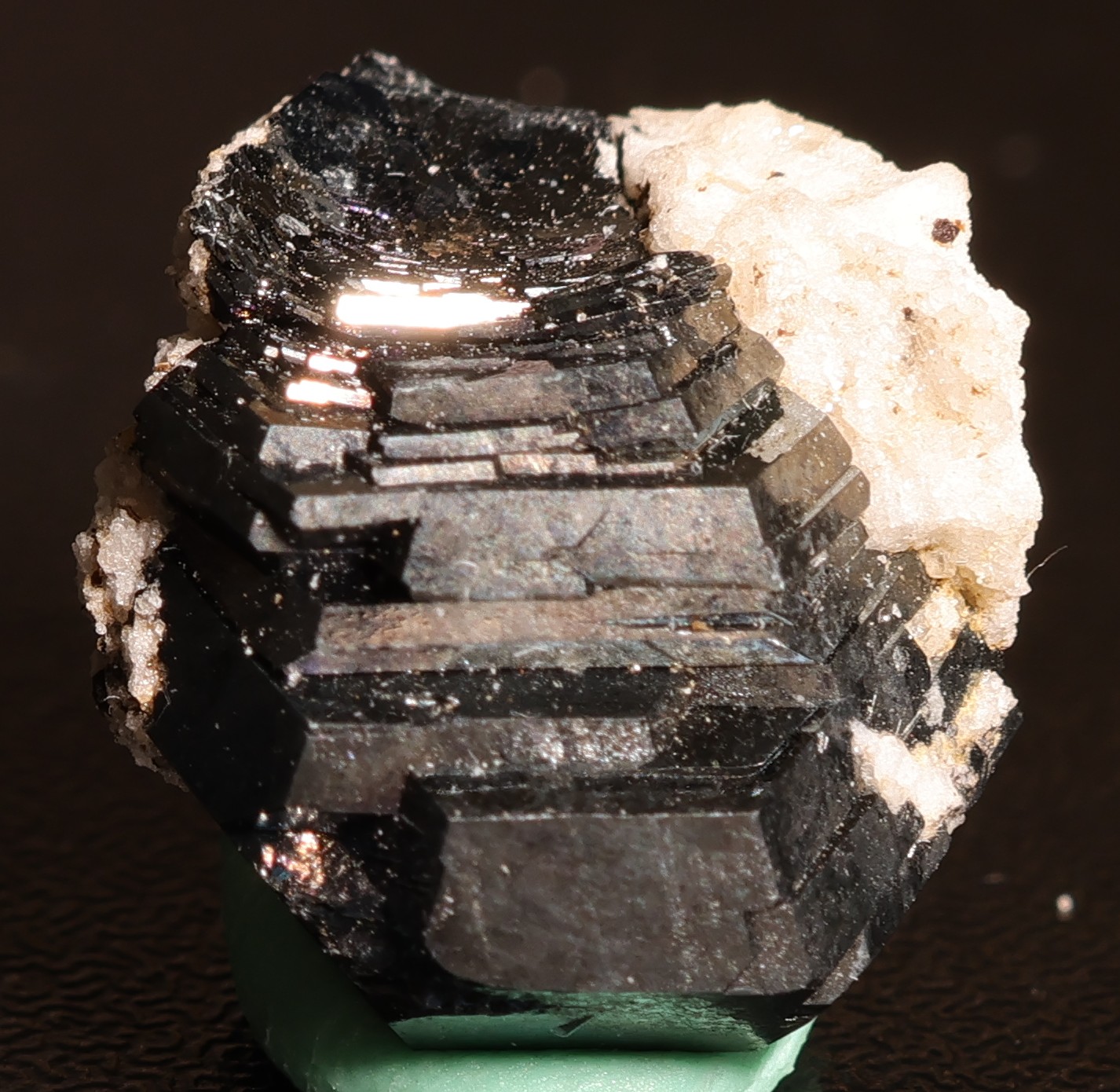
A single, massive crystal of hematite set on a light matrix. The contrast between the black metallic surface and the light background enhances the readability of the form. A clear specimen for display, based on its shape and proportion.
Price: 16 EUR (69 PLN)
Availability: In stock
Location: -, Pakistan
Size: 14 x 12 x 12 mm
Weight: 3.4 g
Chemical formula: Fe₂O₃
Crystal system: Trigonal
Mohs hardness: 5–6
Mineral group: Hematite Group
Rarity: Uncommon
Characteristics Hematite is an iron oxide, occurring in many forms, from massive aggregates to well-formed crystals. Typical specimens of crystalline hematite are steel-gray to black, often with a distinct metallic luster. In earthy or fine-grained form, it ranges from dull to bright, rusty-red. Its name refers to the color of its streak, which is characteristically reddish-brown, resembling the color of blood. Physical Properties The Mohs hardness of hematite ranges from 5 to 6. This mineral is characterized by a metallic luster. It is opaque. Its specific gravity is 5.26. Hematite does not exhibit distinct cleavage, and its fracture is uneven to conchoidal. Colors and Varieties Hematite crystals and its massive varieties are steel-gray to black. Earthy and fine-grained varieties are rusty-red. Known varieties include kidney ore (compact, reniform form), iron rose (aggregates of crystals resembling rose petals), and glassy heads (botryoidal, reniform aggregates). History and Name The name hematite comes from the Greek word "haima", meaning blood, which refers to the characteristic reddish-brown color of its streak. This mineral has been known and used since prehistoric times as a pigment and a source of iron. Uses Hematite is the most important iron ore, used in metallurgy for steel production. Furthermore, due to its color, it is used as a pigment in paints and cosmetics. Polished hematite specimens are sometimes used in jewelry for making ornaments, although due to its hardness and brittleness, it is not an easy material to work with.
Identification Hematite can be identified by its characteristic reddish-brown streak, which is independent of the mineral's color. Crystalline specimens have a metallic luster and are steel-gray to black. Earthy varieties are rusty-red. The mineral is opaque. Distinguishing from Similar Minerals Hematite is distinguished from magnetite by the absence of magnetic properties (although some hematite specimens may exhibit weak magnetism when heated) and a reddish-brown streak (magnetite has a black streak). Hematite differs from goethite and limonite by its higher hardness and metallic luster (goethite and limonite have an earthy or dull luster). Crystal Forms Hematite crystallizes in the trigonal system. It forms tabular, rhombohedral, or platy crystals. It often occurs in compact, granular, reniform (kidney ore), or radiating aggregates. Rosette-shaped aggregates, called "iron roses", are also known.
Genesis Hematite is a common mineral, forming under a wide range of geological conditions. It occurs as a primary mineral in igneous rocks, especially volcanic, and as a product of contact and regional metamorphism. It is also an important component of sedimentary rocks, where it forms as a result of weathering and sedimentation processes, often in oxygen-rich environments, as a product of the oxidation of other iron minerals. Mineral Associations Hematite often co-occurs with other iron minerals, such as magnetite, goethite, limonite, and siderite. In metamorphic rocks, it can be associated with quartz, garnets, and micas. In hydrothermal veins, it is accompanied by barite, calcite, and other ore minerals. Localities Significant hematite deposits occur worldwide. The most important localities include: Brazil (Minas Gerais), Australia (Pilbara region), United States (Lake Superior region), Canada (Labrador), Russia (Kursk Magnetic Anomaly), and Ukraine (Kryvyi Rih). In Europe, hematite occurs in Germany (Erzgebirge), Great Britain (Cumbria), and Italy (Elba), among others.
Quality Criteria The most highly prized collector's items are well-formed hematite crystals, especially those with a distinct metallic luster and attractive forms, such as "iron roses" or specimens with intense color. Size, crystallographic purity, and absence of mechanical damage also affect the value of a specimen. Specimens with surface iridescence are also interesting. Popular Localities Valued hematite specimens come from Brazil, especially from the Minas Gerais region, where large, well-formed crystals are found. High-quality "iron roses" come from the Alps, including Switzerland (Valais) and Italy. Specimens with metallic luster and interesting forms also occur in the United States (Michigan) and Canada.
See mineralogical reference for Hematite in the Knowledge Base →