SKU: B_38_0002
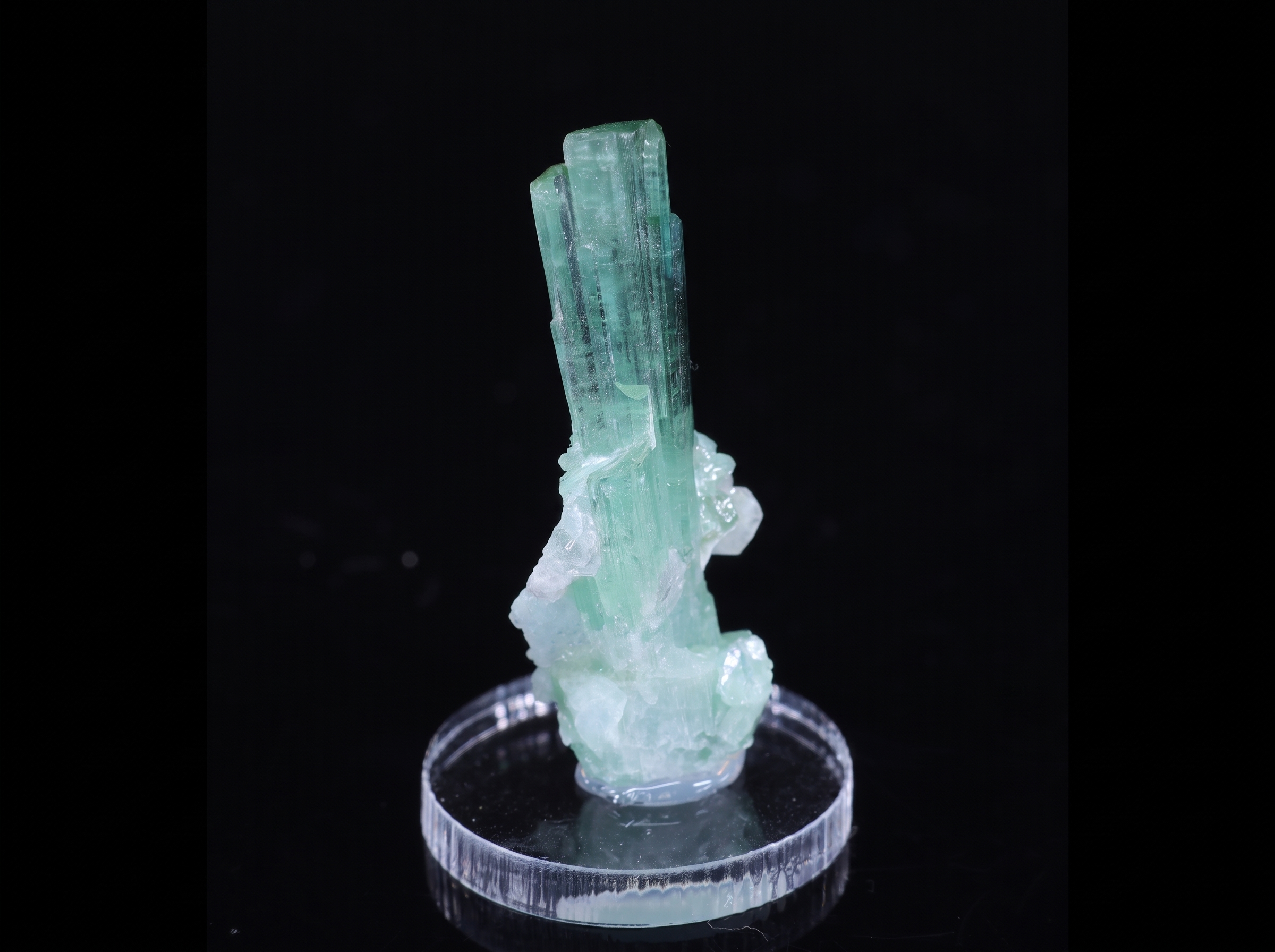
Aesthetic cluster of green tourmaline crystals. The main, slender crystal with a prismatic habit and strong striations on the side walls is characterized by a light green color. The termination of the main prism is multi-faceted, slightly stepped, and preserved in its natural state. At the base and on one side of the specimen, smaller crystals are visible, growing at various angles. Main Features: prismatic habit; distinct striations on side walls; light green color; stepped termination of the main crystal. Condition: Very good - the main crystal is preserved in very good condition with an intact termination.
Price: 32 EUR (139 PLN)
Availability: In stock
Location: -, Afghanistan
Size: 17 x 13 x 30 mm
Weight: 3.1 g
Chemical formula: (Na,Ca)(Li,Mg,Fe,Mn,Al)₃Al₆(BO₃)₃Si₆O₁₈(OH)₄
Mohs hardness: 7-7.5
Characteristics Tourmaline is the name of a group of silicate minerals characterized by a complex chemical composition, containing boron and aluminum, as well as variable amounts of other elements such as iron, magnesium, sodium, lithium, or potassium. Typical tourmaline specimens take the form of elongated, prismatic crystals with a triangular or hexagonal cross-section, often with distinct striations parallel to the long axis. Crystals can be terminated pyramidally or flat, and their surface can be lustrous. Tourmalines also occur as radial, massive, or granular aggregates. Physical Properties The hardness of tourmaline on the Mohs scale is 7-7.5, making it a relatively scratch-resistant mineral. It has a vitreous luster, although iron-rich varieties may exhibit a submetallic luster. It is transparent to opaque, depending on the variety and thickness of the crystal. The density of tourmaline ranges from 3.02 to 3.26 g/cm³, which is a moderate value. This mineral does not exhibit distinct cleavage, and its fracture is conchoidal to uneven. Colors and Varieties Tourmaline is known for its extraordinary variety of colors, which results from the presence of different elements in its structure. It can occur in shades of black (schorl), brown (dravite), pink (rubellite), red, green (verdelite), blue (indicolite), yellow, and can even be colorless (achroite). Bi- or multi-colored crystals are often found, where different color zones occur along or across the crystal. Varieties such as watermelon tourmaline, with a pink core and a green rind, are particularly prized. Other well-known varieties include elbaite (lithium tourmaline, encompassing many colorful varieties) and uvite (calcium-magnesium tourmaline). History and Name The name "tourmaline" comes from the Sinhalese word "turamali", meaning "stone with mixed colors" or "stone that attracts ash". This name refers to the pyroelectric properties of the mineral, which, when heated or rubbed, becomes electrically charged and attracts small particles. Tourmalines were known in Europe as early as the 18th century, imported from Ceylon (now Sri Lanka). Previously, they were often confused with other gemstones, such as rubies or emeralds. Uses Tourmaline is a prized gemstone, used in jewelry making. Due to its pyro- and piezoelectric properties, some varieties are used in the electronics industry, for example, in pressure transducers. Black tourmalines (schorls) are sometimes used as ornamental stones or for collecting purposes.
Identification Tourmaline can be identified by its characteristic prismatic crystal habit with distinct striations parallel to the long axis. It often occurs in the form of triangular or hexagonal cross-sections. The variety of colors, often occurring within a single crystal, is also a diagnostic feature. A hardness of 7-7.5 on the Mohs scale distinguishes it from many similar minerals. Distinguishing from Similar Minerals Tourmaline is sometimes confused with other minerals of similar habit, such as amphiboles (e.g., hornblende) or pyroxenes. It is distinguished from amphiboles by the lack of distinct cleavage and its triangular cross-section (amphiboles have a rhombic cross-section). It differs from pyroxenes in hardness and crystallographic system. In the case of colored varieties, tourmaline can be confused with beryl (emerald, aquamarine), topaz, or garnet, but differences in hardness, density, and crystallographic system allow for their distinction. Crystal Forms Tourmaline most commonly occurs as elongated, prismatic crystals, which can be thin and acicular or thick and prismatic. Crystals often have characteristic, deep striations on their side faces. Crystal terminations are usually complex, often pyramidal or with a combination of faces. Tourmaline also forms radial, massive, granular aggregates, as well as inclusions in other minerals, such as quartz.
Genesis Tourmaline primarily forms in igneous rocks, especially in granites, pegmatites, and aplites, where it crystallizes from hydrothermal solutions rich in boron. It also occurs in metamorphic rocks, such as crystalline schists and gneisses, where it forms as a result of metasomatism or regional metamorphism. It can also be present in quartz veins and in sedimentary rocks as a detrital mineral, resistant to weathering. Mineral Associations Tourmaline often co-occurs with quartz, feldspar (orthoclase, albite), muscovite, biotite, garnet, topaz, beryl, cassiterite, apatite, and fluorite. In pegmatites, it can form associations with lepidolite and spodumene. Localities Brazil (Minas Gerais, Bahia) is known for rich tourmaline deposits, where beautiful, multi-colored crystals occur, including the famous Paraíba tourmalines. Other important localities include Afghanistan (Nuristan), Pakistan (Gilgit-Baltistan), United States (California, Maine), Madagascar, Sri Lanka, Russia (Urals), Mozambique, and Nigeria. In Europe, tourmalines are found, among others, in Italy (Elba) and the Czech Republic.
Quality Criteria The most prized tourmaline specimens are those with intense, pure colors, good transparency, and well-formed crystals. Large crystals, without visible inclusions or fractures, are particularly sought after. Bi- or multi-colored specimens, as well as those with rare color varieties (e.g., Paraíba tourmaline), fetch the highest prices. The aesthetics of the specimen, including its form and how it is embedded in the matrix, are also important. Popular Localities The most prized tourmaline specimens come from Brazil, especially from the states of Minas Gerais and Paraíba. Other popular locations include Afghanistan and Pakistan, known for beautiful, transparent crystals, often in shades of green and pink. The United States (California and Maine) also supplies high-quality tourmalines, especially pink and green ones. Madagascar is a source of diverse varieties, including tourmalines with intense colors.
See mineralogical reference for Tourmaline in the Knowledge Base →