SKU: S_00148
An aesthetic and very rich ore specimen from the historic mining district of Lavrion in Greece. Extensive, intensely green encrustations composed of co-occurring olivine and conichalcite have formed on a dark, massive matrix. These minerals create dense clusters that cover a significant portion of the rock's surface. Main Features: intense, multi-hued green; extensive encrustations; strong contrast with the dark matrix; historic European location. Condition: Very good.
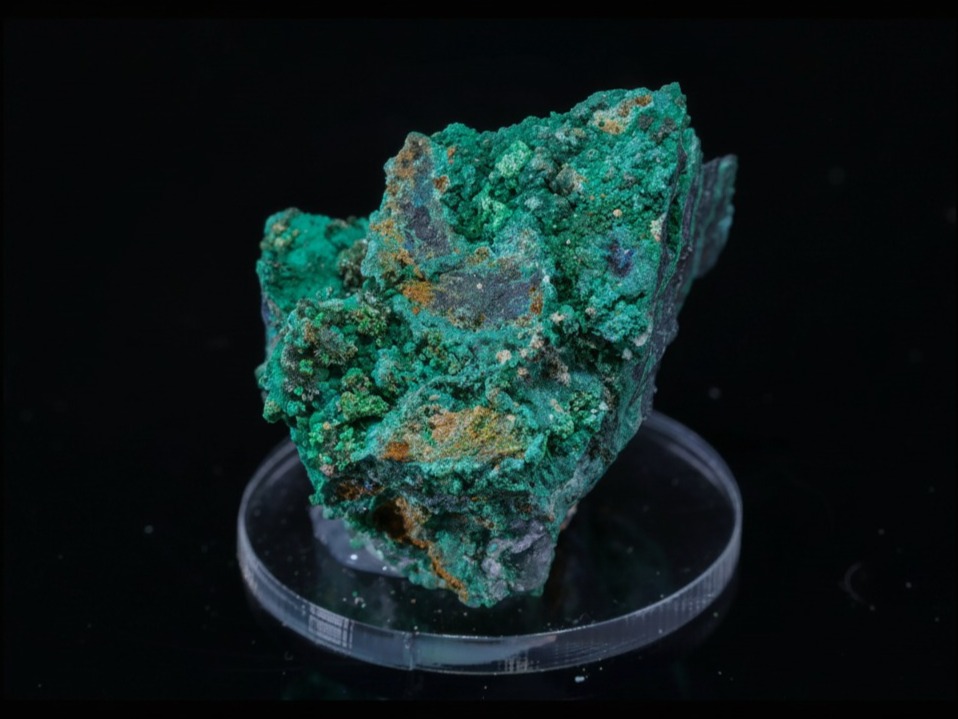
Price: 32 EUR (139 PLN)
Availability: In stock
Location: Hilarion Mine, Hilarion, Kamariza, Agios Konstantinos, Lavrion District, Attica, Greece
Size: 45 x 30 x 30 mm
Weight: 60 g
Chemical formula: Cu₂(AsO₄)(OH)
Mohs hardness: 3
Characteristics Olivenite is a copper arsenate that typically forms small, acicular or prismatic crystals, often aggregated into radial or spherical clusters. Its name refers to its characteristic olive-green color, although this mineral can also occur in shades of yellow, brown, grayish-green, and even grayish-white. Olivenite crystals are usually small, but their intense color makes them easily recognizable. Physical Properties This mineral has a hardness of 3 on the Mohs scale, meaning it is relatively soft. It has a vitreous to adamantine luster, and its density is approximately 4.46 g/cm³. Olivenite is transparent to opaque, and its streak is olive-green to brown. Colors and Varieties The most typical color of olivenite is olive-green, from which its name is derived. It can also occur in shades of yellow, brown, grayish-green, and grayish-white. In transmitted light, this mineral is light green. No specific commercial varieties are distinguished. History and Name Olivenite was described in 1786. Its name comes from its characteristic olive-green color, which is most typical for this mineral. Uses Olivenite has no industrial applications due to its rarity and small crystal sizes. It is a prized collector's mineral, particularly sought after for its intense color and aesthetic crystalline forms.
Identification Olivenite can be identified by its characteristic olive-green color, vitreous to adamantine luster, and relatively low hardness (3 on the Mohs scale). It often occurs as small, acicular or prismatic crystals forming radial or spherical aggregates. The mineral's streak is olive-green to brown. Distinguishing from Similar Minerals Olivenite can be confused with some copper minerals, such as malachite or azurite, but its olive color and lack of reaction with hydrochloric acid (as in the case of malachite) allow for differentiation. Libethenite can also be similar, but olivenite usually has a more intense color and a different crystalline form. Crystal Forms Olivenite most often occurs as small, acicular or prismatic crystals. These crystals often form radial, spherical, or reniform aggregates. Well-formed, single crystals are less common.
Genesis Olivenite is a secondary mineral, formed in the oxidation zones of copper deposits containing arsenic. It forms as a result of the weathering processes of other copper and arsenic minerals in an oxygen-rich environment. Mineral Associations Olivenite often co-occurs with other secondary minerals of the oxidation zone, such as azurite, malachite, chrysocolla, limonite, quartz, and also with arsenic minerals, e.g., pharmacosiderite. Localities Known localities of olivenite include the mines in Tsumeb, Namibia, where some of the best specimens have been found. It also occurs in Cornwall, England, in the Tintic district of Utah, USA, as well as in Chile and Australia.
Quality Criteria The most prized olivenite specimens are characterized by an intense, vivid olive-green color. The aesthetics of the crystalline form are also important – well-formed, distinct crystals or attractive radial or spherical aggregates are more desirable. The size of the specimen, although usually small, also affects its value. Purity and absence of mechanical damage are crucial. Popular Localities The most sought-after olivenite specimens come from the mines in Tsumeb, Namibia, where they occur as well-formed crystals with intense color. Specimens from Cornwall, England, are also valued by collectors.
See mineralogical reference for Olivenite in the Knowledge Base →