Dark Red Proustite on White Matrix from Morocco

SKU: S_00059

A specimen of the rare silver sulfosalt - proustite, originating from the Moroccan Imiter mine. On the light, crystalline matrix are clusters of small mineral crystals. The proustite in this specimen is characterized by a deep, dark red color and a submetallic luster. Main Features: silver mineral (proustite); deep cherry-red color of the crystals; strong color contrast with the light matrix. Condition: Good. The clusters of proustite are intact and stable, although under magnification, minor natural chipping and edge wear can be observed on some of them, typical for such soft ore minerals.
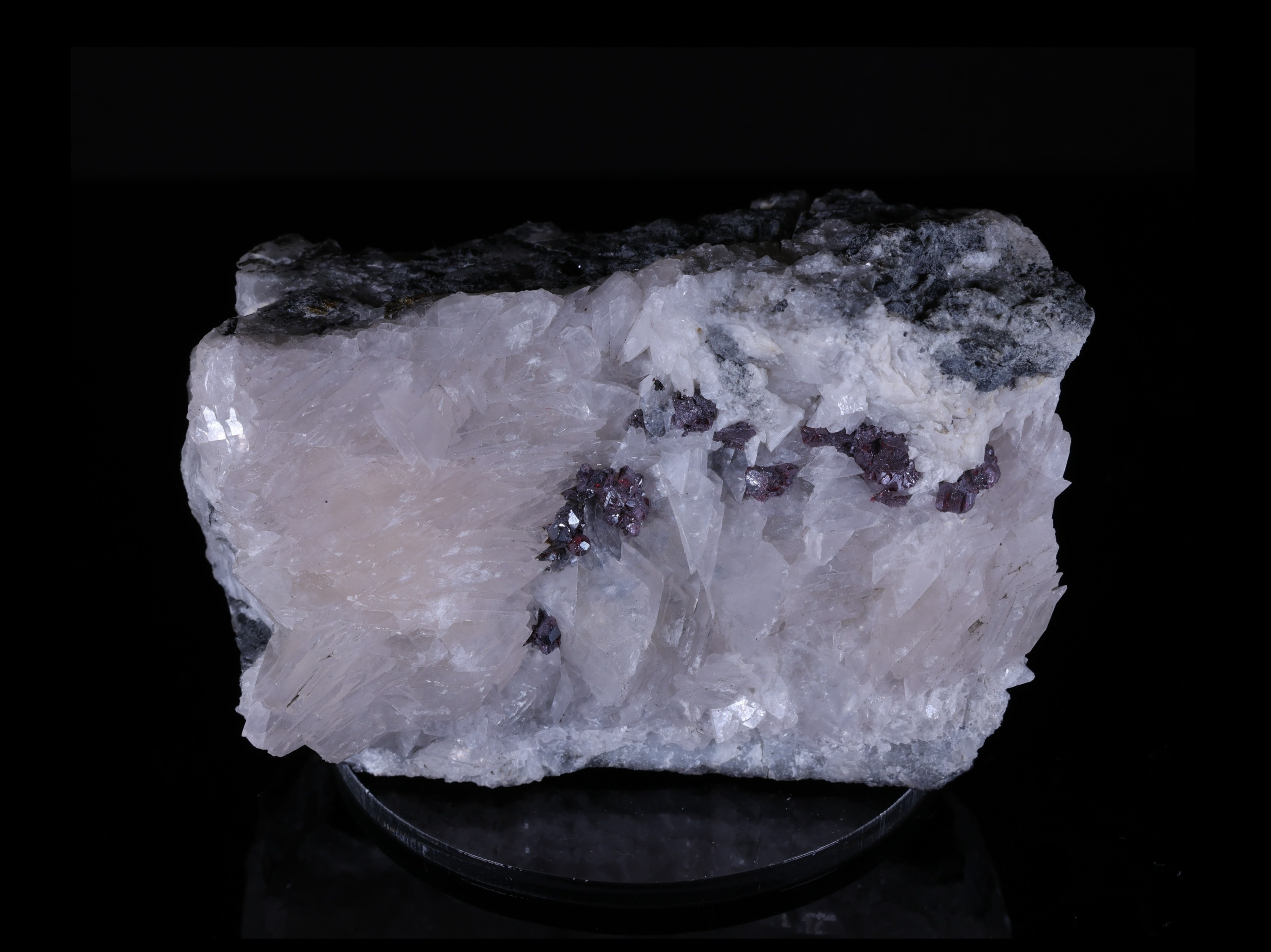
Dark Red Proustite on White Matrix from Morocco

Price: 80 EUR (349 PLN)

Availability: In stock

Location: Imiter Mine, Morocco

Size: 70 x 50 x 40 mm

Weight: 244.2 g

Chemical formula: Ag₃AsS₃

Crystal system: Trigonalny

Mohs hardness: 2-2.5

Characteristics Proustite is a silver arsenic sulfosalt mineral, often called "ruby silver" due to its intense red color. It typically occurs as well-formed, prismatic or rhombohedral crystals, often with distinct striations. Proustite aggregates can be massive or granular. Fresh fractures of the mineral exhibit a strong luster, which dulls over time when exposed to light. Physical Properties Proustite has a hardness of 2-2.5 on the Mohs scale, making it a relatively soft mineral. Its density is approximately 5.57 g/cm³. It possesses distinct cleavage. Proustite's luster is submetallic, and its streak has a characteristic cinnabar-red color. Colors and Varieties The typical color of proustite is scarlet, cinnabar-red, or reddish-gray. When exposed to light, especially sunlight, proustite tends to darken, turning brownish-red or even black. This change is caused by the decomposition of the mineral and the precipitation of fine silver particles. History and Name Proustite was described in 1832. The mineral is named after the French chemist Joseph Louis Proust (1754-1826), who made significant contributions to analytical chemistry and mineralogy. His work included studies on the chemical composition of minerals. Uses Due to its silver content, proustite was historically mined locally as an ore of this metal. Currently, its main significance is as a collector's item, where it is valued for its aesthetic qualities and rarity.

Diagnostic features

Identification Proustite can be identified by its characteristic, intense red color, which often transitions to scarlet or cinnabar. A diagnostic feature is also its cinnabar-red streak. Proustite crystals are typically prismatic or rhombohedral, often with visible striations. The mineral is relatively soft, which can be checked by attempting to scratch it with a copper wire. Distinguishing from Similar Minerals Proustite is sometimes confused with pyrargyrite, another "ruby silver." It differs from pyrargyrite in its chemical composition (pyrargyrite contains antimony instead of arsenic) and a slightly darker color and darker streak (pyrargyrite has a cherry-red to brownish-red streak). Proustite is also brighter and more transparent than pyrargyrite. Another similar mineral is cinnabar, which, however, has a much higher density and a different chemical composition. Crystal Forms Proustite most often forms well-developed crystals with prismatic, columnar, or rhombohedral habits. Crystals with striated faces are common. It can also form massive, granular aggregates, or crusts.

Formation environment

Genesis Proustite is a secondary mineral, formed in low-temperature, hydrothermal ore veins. It occurs in the oxidation and enrichment zones of silver deposits, where it forms as a result of alterations of other silver minerals or through metasomatic processes. Mineral Associations Proustite often co-occurs with other silver minerals, such as argentite, pyrargyrite, native silver, as well as with galena, sphalerite, chalcopyrite, calcite, quartz, and barite. Localities Known localities for proustite include Jáchymov (Czech Republic), Freiberg (Germany), Chañarcillo (Chile), Batopilas (Mexico), Cobalt (Canada), and some areas of the United States, e.g., Arizona and Colorado.

For the collector

Quality Criteria The most prized proustite specimens are those characterized by an intense, scarlet color, high transparency, and well-formed, undamaged crystals. Large, aesthetic crystals, free from impurities and signs of darkening, are particularly sought after. The aesthetics of the entire matrix on which the mineral is embedded are also important. Popular Localities The most valued proustite specimens come from historical mines in Jáchymov in the Czech Republic and Freiberg in Germany. High-quality specimens have also been found in Chile (Chañarcillo) and Mexico (Batopilas).

See mineralogical reference for Proustite in the Knowledge Base →

View product →