Dark Green Epidote with Quartz Crystals from Peru

SKU: P_26-2_11

This specimen of epidote features a distinct, dark green crystal that grows vertically from a light cluster of quartz. The main epidote crystal is slender and elongated, with visible longitudinal striations on the surface, and its color transitions from nearly black at the base to a lighter, olive green at the top. Main features: dominant, slender epidote crystal with variable coloration; metallic luster of the main epidote crystal at the top; presence of numerous transparent quartz crystals on the matrix. Condition: Very good, with no visible mechanical damage.
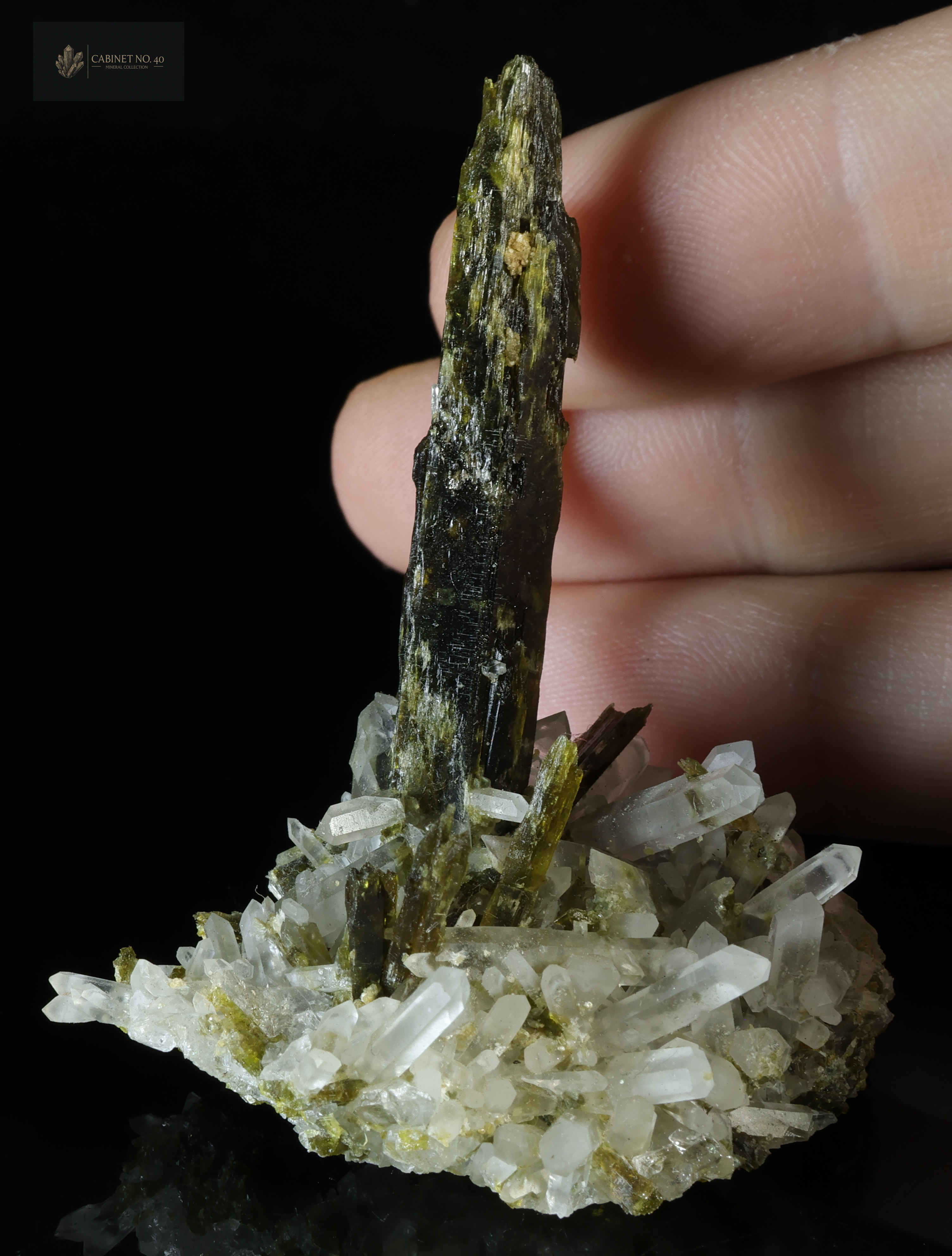
Dark Green Epidote with Quartz Crystals from Peru

Price: 55 EUR (239 PLN)

Availability: In stock

Location: -, Peru

Size: 44 x 58 x 34 mm

Weight: 21.9 g

Chemical formula: Ca₂(Al,Fe)₃(SiO₄)₃(OH)

Crystal system: Monoclinic

Mohs hardness: 6.5

Rarity: Common

Characteristics Epidote is a mineral belonging to the silicate group, often forming elongated, prismatic or acicular crystals. Typical epidote specimens are characterized by a green, yellowish-green, or brownish-green color, which can be intense and deep. Crystals often occur in radial, fibrous, or granular aggregates, forming attractive clusters on rock surfaces. Physical Properties The hardness of epidote on the Mohs scale is 6. This mineral has a vitreous luster. It is transparent to translucent, and in some cases can be opaque. The specific gravity of epidote is 3.38. It exhibits perfect cleavage along one plane ({001}) and imperfect cleavage along another ({100}). The streak of epidote is colorless. Colors and Varieties Epidote occurs in shades of green, from light yellowish-green to dark green, as well as brownish-green and black. The intensity of the color often depends on the iron content. A manganese-rich variety called piemontite is known, which takes on a red or purple color. History and Name The name "epidote" comes from the Greek word "epidosis," meaning "addition" or "increase," referring to the fact that the bases of its crystals are longer on one side than on the other. The mineral was described in 1801. Uses Epidote does not have widespread industrial applications. It is sometimes used as an ornamental stone, especially its varieties with intense colors and attractive crystal forms. It is valued by mineral collectors for its aesthetic qualities.

Diagnostic features

Identification Epidote can be identified by its characteristic green or yellowish-green color, vitreous luster, and elongated, prismatic crystals. It often forms radial or granular aggregates. A hardness of 6 on the Mohs scale is also a diagnostic feature. Distinguishing from Similar Minerals Epidote is sometimes confused with certain varieties of tourmaline, especially dravite, and with diopside. It differs from tourmaline by the absence of a triangular cross-section of its crystals and different cleavage. It differs from diopside in color and chemical composition. Crystal Forms Epidote most often occurs as elongated, prismatic or acicular crystals, which may be striated lengthwise. It often forms radial, fibrous, granular aggregates or massive forms. Crystals are usually monoclinic.

Formation environment

Genesis Epidote is a metamorphic mineral, formed as a result of the transformation of igneous and sedimentary rocks rich in calcium and aluminum, under conditions of medium to high temperatures and pressures. It often forms in skarns, metamorphosed limestones and dolomites, as well as in hydrothermally altered igneous rocks. Mineral Associations Epidote often co-occurs with quartz, calcite, garnets (especially grossular and andradite), amphiboles, chlorite, albite, and magnetite. Localities Known epidote localities include the Alps (Austria, Switzerland, Italy), where beautiful, well-formed crystals are found. Other important localities include Mexico (Baja California), the United States (Alaska, California), Norway, Russia (Urals), and Pakistan.

For the collector

Quality Criteria The most prized epidote specimens are those with well-formed, large, and undamaged crystals of intense, uniform green or yellowish-green color. The transparency and luster of the crystals also contribute to their collector appeal. Specimens with aesthetic radial aggregates or in association with other minerals are also highly valued. Popular Localities The most sought-after epidote specimens come from the Alps, especially from the Knappenwand valley in Austria, where large, well-formed crystals are found. Other valued localities include Mexico (Baja California) and Pakistan, known for high-quality specimens.

See mineralogical reference for Epidote in the Knowledge Base →

View product →